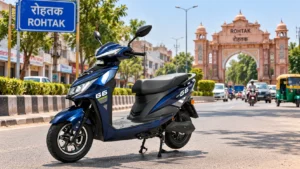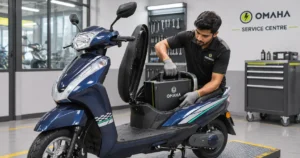
The first lecture starts at 9:15. The bus that would get you there on time left at 8:20, and the next one is full by the time it reaches your stop. So you take a shared auto, then walk the last kilometre from the highway, and slip into the back row at 9:25 hoping attendance has not been called yet. Every college town in India has a version of this morning. For a lot of students, a no-licence electric scooter quietly ends it. Here is how to pick one that fits a student’s route, budget and hostel rules.
The short answer.
For most students, the best electric scooter for college is a low-speed, no-licence model that covers your daily round trip with room to spare, charges where you actually live, and is easy to lock and leave in a crowded campus parking.
Omaha’s low-speed scooters need no driving licence, registration or road tax, charge from a normal 5A socket, and are rated at 70 to 80 km per full charge. Choose lead-acid to keep the price down, or lithium if the battery has to go upstairs to be charged. Then take a test ride on a route like your college run.
Why an electric scooter for college students makes sense
No licence, no registration, no waiting
An electric two-wheeler with a motor rated up to 250 W and a top speed up to 25 km/h is not treated as a motor vehicle under Indian rules. That means no licence test, no RTO visit, no number plate and no road tax. For a first-year who has not had time to get a licence, or a student far from their home RTO, that matters.
Your timetable, not the bus timetable
An 8 AM practical, a gap between lectures, a library session until 7, a tuition across town. A scooter lets the day follow your classes instead of the last bus. Most student trips are short and stop-start, which is exactly where a 25 km/h scooter is comfortable.
Running costs that fit a student budget
There is no petrol to buy and no engine oil to change. The main running cost is electricity, and you can work out your own figure with one simple sum, shown further down. Routine care is mostly the battery, brakes and tyres.
How often will you need to charge?
This is the question students ask us most, especially those in hostels and PGs. Move the slider to your daily round trip: home or hostel to college, plus your usual detours.
Charge about every 3 days
With a safety buffer for heat, a pillion and stop-start traffic.
A rough guide only. It uses 70 km, the low end of Omaha’s rated range, and keeps a 20% buffer, so it plans on about 56 km between charges. Real range varies with load, terrain, weather and riding style.
What a full charge costs you
Ask your dealer for the battery’s capacity in kWh for the model and battery you choose. Multiply that by your electricity rate per unit, and you have the approximate cost of a full charge. Divide by the kilometres you get from it, and you have your cost per kilometre. It is a small number for most students, and it is your own number, not a brochure’s.
Where will you charge it?
Before you pick an electric scooty for students, settle this. It decides your battery choice, and in a hostel it decides whether you can own a scooter at all.
Never charge a battery on your bed, on a cloth-covered surface, or through a cheap extension board. Use a proper wall socket in a dry, open spot, keep the charger on a hard surface, and unplug once the battery is full. If the charger, socket or battery feels unusually hot, stop and contact your dealer.
Budget electric scooty for college: lead-acid or lithium?
Every Omaha model comes with a choice of battery, and it is the biggest single lever on price.
| Lead-acid | Lithium | |
|---|---|---|
| Upfront cost | Lower | Typically ₹10,000 – ₹15,000 more on the same model |
| Charging time | 6 – 8 hours | 3 – 5 hours |
| Weight | Heavier | Much lighter |
| Best for | Students living at home with a ground-floor socket | PG and hostel students who carry the battery to charge |
More detail in our lead-acid vs lithium guide. Model prices are in the Omaha price list; ask your dealer for a quote on both batteries.
Best electric scooter for students: match the model to campus life
When you shortlist an electric scooter for college students, start with the problem you face most often, then look at the models that solve it. These feature pairs are taken from Omaha’s own product pages.
Parking in a big, busy campus lot
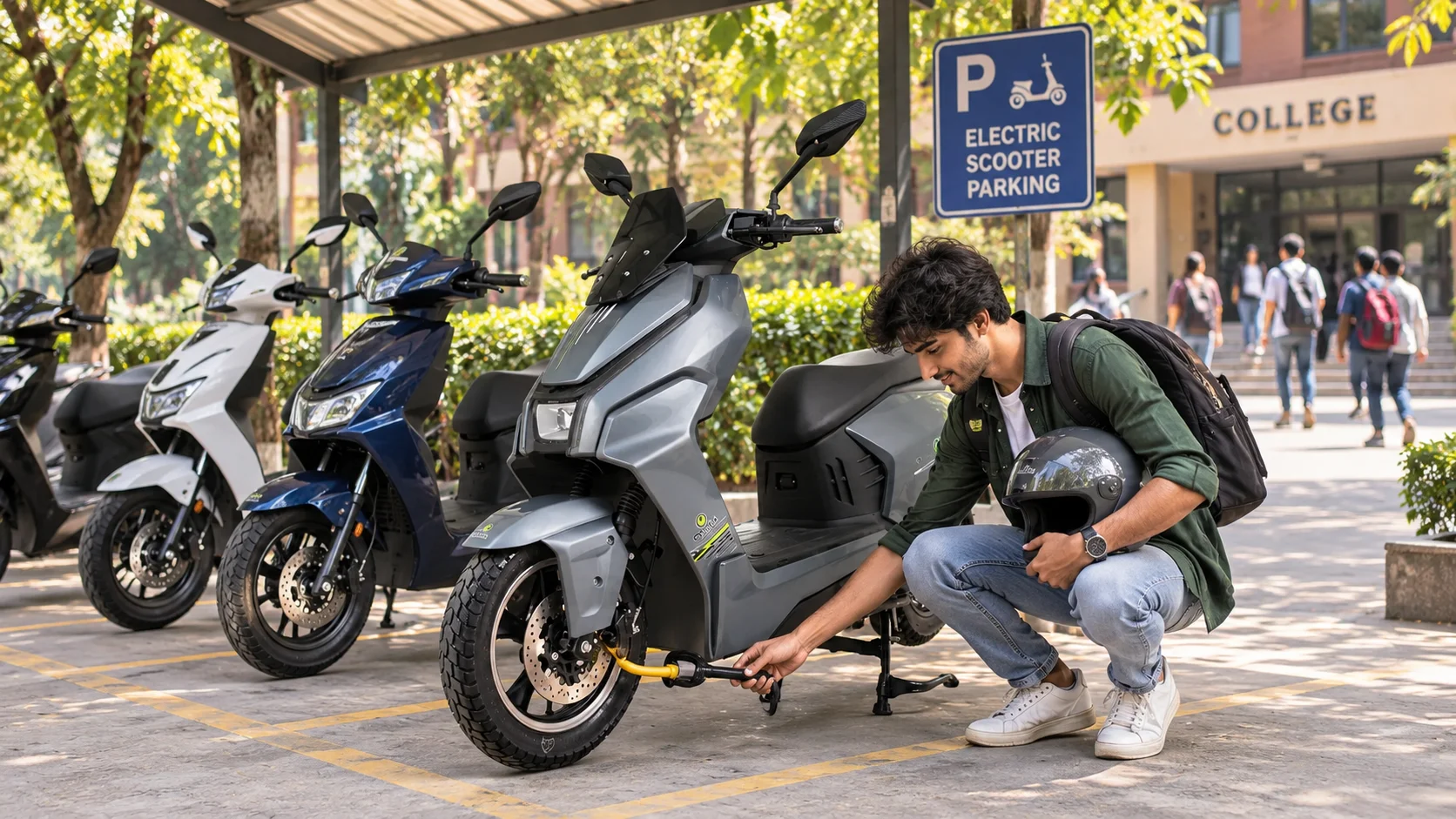
If your scooter will sit in an open college parking for six hours a day, an anti-theft alarm and a parking switch are worth having. The parking switch stops the scooter responding to the throttle while parked, so nobody can ride off by accident or as a prank. Look at the Starling Neo, Tezo GT, Drake and Chetak.
Long days on campus, phone always low
Between maps, UPI, class groups and calls home, a student’s phone works harder than anyone’s. A USB charger on the scooter helps on the ride home, and a cruise controller takes strain off the wrist on longer straight stretches. Look at the Tezo and Canary.
Tight parking rows and narrow lanes near the PG
If you are always squeezing out between other two-wheelers, reverse gear saves you dragging the scooter backwards, and central locking makes quick stops simpler. Look at the Dash Plus, Skylark and Starling Round.
See all models side by side in the electric scooter range, and ask your dealer to confirm in writing that the variant you choose is the low-speed, no-licence version.
From the showroom floor
A second-year commerce student in Rohtak came in with his father. His problem was a 9 AM class and a bus that either came full or did not come at all. His round trip was about 14 km, so we pointed him to a lead-acid model to keep the cost down, since he lives at home with a socket right by the gate. His father asked one question: “Can he make it go faster?” The answer was no, and that it should stay that way. Both seemed relieved.
No licence scooty for students: what it does and doesn’t mean
“No licence” is a real advantage, but students should understand exactly what it covers.
- It applies only to low-speed models, with a motor rated up to 250 W and a top speed up to 25 km/h. Read more in our guide to electric scooters without licence and registration.
- It does not mean no rules. Traffic signals, lane discipline and riding on the left still apply.
- It does not mean no helmet. A helmet may not be legally required for this category, but we strongly recommend one on every single ride.
- If the rider is still under 18, parents should be part of the decision, and the scooter should stay on calm local routes. Check any local rules that may apply.
Do not get the speed “unlocked”. Every college has someone who knows someone who can tweak the controller. A low-speed scooter that is modified to go faster is no longer a low-speed scooter. It can then need a licence and registration, it is likely to void your warranty, and it puts extra strain on the motor, battery and brakes, which were never meant for those speeds.
Riding safely as a student
- One pillion, maximum. No triple riding, however short the trip to the canteen. Your friend wears a helmet too.
- Stay off highways and bypasses. A 25 km/h scooter does not belong where traffic moves far faster. If your college is on a highway, plan a route through service lanes and inner roads.
- No phone in hand. Set the map before you start, or pull over to check it.
- Lights on in the evening, and keep the headlamp, indicators and mirrors clean.
- Rain and fog: slow down, brake earlier, and avoid riding through standing water deep enough to reach the motor.
- Lock it and keep the key. Use the alarm or central locking if your model has one, and park in a visible spot.
New to two wheels? There are no gears or clutch, so most students learn quickly. Still, spend two or three evenings in an empty colony road or college ground practising starts, stops, slow turns and, if your model has it, reverse, before your first ride in traffic.
For parents: questions worth asking together
Many student scooters are bought by parents. A short conversation before the showroom visit avoids most problems later.
- What is the actual route? Distance, busy junctions, and whether any part of it is a highway.
- Where will it be charged? At home, in the PG, or in a hostel that permits it.
- Who maintains it? Agree who books the service and checks the tyres and brakes.
- What are the house rules? Helmet every ride, no triple riding, no speed modifications, and a message on arrival if that helps everyone relax.
From the showroom floor
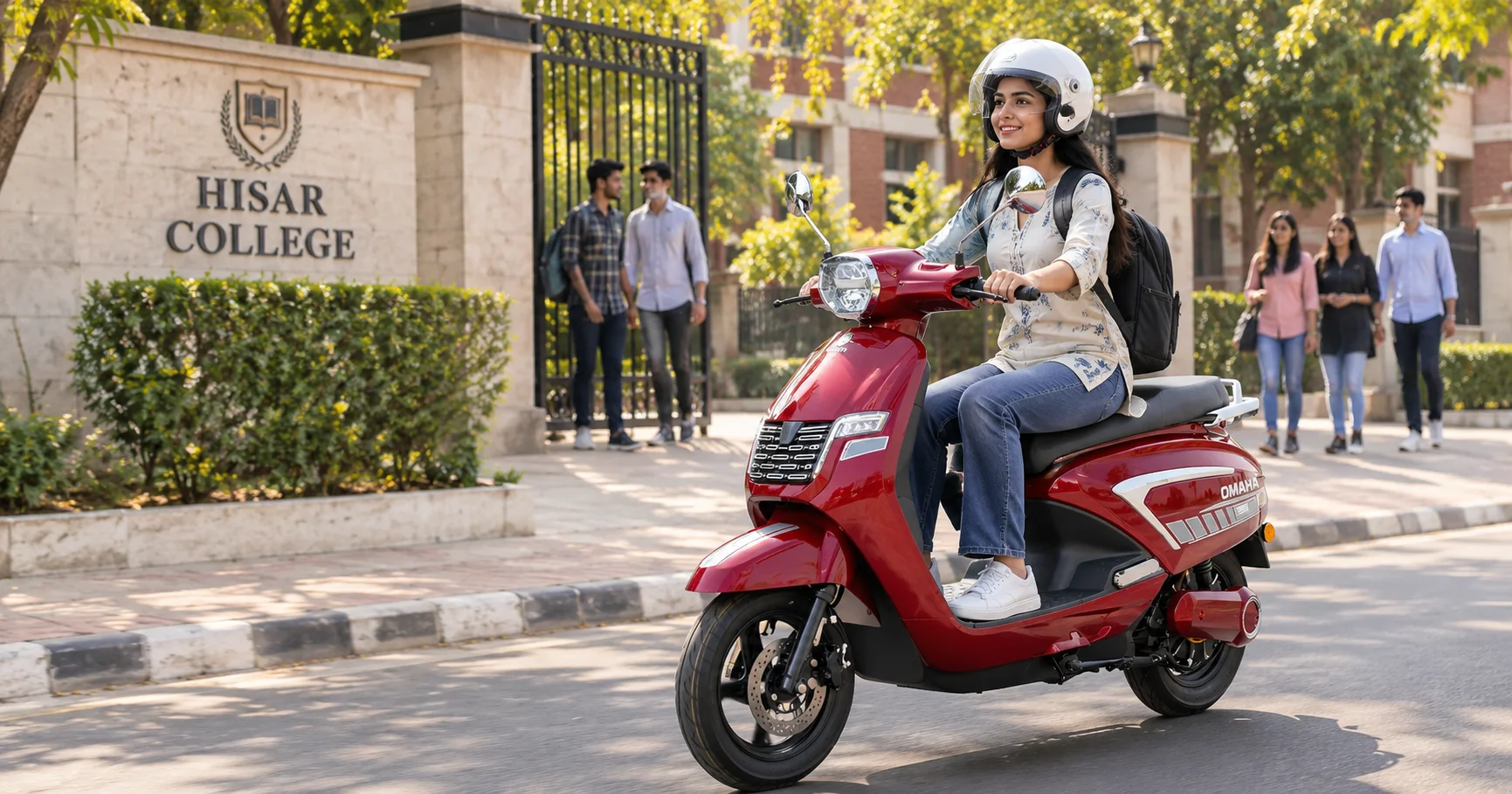
A first-year engineering student from a village near Hisar was moving into a PG near her college. Her parents wanted her to have a scooter, but the PG owner would not allow charging on the ground floor. She chose lithium so she could carry the battery up to her room, and her father checked the socket and the charging spot himself before she moved in. Her mother’s only rule: a two-word message every evening when she reached the PG. She says she has not missed a 9 AM since.
The “From the showroom floor” stories are composite illustrations of common enquiry patterns, not individual customers’ accounts.
Test-ride checklist for students
- Ride a route like yours — a speed breaker, a turn, a slight slope if your college has one.
- Try it with your bag — is there room for a backpack, lab coat or drafter?
- Put it on the stand and roll it off, on your own.
- Brakes — firm and comfortable on both levers.
- Features you chose it for — alarm, parking switch, USB, reverse or locking. Try each one.
- Battery — if you will carry it to charge, lift it out at the showroom.
- Charger — check it matches your battery type. Lead-acid and lithium chargers are not interchangeable.
- Written confirmation — that your variant is the low-speed, no-licence version.
Try the college run before you buy
Book a test ride, bring your bag, and ride it like it is a 9 AM morning.
Conclusion: the right scooter gives you back your mornings
An electric scooter for college students is not about speed. It is about reaching the first lecture without depending on a full bus, staying back for the library without worrying about the last auto, and spending less on getting around than you used to. Pick a low-speed model that covers your round trip comfortably, choose the battery around where you will charge it, and make sure the features match your campus.
Keep it legal, keep it unmodified, and keep the helmet on. Chosen that way, it will see you through every semester. If you want city-specific advice, see our guides to riding in Delhi, Rohtak and Hisar.
Frequently asked questions
Which is the best electric scooter for college students?
The best electric scooter for college students is a low-speed, no-licence model that covers your daily round trip with a buffer, charges where you live, and has the features your campus needs, such as an anti-theft alarm and parking switch for busy college parking. Test-ride two or three models on a route like your own before deciding.
Do college students need a licence for an electric scooter?
Not for a low-speed electric scooter with a motor rated up to 250 W and a top speed up to 25 km/h. These need no driving licence, registration, number plate or road tax. Ask your dealer to confirm in writing that your chosen variant is the low-speed version.
Can a student under 18 ride a no-licence electric scooter?
Low-speed scooters fall outside licensing, so there is no licence test. Even so, we recommend that younger riders ride only with their parents’ agreement, always with a helmet, and on calm local roads. Check any local rules that may apply in your area.
What is the most budget-friendly electric scooty for college?
Choosing the lead-acid battery is the simplest way to lower the price of any Omaha model, as lithium typically costs ₹10,000 to ₹15,000 more. Lead-acid works well if you can charge at a ground-floor socket. See Omaha’s price list and ask your dealer for a quote on both batteries.
Can I charge an electric scooter in a hostel or PG?
Only where the warden or owner permits it. Many hostels restrict charging in rooms, so ask in writing before you buy. If the battery has to be carried upstairs, choose lithium, which is lighter. Always charge at a proper wall socket in a dry, open spot, never on a bed or through a cheap extension board.
How far does a student electric scooter go on one charge?
Omaha scooters are rated at 70 to 80 km per full charge. Real range is lower with a pillion, a heavy bag and stop-start traffic. For a typical 10 to 20 km college round trip, most students charge every two to five days.
Can I increase the speed of my no-licence electric scooter?
You should not. A low-speed scooter modified to go faster is no longer a low-speed scooter, may then need a licence and registration, is likely to void your warranty, and puts strain on parts that were not built for those speeds.
Can I carry a friend on my electric scooter?
One pillion is fine, wearing a helmet, and within the carrying capacity your dealer gives you for that model. Never ride with two pillions, however short the trip.
Is it safe to leave an electric scooter in college parking?
Park in a visible spot, lock it, and take the key. Models with an anti-theft alarm and parking switch, such as the Starling Neo, Tezo GT, Drake and Chetak, add a useful layer of security for long hours in open parking.
About this guide, and its limits
Written by the product team at Omaha Electric, a unit of JVG Electric Private Limited, which manufactures electric scooters and loaders in Hisar, Haryana. We make the models mentioned here, so weigh our view accordingly. Feature pairs are taken from Omaha’s own product pages.
About the charge planner. It is a simple estimate based on the low end of Omaha’s rated range with a safety buffer. Your real range depends on load, terrain, weather, battery condition and riding style.
Safety. Wear a helmet on every ride, never carry more than one pillion, and keep low-speed scooters off highways and fast roads.
About the stories. The “From the showroom floor” examples are composite illustrations of common enquiry patterns, not individual customers’ accounts.
Questions — contact us, message us on WhatsApp, or book a test ride.