Every electric scooter brochure says lithium is better. Every showroom will happily sell you lead-acid because it lowers the price. Both are telling you half the story. The honest answer to lead-acid vs lithium depends on one number most buyers never work out before they pay — how many kilometres they really ride — plus one question nobody asks: where will the battery charge?
The short answer.
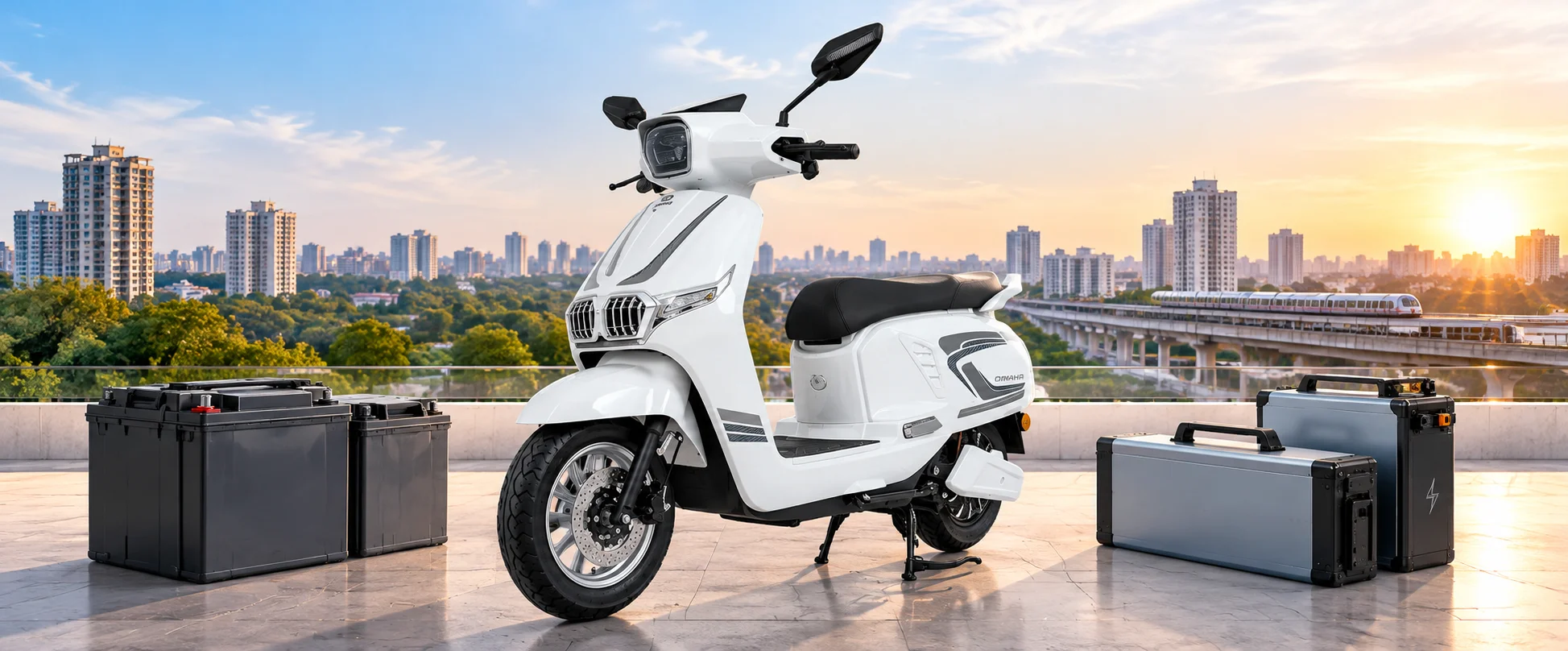
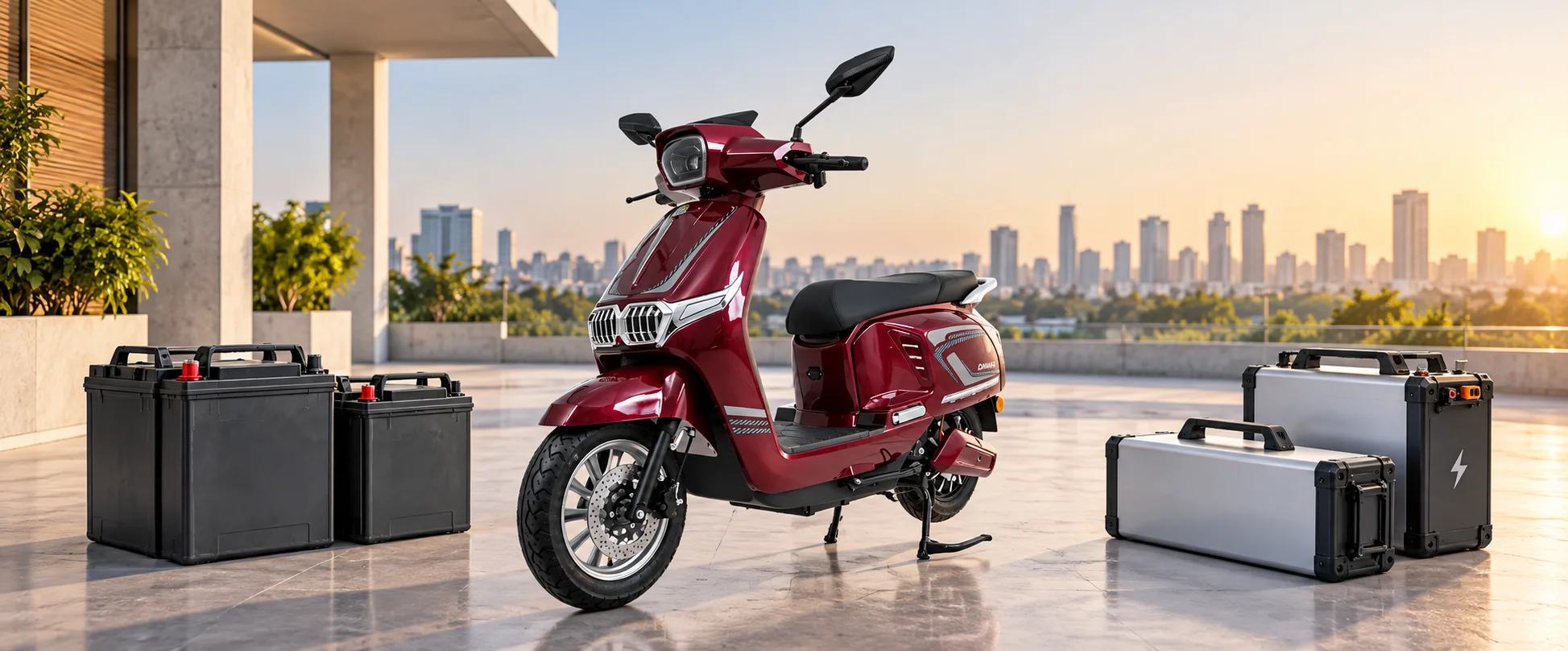
If you ride under about 15 km a day and can charge at a ground-floor socket, a lead-acid scooter is usually the cheaper buy — especially if you will keep it around three years. If you ride above about 25 km a day, or the battery has to go up the stairs to charge, lithium pays for its higher price through a much longer life, faster charging (3–5 hours against 6–8) and far less weight.
Between 15 and 25 km, let two things decide: how long you plan to keep the scooter, and whether you can easily reach a socket. The rest of this guide shows the maths so you can check it for your own ride.
The one number that decides it: your daily kilometres
A battery wears out in two ways — by age and by use. Lead-acid wears out mostly by age: whether you ride 5 km a day or 40, it slowly loses capacity and typically needs replacing in two and a half to three years. Lithium wears out mostly by use: it can take many more charge cycles, so it rewards people who ride a lot.
That single difference explains the whole debate. A light rider on lithium pays extra for cycles they will never use. A heavy rider on lead-acid burns through packs they keep paying for. So start here:
Be honest with the number. Measure your worst regular day — the Saturday with three errands, the day of the long delivery — not your average.
Lithium vs lead acid battery scooter in India — at a glance
| Lead-acid | Lithium | |
|---|---|---|
| Upfront price | Lower — the entry price of each model | Higher — about ₹10,000–₹15,000 more on Omaha models |
| Full charge time | 6–8 hours | 3–5 hours |
| Typical life | About 2.5–3 years, mostly age-limited | Several years; mostly limited by charge cycles |
| Typical charge cycles | A few hundred | Often 1,000–2,000+, depending on chemistry |
| Weight | Heavy — a full set can weigh 25 kg or more | Much lighter, often a third to half |
| Replacement cost | Around ₹16,000–₹20,000 per set | Higher per pack, but needed far less often |
| Charging from a flat | Hard to carry; charge where the scooter is parked | Portable packs can often be carried in |
| Heat sensitivity | Ages faster in North Indian summers | Protected by a battery management system (BMS) |
| Old-battery value | Widely recycled; dealers often give exchange value | Recycling network still growing |
General figures for slow-speed electric scooter batteries. Exact capacity, weight, cycle life and warranty vary by model and pack — confirm them for the specific scooter you are buying.
Lead acid battery scooter life — how long it really lasts
In our experience across dealers in Haryana, Delhi NCR and West Bengal, a lead-acid set on an electric scooter typically gives two and a half to three years of useful service. “Useful” is the key word — the battery does not suddenly die, it slowly gives you less range until one day the ride home feels uncomfortable.
Why lead-acid ages even when you don’t ride much
Lead-acid plates gradually build up sulphate crystals, especially when the battery sits partly discharged. Heat speeds this up. That is why a scooter used only on weekends can need a new set almost as soon as one used every day — and why the “I barely ride it, so it will last forever” logic does not hold for lead-acid.
What kills a lead-acid set early
The four habits we see most in the service bay
- Leaving it discharged. Parking the scooter for days at low charge is the fastest way to lose capacity. Charge it the same day you ride.
- Running it to zero. Riding until the scooter crawls home puts deep stress on the plates. Charge before it gets that low.
- Charging in the sun. A battery baking on a terrace in May ages much faster. Charge in shade with ventilation.
- Using the wrong charger. A cheap roadside charger may not follow the correct charging profile. Use the charger supplied with the scooter.
From the service bay
A retired schoolteacher in Hisar rode barely 5 km a day and was surprised to need a new lead-acid set within about two and a half years. The cause was not the riding — it was the scooter standing half-charged for a week at a time while he visited family. Once he started charging it fully before every long gap, his second set held up noticeably better.
Lithium: what the extra money actually buys
Far more charge cycles
A good lithium pack is typically rated for well over a thousand charge cycles, several times what lead-acid manages. If you ride 30–40 km a day, that is the difference between replacing batteries repeatedly and not thinking about them for years.
Faster charging and less weight
Three to five hours to full means a lunchtime top-up actually gets you somewhere. And a pack that weighs a fraction of a lead-acid set is one you can carry up to a second-floor flat or into your shop — which, for many Indian homes without ground-floor parking, is the deciding factor on its own.
Not all lithium is the same
“Lithium” covers different chemistries. The two you will hear about are LFP (lithium iron phosphate), known for long cycle life and good thermal stability, and NMC, which packs more energy into less weight. Both are used in scooters. Whichever you are offered, what matters just as much is a proper battery management system (BMS), which protects the cells from overcharging, deep discharge and overheating.
Be careful with cheap “lithium conversion” kits. A lithium pack fitted without a matched charger and a proper BMS is a genuine safety risk, not a bargain. If you want lithium, buy it from the manufacturer or an authorised dealer, and ask what BMS protects it.
Lithium battery price difference: is the premium worth it?
This is the question buyers really ask, and it has a clean answer once you stop comparing sticker prices and start counting replacements. Lithium makes financial sense when it saves you more in avoided lead-acid replacements than it costs you up front:
lead-acid replacements avoided × replacement cost > lithium premium
Here is how that works over five years of ownership for three typical riders. We have assumed a lead-acid replacement cost of ₹18,000, a lead-acid pack life of about three years or a few hundred cycles (whichever comes first), and a lithium premium of ₹15,000 — the upper end of the roughly ₹10,000–₹15,000 extra that lithium adds on Omaha models.
| Rider | Daily km | Lead-acid replacements in 5 yrs | Extra lead-acid cost | Lithium premium | Better buy over 5 yrs |
|---|---|---|---|---|---|
| Light | ~10 km | 1 (ageing) | ₹18,000 | ₹15,000 | Roughly even — lead-acid if you’ll sell within 3 years |
| Regular | ~30 km | 2 | ₹36,000 | ₹15,000 | Lithium, by about ₹21,000 |
| Heavy | ~50 km | 3–4 | ₹54,000–₹72,000 | ₹15,000 | Lithium, by a wide margin |
Worked illustration, not a quotation. At a ₹10,000 premium, lithium comes out even further ahead. Replacement prices and pack life vary by model and dealer — put your own dealer’s figures into the formula above.
Two things this table makes obvious. First, for a light rider who keeps the scooter three years or less, lead-acid is simply the cheaper choice — the replacement never arrives. Second, for anyone riding 25–30 km a day or more, the lithium premium is not an expense, it is a saving — and that is before you count the hours saved on charging.
Which battery is best for electric scooty? Four riders, four answers
The school-run parent
Our pick: lead-acid
Why
Two school runs and a vegetable market trip rarely cross 12 km a day. The scooter parks in the ground-floor porch next to a socket. Overnight charging makes the 6–8 hour charge time irrelevant, and the lower price is money better spent elsewhere.
From the showroom floor
A mother in Rohtak came in convinced she needed lithium because “everyone says it’s better”. Her daily total came to about 9 km, and she planned to hand the scooter to her son in three years. She left with lead-acid and the difference stayed in the family budget.
The shop owner on the move all day
Our pick: lithium
Why
Supplier, bank, deliveries, back to the shop, out again — 40–50 km a day of stop-start riding. Lead-acid would need replacing every year or so. Lithium survives the cycling and a quick top-up at the shop counter during a slow afternoon keeps the scooter working through the evening.
From the showroom floor
A kirana wholesaler near Burdwan had gone through lead-acid sets faster than he expected on his first electric scooter. On his second, he chose lithium and carries the pack into the shop to charge while he works. His comment to the dealer was that the scooter now “works the same hours I do.”
The second-floor flat
Our pick: lithium, almost regardless of kilometres
Why
If the scooter parks on the street or in a shared basement without a safe socket, the battery has to come upstairs. Carrying a heavy lead-acid set up two floors every other evening gets old within a week. A lighter lithium pack turns that into a normal chore.
From the showroom floor
A young IT professional in a Delhi builder floor asked for the cheapest option, then asked where she would charge it. There was no socket near her parking. That one question changed her choice to lithium before the test ride was over.
The occasional rider
Our pick: lead-acid — with good charging habits
Why
If the scooter is for weekend errands or a parent’s short colony rides, lithium’s cycle life is wasted. Lead-acid is fine — as long as it is kept charged during the gaps. Set a reminder to charge it fully at least once a week even if it has not been ridden.
Every model in our range is offered with both batteries, so you choose the scooter for your route and the battery for your kilometres. Compare them on the electric scooters page — for example, the Starling Neo charges in 6–8 hours on lead-acid and 3–5 hours on lithium.
Looking after each battery so it lasts
Lead-acid care
- Charge fully after every day’s riding — do not leave it half-empty overnight.
- Do not run it down to a crawl before charging.
- If the scooter will stand for a week or more, charge it fully first and top it up weekly.
- Keep it out of direct summer sun, and let it cool after a hot ride before charging.
Lithium care
- Partial top-ups are fine — lithium does not need to be run down first.
- Avoid regularly draining it to zero or leaving it at 100% in the heat for days.
- Only use the supplied charger, and never charge a pack that is wet, swollen or damaged.
- For long storage, leave it around half charged in a cool, dry place.
Questions to ask at the showroom
- “Which battery is this price for?” A low quote is almost always lead-acid. Compare lead-acid with lead-acid and lithium with lithium.
- “What is the exact price difference for lithium on this model?” Then put it into the formula above with your own daily kilometres.
- “What is the battery warranty — and what does it cover?” Get the period and conditions in writing for the battery, not just the scooter.
- “Which lithium chemistry, and is there a BMS?” A good dealer will answer this without hesitation.
- “What will a replacement set cost, and is there exchange value for the old one?” This tells you your real long-term running cost.
- “Can I upgrade from lead-acid to lithium later?” Ask whether the charger and controller support it — never do it with an unmatched aftermarket kit.
- “Where will I charge it?” Answer this one yourself before you pay. It settles more battery decisions than any spec sheet.
Ride both before you decide
Feel the difference in weight and charging convenience for yourself. Every Omaha scooter comes with a lead-acid or lithium option, built at our own plants in Hisar and Burdwan.
Conclusion: buy the battery your kilometres can use
Lead-acid vs lithium is not a question of which technology is “better”. Lithium is the more advanced battery — longer cycle life, faster charging, far lighter. But a better battery you cannot fully use is just a more expensive one.
If you ride a little, charge at ground level and will keep the scooter around three years, lead-acid is the smart, honest choice. If you ride 25 km or more a day, charge in a flat, or plan to keep the scooter for five years, lithium repays its premium — often several times over. Work out your worst-day kilometres, ask the dealer the exact price difference, put both into the formula, and the right battery picks itself.
Frequently asked questions
Which is better for an electric scooter, lead-acid or lithium?
Lithium is technically better — longer life, faster charging and much lighter — but it costs more. For riders under about 15 km a day who charge at ground level and keep the scooter around three years, lead-acid is usually the cheaper overall choice. Above about 25 km a day, or when the battery has to be carried upstairs to charge, lithium is the better buy.
Which battery is best for electric scooty in India?
It depends on daily usage and charging access. Light riders with a ground-floor socket do well with lead-acid. Daily commuters covering 25–30 km or more, delivery riders and anyone living in a flat without parking-side charging are better served by lithium.
How long does a lead-acid battery last in an electric scooter?
Typically about two and a half to three years of useful life. Lead-acid ages with time as well as use, so even a lightly used scooter needs a replacement set eventually. Leaving the battery discharged, running it to zero and charging in direct heat all shorten its life.
How long does a lithium battery last in an electric scooter?
A good lithium pack is typically rated for well over a thousand charge cycles, which for most riders means several years of use. Actual life depends on the chemistry, the battery management system, charging habits and heat. Check the manufacturer’s battery warranty for the specific model.
What is the price difference between lithium and lead-acid scooters?
On Omaha scooters, the lithium version typically costs about ₹10,000 to ₹15,000 more than the lead-acid version of the same model; the exact figure depends on the model and battery capacity, so ask your dealer. To judge whether it is worth it, multiply the number of lead-acid replacements you would avoid by the replacement cost of around ₹16,000–₹20,000, and compare that with the lithium premium.
How much does a lead-acid battery replacement cost for an electric scooter?
A replacement lead-acid set for a slow-speed electric scooter typically costs around ₹16,000 to ₹20,000, depending on capacity and brand. Many dealers offer exchange value on the old battery, since lead-acid is widely recycled.
Can I change my scooter from lead-acid to lithium later?
Sometimes, but only if the scooter’s charger and controller support a lithium pack with a proper battery management system. Ask the manufacturer or an authorised dealer. Unmatched aftermarket lithium conversion kits can be a safety risk and may affect your warranty.
Does lithium charge faster than lead-acid?
Yes. On Omaha scooters, lithium typically charges fully in 3 to 5 hours, compared with 6 to 8 hours for lead-acid. Lithium also handles partial top-ups well, so a short charge during the day is genuinely useful.
Is a lithium battery safe in hot Indian summers?
A quality lithium pack with a proper battery management system is designed to handle normal Indian conditions. Common-sense care still matters: park and charge in shade, let the battery cool after a hot ride, use only the supplied charger, and never charge a pack that is swollen, wet or damaged.
About this guide, and its limits
Written by the product team at Omaha Electric, a unit of JVG Electric Private Limited, which manufactures electric scooters and loaders at Mandi Adampur, Hisar, Haryana and at Burdwan, West Bengal. Every Omaha model is offered with both lead-acid and lithium batteries, so we have no reason to push you towards one over the other.
About the stories. The “From the showroom floor” and “From the service bay” examples are composite illustrations of common customer patterns, not individual customers’ accounts.
Figures are indicative. Charge times, replacement costs and battery life are typical ranges; the worked cost table uses the upper end of the lithium premium on Omaha models. Capacity, cycle life, warranty and price vary by model, pack and dealer — confirm them for the specific scooter before you buy.
Last reviewed September 2026. Questions about a model or battery option — contact us, message us on WhatsApp, or book a test ride.