
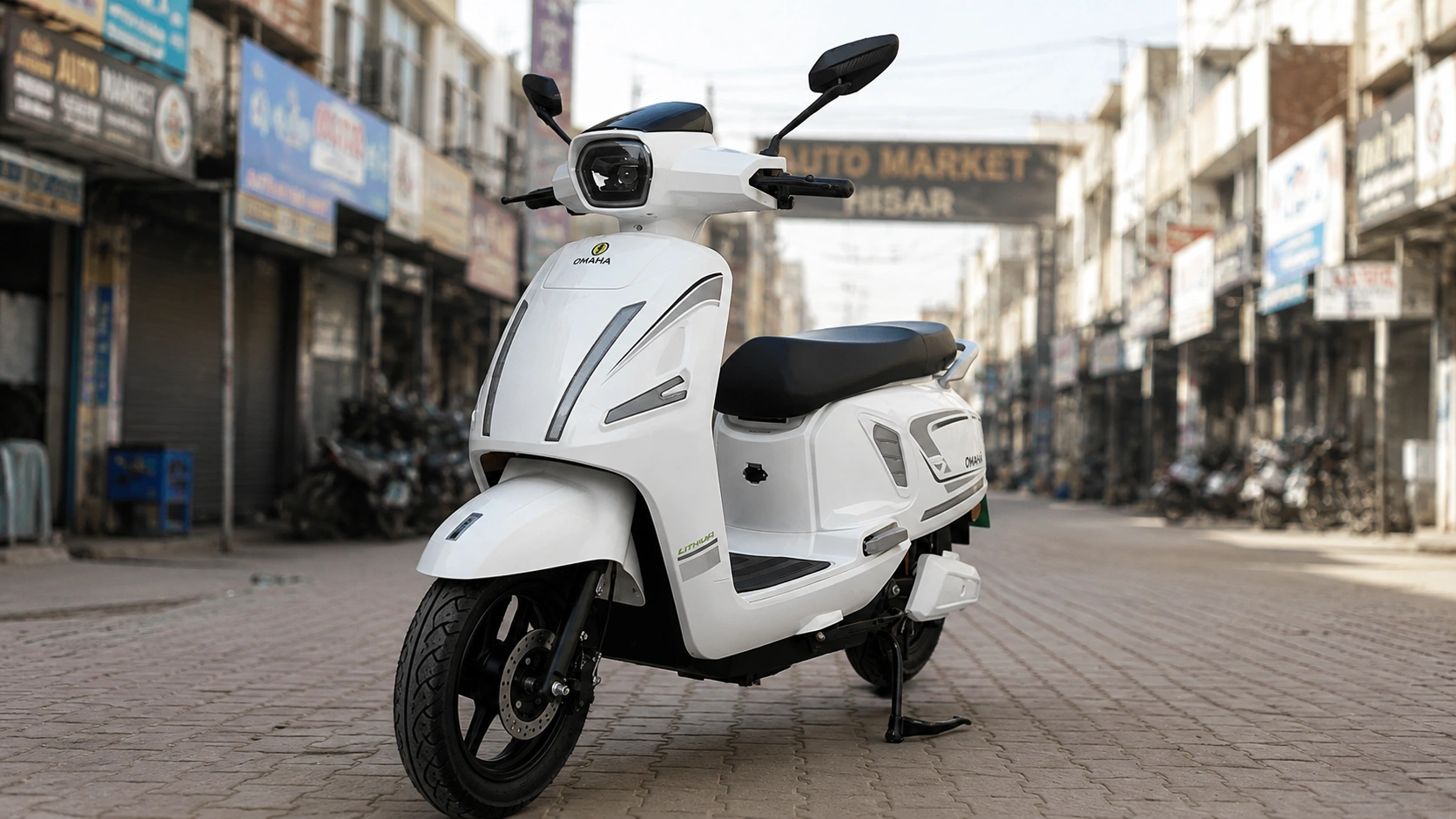
Electric Scooty in Hisar — Made Here, Sold Here, No Licence Needed
Most electric scooty pages say “Made in India.” In Hisar we can say something far more useful: it’s made right here — at Mandi Adampur, about half an hour from your own Auto Market. That one fact quietly changes your service, your spares, your price and your paperwork.
Omaha Electric — a unit of JVG Electric Private Limited · Manufacturing plant at Khairampur Road, Mandi Adampur, Hisar 125052 · Reviewed August 2026 · We publish only what we can evidence.
Walk into a scooter shop in Hisar’s Auto Market and you’ll be shown range figures, colours and EMI plans — the things printed on the brochure. Here’s the thing nobody at most counters will tell you: with an Omaha, the scooty you’re looking at was built about 25–30 km up the Adampur road, in the same district you live in. Not imported. Not shipped from three states away. Made here.
This guide is about buying the best electric scooty in Hisar for how this city actually runs — the tight bazaar lanes behind Nagori Gate, the longer pull down Delhi Road and Tosham Road, the mandi trips out to Barwala and Adampur, and summers that touch 46°C with a hot loo blowing through May and June. We’ll cover honest electric scooter price in Hisar for 2026, where the showroom and dealer fit in, running cost against a petrol scooter, and the one local fact that makes Hisar different from every other city we sell in.
The one fact that makes Hisar different: it’s built here
Omaha Electric is a unit of JVG Electric Private Limited, headquartered in Hisar, with its manufacturing plant on Khairampur Road in Mandi Adampur. For a Hisar buyer, that isn’t a slogan on a wall — it’s the single most practical thing about the brand, and it only starts to matter the day something breaks.
A controller fails. A brake lever snaps. A charger stops working. On an imported or far-made scooter, that’s a four-to-six week wait while the part travels, with the vehicle standing idle outside your house the whole time. Anyone who has owned a cheap EV without a real supply chain has lived exactly this. In Hisar, the arithmetic is different — the parts don’t cross the country to reach you.
Components are made in the state, not clearing customs on a ship. When a dealer needs a part, it’s a short domestic run — days, not weeks.
If your dealer can’t fix something, the company isn’t on the other side of India behind a call-centre. It’s in your own district.
Buying it keeps money and jobs closer to home than an imported product does. No other electric scooty brand can say that to a Hisar buyer.
Turnaround still depends on the part, your dealer and stock on hand — this is a structural advantage, not a guaranteed service time. Want the full picture of how the vehicles are put together? See Omaha’s manufacturing units.
No licence needed — the paperwork you don’t have to do
Most Omaha models are built as slow-speed electric scooters. Under current Motor Vehicle rules, that means:
- No driving licence. A student at GJUST or HAU, a homemaker who never sat for a licence test, an older rider — all of them can buy and ride legally.
- No registration, no RC, no number plate. No trip to the Hisar RTO. No file, no agent, no waiting.
- No insurance formality and no road tax. There’s nothing to register, so there’s nothing to tax.
- Buy and ride the same day. Pay at the showroom, take delivery, ride out. That’s the whole process.
If you hold a licence and your real routine is highway running — regular intercity trips on NH-52 towards Delhi or Chandigarh — a registered high-speed EV is the right vehicle, and Haryana’s 2026 budget made that route genuinely attractive with a 100% motor-vehicle-tax exemption on pure EVs up to ₹30 lakh. A slow-speed scooty sits outside that system entirely, so there’s no tax to exempt in the first place. You pay none either way. We’d rather you buy the right vehicle than the one we make — the full tax breakdown is on the electric scooty in Haryana page.
Hisar is really three rides — and your scooty has to suit yours
This is where most buying advice falls apart. A shopkeeper behind Nagori Gate and an engineer commuting from Sector 14 are buying for completely different conditions. Be honest about which one is you.
- Old Hisar. Nagori Gate, Radha Bazar, the tight lanes around Parijat Chowk — constant stopping, carts and tempos parked at angles, parking measured in inches. Here you want low kerb weight, a tight turning radius and easy low-speed control. Top speed is meaningless; you’ll never touch it.
- New Hisar. Model Town, the sectors, Delhi Road, Tosham Road, Rajgarh Road towards the university side. Longer, faster, straighter runs. You want a fuller battery and strong lighting more than anything else.
- The mandi belt. Out to Adampur, Barwala, Hansi, Uklana, Narnaund — short, frequent, often loaded trips between shop, godown, mandi and village. This is loader territory, not just scooty territory.
- The Hisar summer. Six-odd weeks where the day crosses 45°C and a dry westerly loo blows hard from May to July. Heat is harder on a battery here than in Bengaluru or Pune, and it shapes how you should charge more than any spec sheet admits.
A shopkeeper near Nagori Gate told us his first summer was the one that taught him. His scooty showed comfortably more range in February than by the third week of May, same lane, same rider. “Pehle laga battery kharab ho gayi.” It hadn’t — that’s just heat. Once he stopped charging the second he got home in the afternoon and started plugging in after dinner instead, the number climbed back. Small habit, real difference.
Best electric scooty in Hisar: pick by how you ride, not by a leaderboard
Model names and specs change every quarter. Your daily pattern doesn’t. Match the bucket first, then shortlist inside it — this is how a good showroom should be advising you anyway. Every Omaha comes with a lead-acid or lithium option, so budget and charging speed stay your call.
Under 20 km a day — market runs, school drops, college. A light, compact model like the Active Mini or a Starling variant is plenty. Prioritise weight and turning circle over range.
25–40 km on Delhi Road, Tosham Road or out to the sectors. Go for a higher-capacity model — Drake, Canary, Tezo or Skylark — ideally lithium, with a strong LED lamp for winter fog.
Loaded trips all day around Adampur, Barwala and Hansi. A 300–350 kg electric loader (2-tyre or 3-tyre) is built for exactly this — dairy, agri-input, kirana and water-can supply.
Once you know your bucket, judge every shortlisted model on the same six things: real summer range, battery type and warranty, ingress protection, suspension quality, service reach in Hisar, and warranty terms in writing. Everything else is decoration.
Electric scooter price in Hisar: the honest 2026 spread
Because slow-speed models don’t get registered, there’s no road tax or registration fee stacked on top — the sticker is close to what you pay. Battery choice is the biggest lever on price:
| What you’re choosing | Suits | Indicative price band |
|---|---|---|
| Lead-acid models | Lower upfront, shorter daily runs · 6–8 hr charge | ₹42,000 – 55,000 |
| Lithium models | Lighter, longer life, real daily km · 3–5 hr charge | ₹55,000 – 62,000+ |
| Feature-loaded lithium | Cruise, central lock, reverse, alarm, USB | ₹60,000 – 65,000+ |
| On-road extra (slow-speed) | No RC, registration, insurance or road tax | ₹0 added |
Third-party trade listings have shown Omaha models in roughly the ₹43,000–62,000 band — the Drake around ₹43,000, Canary and Starling near ₹46,000–49,000, Swallow and Starling Plus near ₹61,000–63,000, depending on battery type. Treat these as indicative only; confirm the final on-road figure with your nearest Hisar dealer before booking.
Running cost: electric scooty vs petrol in Hisar
Take the most common Hisar pattern — roughly 30 km a day, home to work or shop and back, six days a week.
Roughly ₹1,700–2,900 a month once you add servicing, engine oil, filters and the pollution certificate.
About ₹300–450 a month of electricity. No oil changes, no clutch, no queue at the pump on Delhi Road.
| What you pay | Petrol scooter | Omaha electric |
|---|---|---|
| Fuel / charging per km | ₹2.20 – 2.40 | ₹0.25 – 0.35 |
| Maintenance per km (avg.) | ₹0.35 – 0.50 | ₹0.08 – 0.15 |
| One 30 km day | ₹65 – 75 | ₹10 – 14 |
| Monthly (26 days) | ₹1,700 – 2,900 | ₹300 – 450 |
| Yearly running cost | ₹20,000 – 30,000 | Under ₹5,000 |
Illustrative 2026 estimates for city riding in Hisar. Short, stop-start trips — which describe most Hisar commuting — are exactly where a petrol engine wears fastest and an electric drivetrain is happiest.
Saving ₹15,000–25,000 a year is real — but it isn’t free. Somewhere around year five or six a battery pack will need replacing, and lead-acid sooner than lithium. That’s a planned expense, not an ambush, and it belongs in your maths from day one. Anyone showing you savings without mentioning the battery is selling, not advising.
The Hisar summer & loo problem — and how to ride around it
Hisar summers cross 45°C, and the dry westerly loo through May–July bakes anything left in the open. Heat hits a battery in two separate ways — keep them apart in your head.
Through May–June, expect 10–20% less range than your winter figure on the same route. It comes back when the weather cools. Normal physics, not a faulty pack.
Charging a hot pack straight after a ride is what actually shortens its life. Let it cool 20–30 minutes in shade before plugging in. Over five years this one habit is worth thousands.
A shaded, ventilated spot beats a closed tin shed every time. Use a proper earthed 5A point — never a loose extension board — and the charger that came with the vehicle.
Two more Hisar habits worth building: keep the scooty off the direct afternoon sun where you can — a ₹500 cover is cheap insurance against the loo — and don’t leave it parked at 100% for days in peak heat; a pack sitting full in extreme heat ages faster than one sitting around 60%.
North Haryana winters bring dense fog from December to January, and on Hisar’s district roads the real danger isn’t the cold — it’s being seen. If you ride early those months, treat a strong LED headlamp as a safety spec, not a feature: ask your dealer to switch it on before you buy. Slow down on the open stretches between towns, wear something reflective, and keep the charging port dry.
Where to buy: showroom, dealer & what to check
Because the manufacturer is in-district, the Hisar service and spares chain is the shortest in the country — but that only pays off if you buy right. A few things to do at the counter:
- Ride your own route, not the demo road. Test it in a real Nagori Gate lane with a pillion, at your usual time of day — not on an empty stretch outside the showroom.
- Get the warranty in writing. Battery warranty, service intervals, replacement cost and lead time — documented. A good dealer will have no problem with that; if one hesitates, that itself tells you something.
- Ask a loaded demo for a loader. If it’s for mandi or dairy work, insist on a demonstration with your actual load on your actual route. That test beats any brochure.
- Confirm the on-road number. Slow-speed models add no registration cost — so the price should be close to the sticker. Get it in a written breakup.
To find your nearest Hisar showroom or dealer, call +91 99961 17882, message on WhatsApp, or browse the full range on omahaev.com. Thinking of running a dealership instead? Entry investment is around ₹5–6 lakh — among the lowest in the Indian EV market — and Hisar district territory is genuinely under-served for a product that fits it this well.
When does it pay back?
Who’s actually buying an electric scooty in Hisar
- Students around HAU and GJUST, buying slow-speed models precisely to skip the licence requirement.
- Homemakers and second-vehicle buyers doing school runs and market trips inside 15 km a day.
- Shopkeepers behind Nagori Gate and Radha Bazar who need something narrow enough to park in the old lanes.
- Mandi traders, commission agents and dairy collectors around Adampur, Barwala and Hansi, for whom a loader’s running cost is the whole business case.
- New-city commuters from the sectors and Model Town with a predictable daily distance.
Mistakes first-time buyers make in Hisar
- Testing on the empty road outside the showroom instead of a real Nagori Gate lane, with pillion, at 6 pm.
- Choosing on advertised range instead of asking a current owner what they actually get in May.
- Buying lead-acid when you do real daily kilometres — or lithium when you barely ride and the cheaper pack was fine.
- Not using the one Hisar advantage — asking where the nearest service point is and how fast spares arrive.
- Plugging into a loose extension board. A ₹1,500 earthing job protects a ₹50,000 vehicle.
- Not reading what the battery warranty covers — years, kilometres and capacity retention are three different promises.
Ride it on your own Hisar route first
The only real test is your lane, your load, your time of day. Omaha builds these scooters right here in Hisar, for exactly these conditions — heat, tight bazaars and daily short runs. Come ride one and judge it yourself.
Book a Free Test RideSee how it’s built: Omaha’s manufacturing units · Full state guide: Electric scooty in Haryana
Conclusion
There’s no single best electric scooty in Hisar — there’s the one that fits your ride. Be honest about your daily distance, pick lead-acid or lithium on the basis of how much you actually ride, use the fact that the factory is in your own district to nail down service and spares, and build the summer charging habit from week one. Do those things and the running-cost maths quietly works in your favour every month. And in Hisar you get something no other brand can offer a local buyer: a scooty made, sold and serviced from the same district you live in — with no licence, no RTO, and no waiting. When you’re ready, see where it’s built or book a test ride on your own route.
1 comment