Ask ten people in Delhi for the best electric scooty and you will get ten model names — and most of them will be right for somebody else. A scooty that is perfect in the lanes of Chandni Chowk is the wrong buy for a Dwarka-to-Gurugram commute, and the one that suits a retired father in Pitampura would frustrate a shopkeeper in Karol Bagh. So this guide does not rank scooters. It ranks routes — six real Delhi routes — and gives an honest pick, with a price, for each.

The short answer.
The best electric scooty in Delhi is the one that matches your daily route, not the one with the biggest number on the spec sheet. For short, crowded, inner-city routes, a licence-free slow-speed scooty in the ₹45,000 to ₹61,000 band is usually the smartest buy — no licence, no registration, no road tax. For Ring Road, expressway or cross-border commutes, a registered high-speed electric scooter (roughly ₹75,000 to ₹1,21,000 ex-showroom) is the right answer, and we will say so even though we don’t make one.
Find your route in the map below, then jump to its section for the pick, the price band and what to watch out for.
The six Delhi routes — and the best scooty for each
These six routes cover the large majority of enquiries our Delhi NCR dealers handle. If your day looks like two of them, pick the harder one — the scooty has to survive your worst day, not your average one.
Notice that the sixth answer is not an Omaha model. That is deliberate, and it is explained properly in Route 6.
How we decided what “best” means in Delhi
We manufacture electric scooters at our own plants in Hisar, Haryana and Burdwan, West Bengal, and sell them through dealers across Delhi NCR. What follows is built from the questions Delhi buyers bring to those showrooms and the problems they bring back to service — not from a spec-sheet race.
When a Delhi rider comes back unhappy, it is almost never about top speed. It is about one of six things:
- Width and weight — can it squeeze through a gali and be pushed by hand when the lane is jammed?
- Parking security — will it still be there, battery included, after nine hours at a metro station?
- Suspension — does the rider’s back hurt after a month on Outer Delhi roads?
- Where the battery charges — a ground-floor socket or a third-floor flat changes everything.
- Who is riding — a 16-year-old, a working adult or a 68-year-old need different machines.
- Service reach — is there a mechanic who knows the model within a reasonable ride?
Every pick below is judged on those six, route by route.
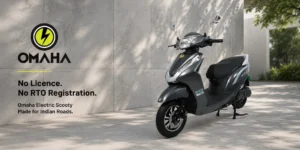
A quick word on licence-free scooters. A slow-speed electric scooty — motor rated under 250 W, top speed under 25 km/h — is not classed as a motor vehicle, so it needs no licence, no registration, no number plate and no road tax, and can be ridden from age 16. The flip side: because it is never registered, it cannot claim Delhi’s EV purchase subsidy, which is paid against a Delhi registration. Its advantage is that the price you are quoted is the price you pay. Our Delhi page covers the city-specific detail.
Route 1: Old Delhi lanes and crowded bazaars
In the galis around Chandni Chowk, Kinari Bazar and Ballimaran, nobody is going faster than a cycle rickshaw anyway. A 25 km/h limit is not a limitation here — it is irrelevant. What matters is how narrow the scooty is, how easily you can walk it through a jam, and whether you can fit it into the half-metre of space outside a shop.
Best pick: Omaha Active Mini — around ₹45,000 (lead-acid)
Why it fits this route
It is the most compact model in our range and the entry point on price. Short daily distances mean a lead-acid battery comfortably covers the day, which keeps the cost at the bottom of the band. No licence also means a younger family member can take the evening delivery or tuition run.
What to watch
Old Delhi buildings often mean narrow stairs and no ground-floor socket. A lead-acid pack is heavy to carry up. If charging means hauling the battery upstairs, pay the extra for lithium — it is far lighter and charges in 3–5 hours instead of 6–8.
From the showroom floor
A textile shop family near Katra Neel had been sending a staff member out on foot for fabric samples — twenty minutes each way through the crowd. A compact scooty cut that to under ten, and because it needs no licence, the owner’s 17-year-old nephew now does the afternoon runs during school holidays. Their first question at the showroom was not “how fast?” but “will it fit between the handcarts?”
Route 2: Home to metro, metro to home
This is the most common Delhi commute we see. The ride itself is easy — two to five kilometres from a Rohini sector or a Dwarka society to the nearest station. The real test is the eight or nine hours the scooty spends standing in a metro parking lot while you are in office.
Best pick: Omaha Starling Neo — around ₹50,000 to ₹55,000
Why it fits this route
It is our most-asked-for model in Delhi NCR, and the reason is the anti-theft alarm and parking switch that come standard. For a scooty that stands unattended all day, that matters more than any performance figure. A short daily distance also means one overnight charge easily covers several days.
What to watch
Check your station’s parking rules for electric two-wheelers before you buy. And if your daily total quietly climbs towards 15–20 km — office, then gym, then a market stop — look at the Tezo GT instead. Its cruise control and USB charging make a longer colony-road day more comfortable.
From the showroom floor
A common Dwarka pattern: a working woman who was spending ₹80–100 a day on autos to and from the metro, plus waiting time in summer heat. After switching, her monthly charging cost is a few hundred rupees. What she mentions first, though, is not the saving — it is not having to argue about the fare at 8:40 every morning.
Route 3: The shopkeeper’s stop-start market day
A shop owner in Karol Bagh or Kamla Nagar does not ride far. He rides often — bank, supplier, a customer delivery, back to the shop, out again for change. Every stop means parking nose-in between other two-wheelers and then dragging the scooty backwards out of the row.
Best pick: Omaha Active Pro — around ₹55,000 to ₹60,000
Why it fits this route
Two features built for exactly this day: a reverse gear, so you roll out of a packed row without dismounting and heaving, and central locking, so a quick stop at the bank does not mean fumbling with keys while carrying a bag. Do it fifteen times a day and you understand why this is the shopkeeper’s pick.
What to watch
Stop-start riding with a load draws more from the battery than steady riding. If you run stock around all day, ask the dealer about lithium so a mid-afternoon top-up at the shop is quick.
From the showroom floor
A mobile-accessories wholesaler in Gaffar Market told a dealer that his old scooter’s biggest cost was not fuel — it was the small daily strain of pulling a heavy machine backwards out of the parking row, a dozen times a day. The reverse gear was the feature he asked to test first, before he asked the price.
Route 4: Outer Delhi’s broken, patchy roads
Burari, Narela, Najafgarh, Sangam Vihar, Karawal Nagar — the roads here are a mix of fresh tar, patchwork, unmarked speed breakers and stretches that turn into ponds every July. A light scooty with basic suspension will get you there, but your lower back will keep a record of every trip.
Best pick: Omaha Skylark Super — around ₹58,000 to ₹61,000
Why it fits this route
Heavy-duty suspension is the whole point of this model. On a daily route with broken stretches, a flyover approach road or a kachcha link to the main road, it is the one in our range that will not punish you for the road’s condition.
What to watch
Longer daily distances plus rough roads mean you should budget for lithium if you ride above about 25 km a day. And in the monsoon, do not ride through standing water deeper than the footboard — no scooty, electric or petrol, enjoys that. Charge only when the scooty is dry.
From the showroom floor
A tuition teacher in Burari moving between three batches a day across the colony told us her first scooty “rattled like a steel almirah” within two months. What she asked for the second time was simple: something that would take the speed breakers without her gripping the handlebar in dread. Suspension was her entire brief.
Route 5: Senior riders inside the colony
Many Delhi families have a parent who stopped riding a two-wheeler after a small fall or a knee problem — and quietly lost a lot of independence with it. The morning walk to the park becomes a request for a lift. The chemist run waits for the evening. This route is short, but it matters a great deal.
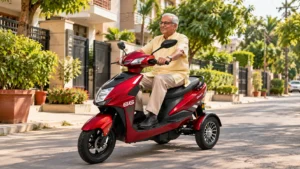
Best pick: Omaha Drake 3 Wheel
Why it fits this route
It is built for riders who no longer trust their balance. There is no need to put a foot down at every speed breaker or stop, and a gentle speed inside the colony is exactly what a senior rider wants. For families, the relief is knowing the machine will not tip at a standstill.
What to watch
A three-wheeler is wider than a scooty, so measure your gate and parking spot first. And do a test ride with the actual rider, not the son or daughter buying it — comfort getting on and off is the real test.
From the showroom floor
A pattern dealers see often: a son from Pitampura comes in alone to “just check”, then returns a week later with his retired father. The father sits on it, rides it around the showroom lot twice, and the decision is made. The questions are always the same — “will it fall if I stop?” and “can I lift the stand myself?”
Route 6: Ring Road, NH-48, DND or Barapullah
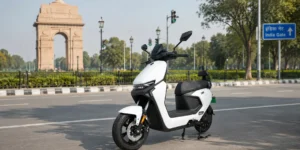
If your daily route runs Janakpuri to Gurugram on NH-48, Mayur Vihar to Noida over the DND, or a long stretch of Ring Road or Outer Ring Road, you are sharing lanes with traffic moving at 50–60 km/h and more. A scooty limited to 25 km/h is not just slow there — it is a safety problem, for you and everyone around you.
Best pick: a registered high-speed electric scooter — roughly ₹75,000 to ₹1,21,000 ex-showroom
Why we are recommending something we don’t make
Because it is the right answer. A registered electric scooter with a 2.9–3.7 kWh battery and a real 60–80 km/h speed is built for this route. It needs a licence, registration and insurance — but in Delhi, registered electric two-wheelers currently pay no road tax or registration fee, and can claim a battery-linked purchase incentive, which brings the real cost gap with a slow-speed scooty down far more than sticker prices suggest.
What to watch
Calculate your own subsidy from the battery’s kWh rather than accepting a flat “₹30,000 off”, check the latest slab on the Delhi Transport Department’s EV portal, and note that subsidised vehicles face restrictions on transfer out of Delhi for a period. Our full breakdown of these numbers is in our Delhi price guide.
If a showroom tells you a licence-free scooty is “fine on the Ring Road”, walk away. It may not be illegal for a slow-speed vehicle to be on that road, but at 25 km/h in 60 km/h traffic you are the slowest thing in the lane, and heavy vehicles are not expecting you. Buy for the road you ride.
Best scooty in Delhi with price — all six routes side by side
| Route | Best pick | Price band (Delhi) | Battery we’d suggest | Licence? |
|---|---|---|---|---|
| Old Delhi lanes | Active Mini | Around ₹45,000 | Lead-acid; lithium if charging upstairs | No |
| Home ↔ metro | Starling Neo | ₹50,000 – ₹55,000 | Either; lead-acid is enough for short runs | No |
| Market stop-start | Active Pro | ₹55,000 – ₹60,000 | Lithium for quick mid-day top-ups | No |
| Outer Delhi roads | Skylark Super | ₹58,000 – ₹61,000 | Lithium above ~25 km/day | Confirm with dealer |
| Senior, inside colony | Drake 3 Wheel | Ask your dealer | Lead-acid usually enough | Confirm with dealer |
| Ring Road / NH-48 / DND | A registered scooter | ₹75,000 – ₹1,21,000 ex-showroom | 2.9–3.7 kWh lithium | Yes |
Indicative bands for Delhi, 2026. Omaha sells through dealers, so the final figure moves with battery choice and dealer offers. Registered-scooter figures are typical listed ex-showroom prices of other brands, not quotations. Confirm at the showroom.
Best battery scooty in Delhi: lead-acid or lithium?
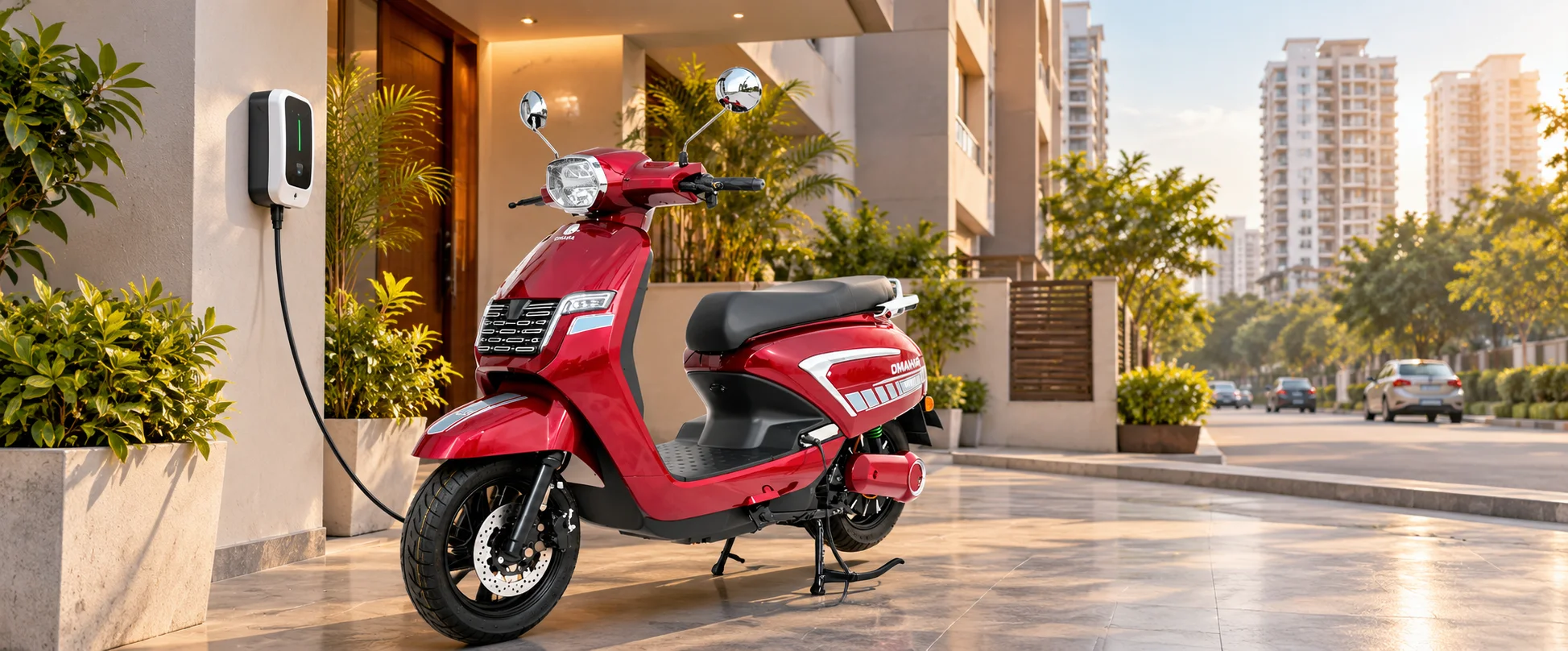
Every Omaha model is offered with either battery, and in Delhi this choice decides more about your ownership experience than the model name does. The honest version:
When lead-acid is the smarter buy
If you ride under about 15 km a day and can charge at a ground-floor socket, lead-acid keeps the upfront price at the bottom of the band. It charges in 6–8 hours, which overnight is no problem. Plan for a replacement pack after two and a half to three years — roughly ₹16,000 to ₹20,000 — because the battery, not electricity, is the real running cost.
When lithium pays for itself
Above about 25 km a day, or in any Delhi flat where the battery has to go up the stairs to charge, lithium wins over the life of the scooty. It is much lighter, charges in 3–5 hours, and lasts considerably longer. For DDA flats and builder floors without ground-floor parking — a huge share of Delhi housing — this is usually the deciding factor.
Our rule of thumb for Delhi buyers
Under 15 km a day with a ground-floor socket: lead-acid. Over 25 km a day, or charging upstairs: lithium. In between, let the stairs decide.
Delhi’s seasons are part of the route too
Summer (May–June): Park in shade wherever you can, and let the battery cool for a while after a hot afternoon ride before you plug it in. Charge in a ventilated spot, never in a closed, sun-baked balcony.
Monsoon (July–September): Know your route’s waterlogging points — Minto Bridge and low underpasses flood every year. Take the longer dry route rather than riding through deep water, and never charge a wet scooty or battery.
Winter (December–January): Fog is the risk, not cold. Check that your headlamp and indicators work before the season, and give yourself extra time on early morning runs.
Before you buy the best electric scooter in Delhi — a checklist
- Name your route first, the model second. Write down your worst-day distance and the roads you actually take. That picks the category before any showroom conversation starts.
- For a licence-free scooty, get the motor’s 30-minute rating on the invoice. Under 250 W is what makes it licence-free. A higher-rated motor that has been software-limited to 25 km/h does not qualify, whatever you are told.
- Ask which battery the price is for. A surprisingly low quote is almost always lead-acid being compared with somebody else’s lithium.
- Test-ride on your own road, with a pillion, at the hour you normally travel. A showroom lot tells you very little.
- Confirm where you will charge it — socket, floor, and whether a battery can be carried up easily.
- Ask where the nearest service point is and get the battery and motor warranty terms in writing.
- Be wary of subsidy promises on unregistered scooters. If a dealer offers one, ask them to put it in writing before you pay.
Find the right scooty for your Delhi route
Fifteen models, each with full specifications and both battery options. Built at our own plants in Hisar and Burdwan, with spares and service on domestic supply chains.
Conclusion: the best electric scooty in Delhi is the one built for your road
There is no single best electric scooty in Delhi, and any list that claims one is ranking scooters for a city that does not exist. Delhi is six different cities stitched together — Old Delhi’s galis, the metro colonies, the market rows, the unfinished roads of the outer belt, the quiet lanes where retired parents want their independence back, and the fast arterials that tie it all to Gurugram and Noida.
For the first five, a licence-free scooty between ₹45,000 and ₹61,000 is usually the smartest money you can spend on getting around — no licence, no RTO, no road tax, and a running cost of a few hundred rupees a month. For the sixth, buy a registered electric scooter, claim the subsidy you are actually entitled to, and ride safely at the speed the road demands.
Pick your route, then pick your battery, then test-ride on your own road. Do it in that order and you will not regret the purchase.
Frequently asked questions
Which is the best electric scooty in Delhi?
It depends on your route. For crowded Old Delhi lanes, a compact licence-free model like the Omaha Active Mini fits best. For metro last-mile commutes, the Starling Neo’s anti-theft alarm matters most. For market stop-start riding, the Active Pro’s reverse gear helps. For rough Outer Delhi roads, the Skylark Super’s suspension. For senior riders, the Drake 3 Wheel. For Ring Road, NH-48 or DND commutes, a registered high-speed electric scooter is the better choice.
What is the price of the best electric scooty in Delhi?
Licence-free slow-speed scooties in Delhi cost roughly ₹45,000 to ₹61,000, and their on-road price is effectively the same as the showroom price because there is no registration, road tax or compulsory insurance. Registered high-speed electric scooters cost roughly ₹75,000 to ₹1,21,000 ex-showroom, before any Delhi subsidy.
Which is the best electric scooter in Delhi without a licence?
Any scooter with a motor rated under 250 W and a top speed under 25 km/h can be ridden without a licence or registration, from age 16. Among Omaha’s range, the Active Mini, Starling Neo and Active Pro are popular Delhi choices, depending on whether your priority is compactness, parking security or reverse gear. Always get the motor’s rating printed on the invoice.
Is a slow-speed electric scooty good for daily use in Delhi?
Yes, for short and medium inner-city routes — colony rides, metro last-mile, market runs and school drops. It is not suitable for fast arterial roads such as Ring Road, NH-48 or the DND flyway, where traffic moves much faster than 25 km/h.
Which is the best battery scooty in Delhi — lead-acid or lithium?
Under about 15 km a day with a ground-floor charging point, lead-acid is usually the cheaper overall choice. Above about 25 km a day, or if the battery has to be carried upstairs to charge, lithium is better value over the scooty’s life — it is lighter, charges in 3 to 5 hours instead of 6 to 8, and lasts longer.
Can I get the Delhi EV subsidy on a licence-free scooty?
No. Delhi’s purchase incentive is paid against a vehicle registered in Delhi, and a slow-speed scooty is never registered. Its advantage is different: it pays no registration fee, road tax or compulsory insurance, so the quoted price is what you pay.
What is the best electric scooter for senior citizens in Delhi?
For older riders who are unsure of their balance, a three-wheel electric scooter such as the Omaha Drake 3 Wheel is often the best choice, because there is no need to put a foot down at stops. Measure your gate and parking space first, and let the actual rider do the test ride.
How much does it cost to run an electric scooty in Delhi?
Electricity for a typical 30–40 km daily commute usually comes to about ₹300 to ₹450 a month, compared with ₹3,000 to ₹4,000 on petrol. The bigger cost is battery replacement: a lead-acid pack typically needs replacing every two and a half to three years at roughly ₹16,000 to ₹20,000.
Where can I buy an Omaha electric scooty in Delhi?
Omaha sells through authorised dealers across Delhi NCR. Send your locality on WhatsApp or call us and we will tell you the nearest showroom — and tell you honestly if there is not one near you yet. Model details are on the electric scooters page and city information on our Delhi page.
About this guide, and its limits
Written by the product team at Omaha Electric, a unit of JVG Electric Private Limited, which manufactures electric scooters and loaders at Mandi Adampur, Hisar, Haryana and at Burdwan, West Bengal. The route patterns described here come from the enquiries and service feedback our Delhi NCR dealers handle.
We have an interest here. We make slow-speed electric scooters, not registered high-speed ones, so weigh our view accordingly — and note that this guide recommends a registered scooter from another maker for Route 6, and says plainly that our category cannot claim the Delhi subsidy.
About the stories. The “From the showroom floor” examples are composite illustrations of common enquiry patterns, not individual customers’ accounts.
Prices and policy are not advice. Price bands are indications for Delhi in 2026, not quotations; other brands’ figures are typical listed prices and are not endorsed by those manufacturers. Subsidy terms are set by the Government of NCT of Delhi and change — confirm them on the official Delhi Transport Department portal before you buy.
Last reviewed September 2026. Questions about a model or a price in your area — contact us or message us on WhatsApp.