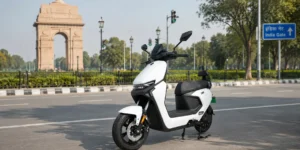
A customer called us one winter morning, upset. “The brochure said 80 km. I got 52.” We asked three questions. Does your wife ride with you? Yes, every day to the market. Is there a flyover on the way? Two. When did you last check the tyres? He laughed and said, never. His scooter was fine. His expectation was not. Range on an electric scooter is not a fixed number like a fuel tank’s litres. It is a number that changes with who rides, where, how, and in what weather. Once you know what moves it, you can plan around it and stretch it.
The short answer.
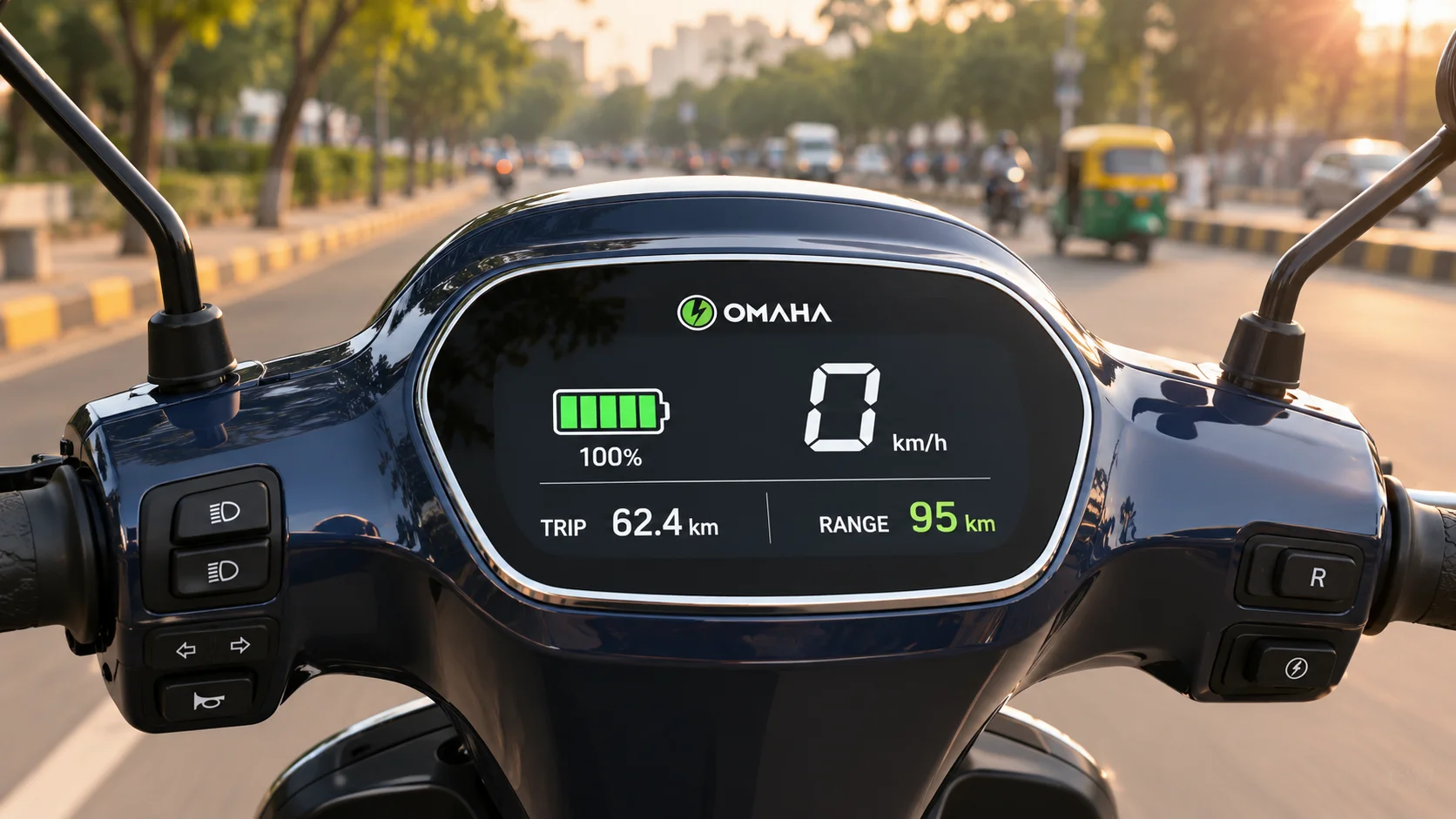
Omaha rates its scooters at 70 to 80 km per full charge. That is the electric scooter range per charge in favourable conditions. In everyday use, with a pillion, traffic, slopes and Indian weather, most riders get less.
A sensible rule of thumb for planning is about 55 to 60 km between charges, more if you ride solo on flat roads, less with a pillion, hills or heavy loads. The best number is your own: measure it once with the simple method below, and keep tyres, throttle and charging habits in good shape to hold on to it.
What “rated range” actually means
Rated range is the distance a scooter covers on one full charge under controlled, favourable conditions: typically a single rider, a steady speed, a flat surface and mild weather. It is useful for comparing scooters with one another. It is not a promise of what you will see on your own commute.
Think of it like a mileage figure for a petrol bike. Everyone knows the number on the poster and the number on the road are different. With an electric scooter the gap is easier to see, because the battery gauge shows it every day.
Why it’s still worth knowing
Rated range tells you the ceiling. If your daily round trip is 20 km and the rated range is 70 to 80 km, you have plenty of room even after real-world losses. If your round trip is 65 km, you are planning on the ceiling, and that is where disappointment starts.
The range robbers: what really cuts electric scooter range per charge
These are the factors we see most often when riders ask why their range is lower than expected, roughly in order of how much they matter.
Impact levels are general guidance from everyday use, not lab measurements. Several small robbers together can matter as much as one big one.
How many km will an electric scooter run in one charge on your route?
Here is how real-world range usually compares across common Indian riding patterns. Use it to set expectations, then measure your own.
| Your riding | What to expect against the 70–80 km rating |
|---|---|
| Solo rider, flat colony and town roads, smooth throttle | Closest to the rated figure |
| Daily commute, mixed traffic, some signals | Somewhat lower; plan on roughly 55–60 km |
| Rider plus pillion, market trips, frequent stops | Noticeably lower |
| Flyovers, slopes or carrying heavy loads | Lowest; keep a generous buffer |
| Cold winter mornings, especially on lead-acid | Lower than the same route in mild weather |
A planning guide, not a guarantee. Your scooter, battery, load and roads decide the real figure.
What this means for most riders
When people ask about electric scooty range, what they really want to know is whether it covers their day. Most daily trips in Indian towns, such as office, school, market and tuition, add up to well under the planning figure. If your round trip is 15 to 25 km, you will typically charge every two or three days, with range to spare. Our route-by-route guides for Delhi and Jaipur show how this plays out in real cities.
Measure your own real range in three days
Nothing beats your own number for electric scooter range per charge. This takes no tools beyond the scooter’s trip meter and a notebook or phone.
- Charge to full overnight, or for the full charging time for your battery.
- Reset the trip meter, or note the odometer reading before your first ride.
- Ride your normal routine for a few days. Same routes, same pillion, same bags. Do not change how you ride for the test.
- Stop at the low-battery warning, not at zero, and note the kilometres.
- Repeat once more on another full charge. The average of two runs is your real electric scooter range for your life.
Don’t deliberately run the battery flat. Riding until the scooter stops is hard on any battery, and especially on lead-acid. The low-battery warning is your signal to head home and charge. Use the kilometres at that point as your working range.
From the showroom floor
A shopkeeper in Jaipur was sure his scooter’s range had “gone bad” within two months. Before replacing anything, we checked the basics. Both tyres were well under pressure. After a pump-up and one week of normal riding, his range came back to what he had seen when the scooter was new. He now checks the tyres every Sunday on the way to the mandi.
Lead-acid vs lithium: how the battery changes real range
Every Omaha model offers both battery types. On paper they share the same rated range. On the road, they behave a little differently.
| Lead-acid | Lithium | |
|---|---|---|
| Under heavy load or on slopes | Range drops more noticeably | Holds up better |
| Cold mornings | More affected | Less affected |
| Over the years | Capacity typically fades sooner | Usually keeps capacity longer |
| Charging time | 6 – 8 hours | 3 – 5 hours |
| Price on the same model | Lower | Typically ₹10,000 – ₹15,000 more |
For short, flat daily trips, lead-acid is often all you need. For a pillion every day, slopes or winter riding, lithium earns its price. Full comparison in our lead-acid vs lithium guide.
How to increase electric scooter range
Ride smoothly
Roll on the throttle gently from a stop, look ahead, and ease off early instead of braking late. On longer steady stretches, a model with a cruise controller, such as the Tezo, helps hold a steady speed without wrist effort.
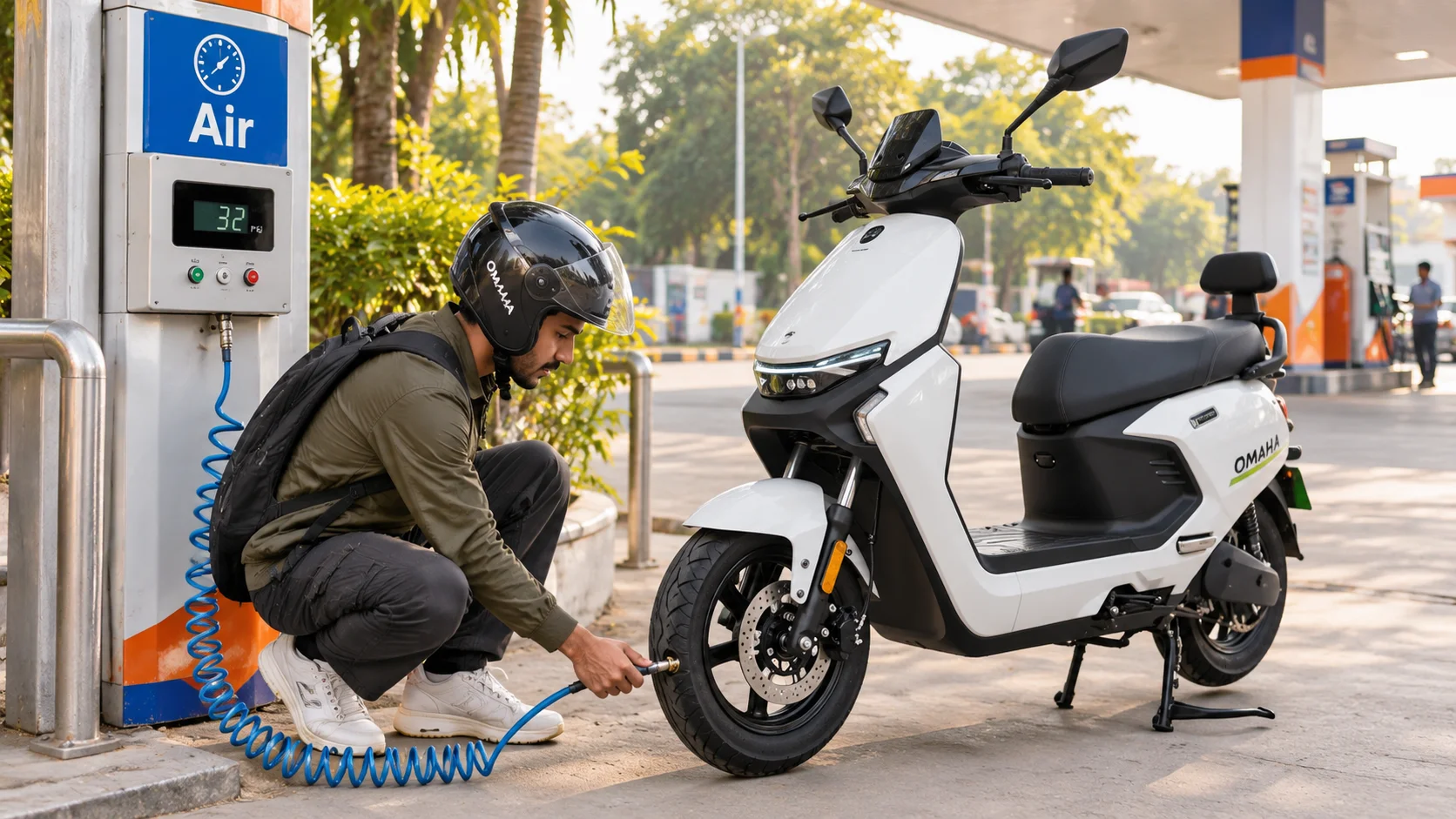
Keep the tyres at the right pressure
Check once a week at any air machine, using the pressure recommended in your manual. It takes two minutes and is the single easiest way to win back lost kilometres.
Carry only what you need
The tools, the extra bag, the spare everything that has lived under the seat for months all add weight on every ride. Clear out what you don’t use.
Charge with good habits
- Use the charger that came with the scooter. Lead-acid and lithium chargers are not interchangeable.
- Don’t leave the battery flat for long. Charge soon after the low-battery warning.
- Charge in a dry, shaded, ventilated spot, not in direct afternoon sun.
- Unplug once it is full, and follow the charging advice in your manual.
Look after it through the seasons
- Summer: park in shade where you can. Heat is hard on batteries over the long term.
- Winter: expect a little less range on cold mornings, and charge in a sheltered spot rather than an open, cold one.
- Monsoon: avoid riding through water deep enough to reach the motor or battery area.
Get it serviced
At each service, ask the dealer to check the brakes for drag, the wheel bearings, and the battery’s health. A brake that rubs slightly can cost you kilometres for months without you noticing.
Thinking of “boosting” range or speed with a controller tweak? Don’t. Modifying a low-speed scooter can take it out of the no-licence category, is likely to void the warranty, and usually reduces range rather than increasing it, because the scooter then uses more energy per kilometre.
When lower range is a sign to get the battery checked
Some loss of range over the years is normal. These are signs it is time to visit your dealer:
- A sudden drop on the same route, with the same load, that tyre pressure does not explain.
- The battery gauge falls very fast in the first few kilometres after a full charge.
- The scooter feels weak on slopes it used to climb easily.
- Charging time has changed noticeably, either much shorter or much longer than usual.
- The battery, charger or socket gets unusually hot. Stop charging and get it checked straight away.
From the showroom floor
An office worker in Delhi noticed his range dropped every December and assumed the battery was dying. It wasn’t. He was charging the scooter in an open, unheated parking area and riding at 7 AM in the cold. When he moved charging to a covered spot and started his ride after the scooter had been in the sheltered area, the winter dip became much smaller. The battery was fine all along.
The “From the showroom floor” stories are composite illustrations of common enquiry patterns, not individual customers’ accounts.
Choosing a scooter with range in mind
- Add up your daily round trip, including detours, and compare it with the planning figure, not the rated one.
- Count the pillion and the load you will usually carry.
- Think about your route: flyovers, slopes, traffic.
- Pick the battery with your load, slopes and weather in mind.
- Test-ride on a stretch like yours, with your usual pillion if possible.
Ride your own route before you decide
Book a test ride, bring your usual pillion, and see how the scooter feels on roads like yours.
Conclusion: know your number, then protect it
The brochure’s 70 to 80 km is a ceiling, not a promise. Your real electric scooter range per charge depends on weight, throttle, slopes, traffic, tyres, weather and battery age, and most of those are in your hands. For most Indian riders, the real number is still far more than a day’s riding needs.
Measure your own range once, plan with a buffer, keep the tyres pumped and the throttle smooth, and charge with good habits. Do that, and the gap between the brochure and the road stays small for years.
Frequently asked questions
How many km does an electric scooter run on one charge?
Omaha rates its scooters at 70 to 80 km per full charge in favourable conditions. In everyday riding with traffic, a pillion or slopes, most riders get less, so a planning figure of about 55 to 60 km between charges is sensible. Measure your own range for the most accurate number.
Why is my electric scooter’s real range less than the claimed range?
Rated range is measured in favourable conditions. Real range drops with extra weight, hard acceleration, slopes, stop-start traffic, low tyre pressure, cold weather and battery age. Checking tyre pressure and riding more smoothly usually recovers some of the gap.
Does a lithium battery give more range than lead-acid?
On Omaha scooters both share the same rated range. In real use, lithium usually holds up better under heavy loads, on slopes and in cold weather, and tends to keep its capacity longer over the years. It typically costs ₹10,000 to ₹15,000 more on the same model.
How can I increase my electric scooter’s range?
Keep tyres at the recommended pressure, accelerate and brake smoothly, carry only what you need, charge with the original charger in a dry, shaded spot, avoid leaving the battery flat, and get brakes and battery checked at each service.
Does carrying a pillion reduce range?
Yes. Extra weight is one of the biggest factors in real-world range, because every start and every slope needs more energy. If you ride with a pillion daily, plan with a bigger buffer, and consider lithium if you also face slopes.
Does winter or summer affect electric scooter range?
Cold mornings reduce the energy a battery can deliver, so winter range is usually a little lower, especially with lead-acid. Summer heat does not cut daily range much but is hard on batteries over the long term, so park and charge in shade where possible.
Is it bad to run an electric scooter battery to zero?
Yes, regularly riding until the scooter stops is hard on any battery, and especially on lead-acid. Treat the low-battery warning as your signal to charge, and avoid leaving the battery flat for long periods.
How do I check my scooter’s real range?
Charge to full, reset the trip meter, ride your normal routine for a few days, and note the kilometres when the low-battery warning appears. Repeat once more and take the average. That is your real working range.
When should I get my battery checked for low range?
Visit your dealer if range drops suddenly on the same route and load, the gauge falls very fast after a full charge, the scooter feels weak on familiar slopes, charging time changes noticeably, or the battery or charger gets unusually hot.
About this guide, and its limits
Written by the product team at Omaha Electric, a unit of JVG Electric Private Limited, which manufactures electric scooters and loaders in Hisar, Haryana. We make the scooters mentioned here, so weigh our view accordingly.
About the figures. The 70 to 80 km figure is Omaha’s rated range. The 55 to 60 km planning figure is a rule of thumb with a safety buffer, and the range-robber impact levels are general guidance, not lab measurements. Your real range depends on your scooter, battery, load, roads, weather and riding.
Safety. If a battery, charger or socket ever feels unusually hot, smells of burning or looks swollen, stop using it and contact your dealer.
About the stories. The “From the showroom floor” examples are composite illustrations of common enquiry patterns, not individual customers’ accounts.
Questions — contact us, message us on WhatsApp, or book a test ride.