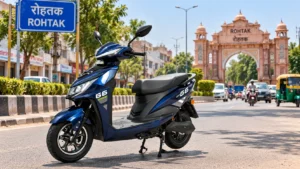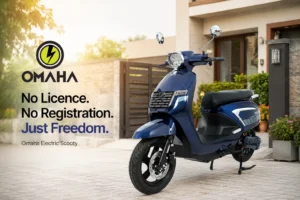
The Omaha Starling Neo is not trying to be the fastest or the flashiest scooter in our range. It was built for a very specific, very common kind of rider — someone whose scooter spends more hours parked than moving, in a place they cannot keep an eye on it. This page covers its price, its real range, the specifications that matter, and an honest view of who should buy it and who should look elsewhere.
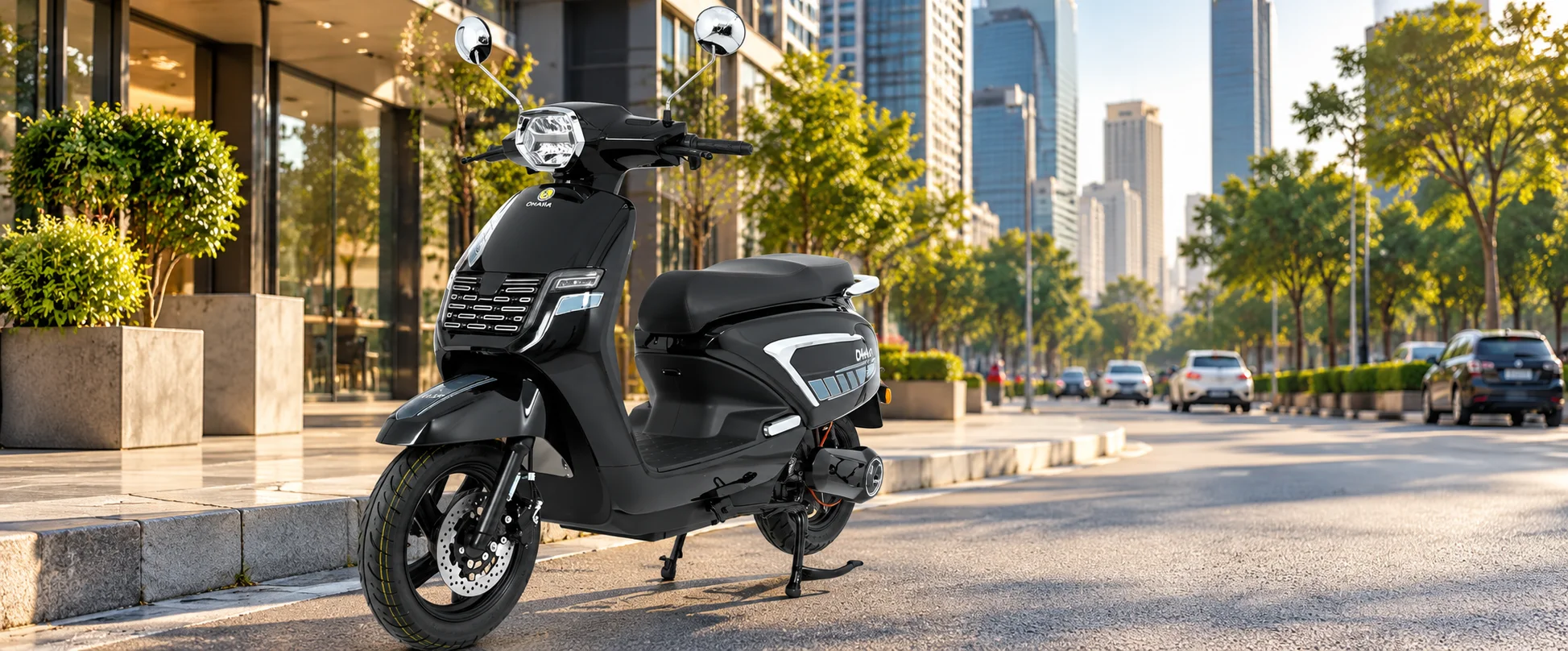
The short answer.
The Omaha Starling Neo is a compact, no-licence electric scooter built in Hisar, Haryana. It is priced at roughly ₹50,000 to ₹55,000 depending on battery and dealer, with the lithium version costing about ₹10,000 to ₹15,000 more than lead-acid. Omaha scooters are rated for a 70–80 km range on a full charge from an ordinary 5A home socket, and the Starling Neo charges in 6–8 hours on lead-acid or 3–5 hours on lithium.
What sets it apart is security: an anti-theft alarm and a parking switch come standard. It is the scooter for riders who park for long hours in public places — metro stations, college lots, office basements and market rows.
Omaha Starling Neo at a glance
From Omaha’s published product information. Price is indicative and varies by battery choice, dealer and city. Full specification sheet on the Starling Neo product page.
Starling Neo price — what you’ll actually pay
The Starling Neo sits in the middle of Omaha’s compact range. Its indicative price runs from about ₹50,000 to ₹55,000, and nearly all of that spread comes down to one decision: the battery.
Lead-acid vs lithium price
| Version | Price position | Full charge | Best for |
|---|---|---|---|
| Starling Neo — lead-acid | Lower end of the band | 6–8 hours | Under ~15 km a day, charging at a ground-floor socket |
| Starling Neo — lithium | About ₹10,000–₹15,000 more | 3–5 hours | Over ~25 km a day, or carrying the battery upstairs to charge |
Ask your dealer to quote both versions of the same model side by side, so you are comparing like with like.
If you are unsure which to choose, our lead-acid vs lithium guide works through the maths for different daily distances. The short rule: light riders save money with lead-acid; regular 25 km-plus riders save money with lithium over the scooter’s life, because they avoid repeated lead-acid replacements.
Starling Neo on-road price
Here is the part that surprises petrol scooter buyers. Because the Starling Neo is sold as a no-licence, low-speed scooter, it does not need registration, a number plate or road tax, and insurance is not compulsory. That means its on-road price is effectively the same as the showroom price — the figure your dealer quotes is very close to the figure you pay, apart from any accessories or optional insurance you choose.
One thing to know about subsidies. State EV purchase subsidies are generally paid against a registered vehicle. A no-licence scooter is never registered, so it usually cannot claim them. That is not a hidden cost — it is simply why the Starling Neo’s price advantage comes from zero paperwork and zero registration charges, not from a subsidy. If anyone promises you a subsidy on it, ask for that promise in writing.
Why we quote a band, not one number
Omaha sells through dealers across India, and the final price moves with the battery you pick, local offers and transport to the showroom. A single all-India number for a dealer-sold scooter would be a guess. The band above is honest; your dealer’s quote is final.
Starling Neo range — rated vs real-world
Omaha’s scooters are rated for a range of 70–80 km on a full charge. That rating reflects good conditions — a single rider, flat roads, steady speed. On your road, you should plan around a lower figure, and the honest reason is worth understanding.
What reduces your range
The five things that eat into every charge
- A pillion or heavy load. Two riders, or a bag of shop stock, draws noticeably more power.
- Stop-start traffic. Every restart from zero costs more energy than steady cruising.
- Flyovers and slopes. Climbing takes power; you only get a little of it back on the way down.
- Battery age and heat. An older lead-acid set, or a battery baked in summer sun, holds less charge.
- Low tyre pressure. The easiest range loss to fix — check it every fortnight.
For planning, a sensible working assumption is to use about two-thirds of the rated figure on a mixed city day. That still covers most Indian commutes several times over:
| Your daily riding | How often you’d charge | Battery we’d suggest |
|---|---|---|
| 5–10 km (colony, market, school run) | Every 3–4 days | Lead-acid |
| 10–20 km (home ↔ metro, college) | Every 2–3 days | Lead-acid or lithium |
| 20–35 km (office commute, errands) | Every 1–2 days | Lithium |
| 35 km+ (deliveries, all-day shop runs) | Daily | Lithium |
Planning guide only, based on using roughly two-thirds of the rated range on a mixed city day. Lead-acid should still be fully charged the same day you ride, even if charge is left, to protect its life.
Starling Neo specifications
| Specification | Omaha Starling Neo |
|---|---|
| Category | Low-speed electric scooter — no licence or registration |
| Manufacturer | JVG Electric Pvt Ltd (Omaha Electric), Hisar, Haryana |
| Battery options | Lead-acid or lithium |
| Rated range | 70–80 km per full charge |
| Charging time — lead-acid | 6–8 hours |
| Charging time — lithium | 3–5 hours |
| Charging socket | Ordinary 5A home socket |
| Anti-theft alarm | Yes |
| Parking switch | Yes |
| Body style | Compact, for tight lanes and short trips |
From Omaha’s published product information. See the Starling Neo product page for the complete, current specification sheet and colour options.
The two features that define the Starling Neo
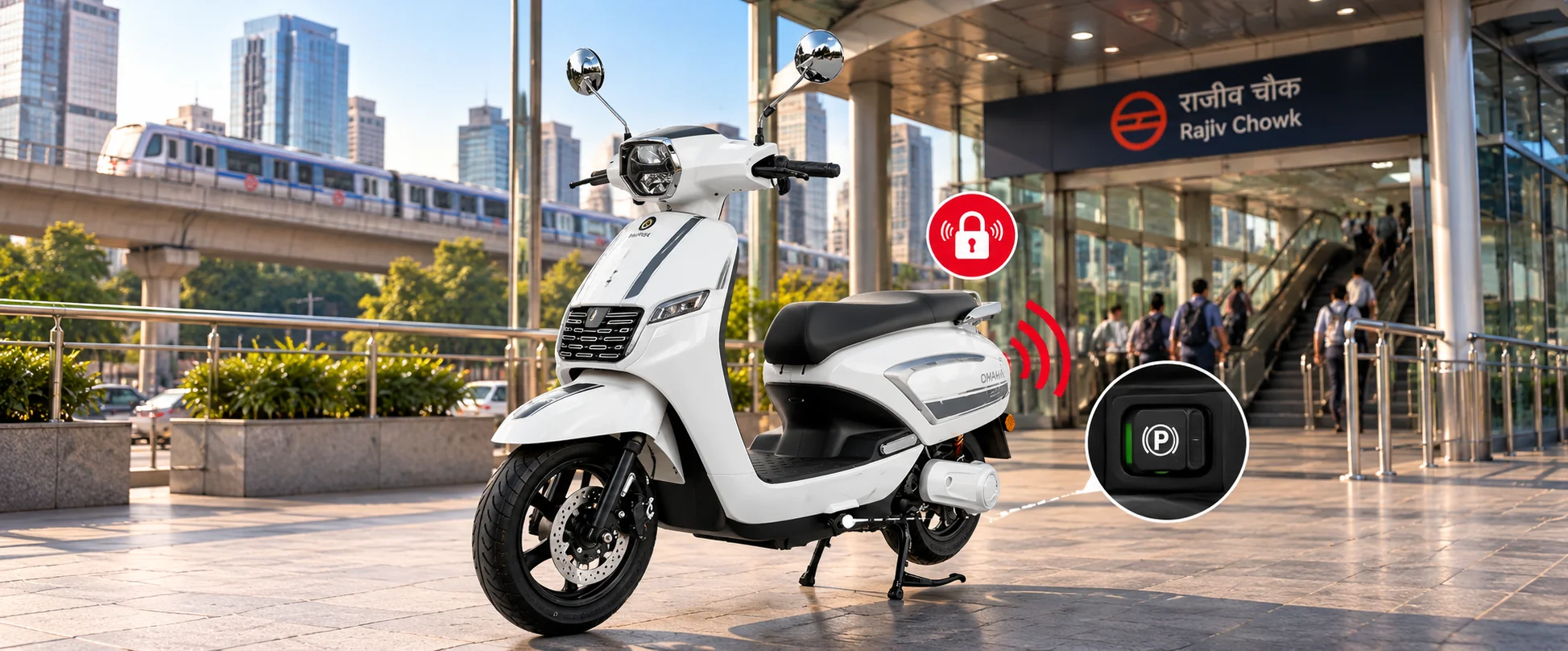
Anti-theft alarm
When your scooter stands in a metro lot or a college parking row for eight or nine hours, the biggest worry is not range — it is whether it will still be there, battery included. The alarm sounds if the parked scooter is disturbed, drawing attention the moment someone tampers with it. It will not stop a determined thief on its own, which is why a physical lock is still sensible, but it makes the Starling Neo a much less attractive target than the unguarded scooter next to it.
Parking switch
The parking switch puts the scooter into a parked state so it cannot move off accidentally — for example if the throttle is nudged while you are loading a bag, or while a child is sitting on it for a photo. It is a small safety feature that matters most in exactly the crowded places this scooter is built for.
The rider the Starling Neo was built for
Every Omaha model shares the same fundamentals — made in Hisar, no licence needed, a choice of battery. So choosing between them really means choosing a body style and a feature set. The Starling Neo’s feature set points clearly at four kinds of rider.
1. The metro or bus-stand commuter
Why it fits
A short ride to the station, then a long day parked unattended. The alarm is the reason to buy this model over a similar-priced scooter without one.
From the showroom floor
A bank clerk in Rohini rode to Rithala metro every morning and admitted he spent the first hour at work wondering about his parked scooter. His question at the dealership was not about top speed — it was “does it make noise if someone touches it?” The answer decided the sale.
2. The college student aged 16 and above
Why it fits
No licence is needed, so a student who is not yet 18 can ride it legally. Campus and hostel parking lots are exactly where the alarm earns its keep. Parents also appreciate the low speed.
From the showroom floor
A father in Hisar bought one for his daughter’s first year at college, ten kilometres from home. He chose lead-acid because she rides a fixed, short route and the scooter charges overnight in their ground-floor porch.
3. The working professional in a flat
Why it fits
Office basements and society parking are shared spaces. The Starling Neo’s compact size is easy to squeeze into a two-wheeler row, and with the lithium option the battery charges in 3–5 hours — useful if you top up at home in the evening.
4. The family’s “second scooter”
Why it fits
Many households have one petrol scooter and two people who need to leave at the same time. A Starling Neo takes the short daily trips — market, tuition, a nearby office — while the petrol scooter handles longer rides. No second licence, no registration, and a running cost of a few hundred rupees a month.
From the showroom floor
A couple in Sirsa were debating a second petrol scooter. Once they worked out that the wife’s daily route was under eight kilometres, they chose a Starling Neo instead, charged from a regular socket at home.
The “From the showroom floor” stories are composite illustrations of common enquiry patterns, not individual customers’ accounts.
Who should not buy the Starling Neo
An honest review has to say this part too. The Starling Neo is the wrong choice if:
Your route includes a highway or fast arterial road
As a low-speed scooter, it is not meant for highways, bypasses or fast ring roads where traffic moves far quicker. If that is your daily route, a registered high-speed electric scooter is the right tool — from whichever brand suits you.
You want reverse gear, central locking or cruise control
Those features exist in the Omaha range, just not on this model. If you park nose-in and reverse out many times a day, look at models with reverse gear and central locking such as the Active Pro or Starling Round. If you ride longer and want cruise control and a USB charger, the Tezo is the better fit.
You need maximum comfort on rough roads every day
For long daily distances on broken roads, a model built around heavier-duty suspension will be kinder to your back. Compare them on the electric scooters page.
Omaha Starling Neo review: strengths and limits
What we’d tell a friend it does well
- Anti-theft alarm and parking switch as standard
- No licence, no registration, no road tax
- On-road price ≈ showroom price
- Choice of lead-acid or lithium
- Charges from a normal 5A home socket
- Compact size for tight lanes and parking rows
- Made in Hisar, so spares move on domestic supply chains
What it is not built for
- Highways, bypasses and fast arterial roads
- Riders who need reverse gear or central locking
- Claiming state EV purchase subsidies
- Carrying a heavy lead-acid battery up stairs daily — choose lithium instead
- Long, rough daily routes where suspension matters most
What the Starling Neo costs to run
A full charge typically draws around two to two and a half units of electricity. At common domestic tariffs, that is roughly ₹15 to ₹20 per charge. For a rider covering 15–20 km a day, electricity usually comes to a few hundred rupees a month — against several thousand for a petrol scooter over the same distance.
There is no engine oil, no clutch, no spark plug and no pollution certificate. The real long-term cost is the battery: a lead-acid set usually needs replacing after about two and a half to three years, at roughly ₹16,000 to ₹20,000. Lithium costs more upfront but lasts considerably longer, which is why it wins for heavier riders.
Before you buy — a test-ride checklist
- Ride it on your own route, at the time you normally travel, not just around the showroom.
- Try it with a pillion if you’ll ever carry one, and with the bag you usually carry.
- Trigger the alarm and try the parking switch so you know exactly how both work.
- Get both battery quotes — lead-acid and lithium — for the same model.
- Check the motor rating printed on the invoice for a no-licence scooter.
- Ask for the vehicle and battery warranty in writing, and where your nearest service point is.
- Decide where it will charge — that one answer often settles lead-acid versus lithium.
See the Starling Neo in person
Check the full specification sheet and colours, then ride it on your own road before you decide.
Conclusion: a scooter designed around where it waits
Most scooter reviews focus on what happens while you ride. The Omaha Starling Neo makes more sense when you think about what happens while you don’t — the eight hours at a metro station, the college day, the long shift in an office basement. Its anti-theft alarm and parking switch are built for exactly that, and they come with the practical basics every Omaha rider gets: no licence, no registration, a 70–80 km rated range and a choice of battery.
If your daily riding is short to medium distance on city roads and your scooter spends long hours parked in public, the Starling Neo is one of the most sensible buys in the ₹50,000–₹55,000 range. If your route runs on highways, or you need reverse gear and central locking, choose another model — and ride before you buy either way.
Frequently asked questions
What is the price of the Omaha Starling Neo?
The Omaha Starling Neo is priced at roughly ₹50,000 to ₹55,000, depending on battery choice and dealer. The lithium version typically costs about ₹10,000 to ₹15,000 more than the lead-acid version. Ask your nearest dealer for an exact quote on both.
What is the Starling Neo on-road price?
Because the Starling Neo is a no-licence, low-speed scooter, it needs no registration, number plate or road tax, and insurance is not compulsory. Its on-road price is therefore effectively the same as the showroom price, apart from any accessories or optional insurance you choose.
What is the range of the Omaha Starling Neo?
Omaha scooters are rated for a range of 70–80 km on a full charge. Real-world range is lower with a pillion, heavy loads, stop-start traffic, slopes, heat or an ageing battery. For planning, assume about two-thirds of the rated figure on a mixed city day.
How long does the Starling Neo take to charge?
About 6 to 8 hours on the lead-acid battery and 3 to 5 hours on lithium, from an ordinary 5A home socket.
Do I need a driving licence for the Omaha Starling Neo?
No. Omaha sells the Starling Neo as a no-licence, low-speed scooter, so it needs no driving licence or registration and can be ridden from age 16. Check that the motor rating is printed on your invoice.
What features does the Starling Neo have?
Its standout features are an anti-theft alarm and a parking switch, both standard. It is offered with a lead-acid or lithium battery and has a compact body suited to tight lanes and short trips. The complete specification sheet is on the Starling Neo product page.
Which is better for the Starling Neo — lead-acid or lithium?
Choose lead-acid if you ride under about 15 km a day and charge at a ground-floor socket. Choose lithium if you ride over about 25 km a day, or need to carry the battery upstairs to charge — it is lighter, charges faster and lasts longer.
Can I claim an EV subsidy on the Starling Neo?
Usually not. State EV purchase subsidies are generally paid against a registered vehicle, and a no-licence scooter is never registered. Its saving comes instead from paying no registration fee, no road tax and no compulsory insurance.
How do I book a Starling Neo test ride?
Use Omaha’s test ride booking page, or message on WhatsApp with your locality and you will be directed to the nearest authorised dealer.
About this guide, and its limits
Written by the product team at Omaha Electric, a unit of JVG Electric Private Limited, which manufactures electric scooters and loaders in Hisar, Haryana. We make the Starling Neo, so weigh our view accordingly — and note that this guide sets out plainly who should choose a different model instead.
About the stories. The “From the showroom floor” examples are composite illustrations of common enquiry patterns, not individual customers’ accounts.
Figures are indicative. Prices vary by battery, dealer and city. Range is a rated figure; real-world range depends on load, road and battery condition. Running costs depend on your electricity tariff. Confirm the current specification sheet and warranty terms at your dealer before you buy.
Last reviewed September 2026. Questions about the Starling Neo — contact us, message us on WhatsApp, or book a test ride.