The electric scooter price in Delhi runs from about ₹45,000 to about ₹1,21,000, and the gap between those two numbers is not really about quality — it is about which side of a legal line the scooter sits on, and whether the ₹30,000 state subsidy is available to you. This page sets out the whole ladder, the on-road maths after Delhi’s EV Policy 2.0, and the crossover point where a more expensive scooter genuinely becomes the cheaper buy.
The short answer.
In Delhi in 2026, an electric scooter costs roughly ₹45,000 to ₹61,000 if it is a slow-speed model that needs no licence or registration, and roughly ₹75,000 to ₹1,21,000 ex-showroom if it is a registered high-speed model. Under Delhi’s EV Policy 2.0, a registered electric two-wheeler pays no road tax and no registration fee, and can claim a purchase subsidy of ₹10,000 per kWh capped at ₹30,000 in the policy’s first year.
The subsidy is the reason this decision is less obvious than the sticker prices suggest — and there is a catch in it that almost nobody explains properly. It is covered in full below.
The Delhi price ladder — four tiers, not one
Search “ev scooter price in Delhi” and you get a jumble of numbers between forty thousand and a lakh and a half with no explanation of why they differ. They differ because there are four genuinely distinct products being sold under one phrase.
Indicative bands for Delhi, August 2026. High-speed figures are typical listed ex-showroom prices and vary by model, variant and dealer. Confirm at the showroom.
Once you see it as a ladder rather than a range, the question changes. It stops being “what is the electric scooter price in Delhi” and becomes “which rung is right for how I actually ride” — and that is a question you can answer.
Electric scooter price in Delhi on road — why the gap almost vanished
In most cities, the on-road price is meaningfully higher than the ex-showroom price: registration fee, road tax, insurance, handling. In Delhi, for an electric two-wheeler, two of those have gone to zero.
The Delhi Electric Vehicles Policy, 2026 — notified on 30 June 2026 and in force from 1 July 2026 until 31 March 2030 — grants eligible battery electric vehicles a 100 per cent waiver on road tax and registration fees for the policy period. For a registered electric scooter, that removes the two biggest line items that normally sit between the ex-showroom figure and the on-road figure.
What remains is insurance, and any handling or accessory charges the dealer applies. So in Delhi, an electric scooter’s on-road price is typically its ex-showroom price plus insurance — a much smaller step-up than a petrol buyer is used to.
For a slow-speed scooter the arithmetic is simpler still. With no registration, no road tax and no compulsory insurance, the on-road price is effectively the ex-showroom price. The figure the dealer quotes is the figure you pay.
The Delhi EV subsidy, with the actual numbers
This is where most pages get vague, so here it is precisely, from the notified policy.
| Benefit | Amount | Conditions worth knowing |
|---|---|---|
| Purchase incentive — Year 1 | ₹10,000 per kWh, capped at ₹30,000 | Ex-showroom price must not exceed ₹2.25 lakh. Applies to plug-in and battery-swapping models alike. |
| Purchase incentive — Year 2 | ₹6,600 per kWh, capped at ₹20,000 | The slab drops on the policy anniversary, not on 1 April. |
| Purchase incentive — Year 3 | ₹3,300 per kWh, capped at ₹10,000 | The same scooter earns a third of the Year 1 amount. |
| Scrapping incentive | ₹10,000 | Scrap a Delhi-registered BS-IV or older two-wheeler and buy within six months of the Certificate of Deposit. |
| Road tax & registration fee | 100% waived | For eligible battery electric vehicles, through 31 March 2030. |
| How it reaches you | Direct benefit transfer | Paid into the buyer’s account, with disbursal stated at within 60 days of applying. Delhi residents, vehicle registered in Delhi. |
From the Delhi Electric Vehicles Policy, 2026 as notified. Operational guidelines and portal requirements are issued by the Transport Department, GNCTD — check the official portal for the current process before you rely on any figure here.
Three conditions people find out about too late
The subsidy is per kWh, not a flat ₹30,000. At ₹10,000 per kWh, a 3 kWh scooter reaches the cap exactly. A 2 kWh scooter claims ₹20,000. A 1.5 kWh scooter claims ₹15,000. If a showroom quotes you “₹30,000 off” without asking which model, they are quoting the cap rather than your entitlement.
There is a three-year lock on taking the scooter out of Delhi. A vehicle that claims a purchase incentive under this policy is not eligible for a No Objection Certificate for transfer or re-registration outside Delhi for three years from the policy’s notification. If there is any chance of a transfer to another state — a job move, a family relocation — factor that in before you claim.
The central PM E-DRIVE layer may already be gone. The central incentive of ₹2,500 per kWh capped at ₹5,000 carried an ex-factory ceiling of ₹1.5 lakh and was scheduled to close on 31 July 2026, with a fund-limited budget. Do not build it into your calculation on the strength of a blog post. Ask the dealer to show it on the invoice, or treat it as zero.
The part nobody explains: a slow-speed scooter cannot claim the subsidy
We sell slow-speed scooters, and we are going to be straight with you about a genuine disadvantage of the category, because you will find out either way and it is better you find out here.
The Delhi purchase incentive is paid on a two-wheeler that is purchased and registered in Delhi, with the money transferred to the buyer against that registration. A slow-speed scooter under 250 W and 25 km/h is not a motor vehicle, so it is never registered, has no RC and no number plate — and therefore has nothing for the subsidy to attach to.
If a dealer tells you that you can buy a no-licence scooter and still collect ₹30,000 from the Delhi government, ask them to show you where in the policy that works. The incentive is disbursed against a Delhi registration. No registration, no disbursal. A promise like that costs the dealer nothing to make and costs you the difference when the money never arrives. Get any subsidy claim in writing before you pay a rupee.
The honest framing is this: a slow-speed scooter forfeits the subsidy, but it also never pays registration, road tax or compulsory insurance, and it needs no licence — so its advantage was never the subsidy in the first place. Its advantage is that the ₹52,000 quoted is the ₹52,000 you pay, today, with no paperwork and no waiting for a transfer.
The crossover: when the ₹1.05 lakh scooter is actually the cheaper one
Here is the comparison that decides most Delhi purchases, and that we have never seen written out properly anywhere. Two buyers, same city, same month.
| Slow-speed scooter | Registered scooter, 3 kWh | |
|---|---|---|
| Ex-showroom | ₹55,000 | ₹1,05,000 |
| Registration fee & road tax | Not applicable | ₹0 — waived under EV Policy 2.0 |
| Insurance (first year) | Not compulsory | Add roughly ₹5,000–₹8,000 |
| Delhi purchase subsidy | ₹0 — no registration | −₹30,000 (Year 1, 3 kWh) |
| Scrapping incentive, if eligible | ₹0 | −₹10,000 |
| Effective cost, best case | ≈ ₹55,000 | ≈ ₹70,000–₹73,000 |
| Licence required | No | Yes |
| Minimum rider age | 16 | 18 |
| Highway and bypass use | No | Yes |
| Free to move out of Delhi | Yes | NOC restricted for three years if the incentive is claimed |
Worked illustration using 2026 Delhi policy slabs and typical listed prices, not a quotation. Your subsidy depends on your scooter’s battery capacity and the policy year in which you register.
Read that table properly and the conclusion is not the one either side wants to sell you. The gap between a ₹55,000 slow-speed scooter and a fully-subsidised ₹1.05 lakh registered scooter narrows to somewhere around fifteen to eighteen thousand rupees — far less than the sticker prices suggest.
Which means the decision is not really financial. It comes down to four questions:
- Does the rider have a licence, or can they get one? If the rider is sixteen, or is a parent or grandparent who never took one, the registered option is not available at any price.
- Does the route include a highway or a bypass? If yes, buy registered. A 25 km/h vehicle has no business there.
- How many kilometres, honestly, on your worst day? Not your average day.
- Might the scooter leave Delhi within three years? The NOC restriction on subsidised vehicles is real.
Answer those four and the rung picks itself. If your answers point at a registered high-speed scooter, buy one — from whoever makes the model that suits you. That is the right advice even though it costs us the sale.
What ₹45,000 to ₹61,000 actually buys you in Delhi
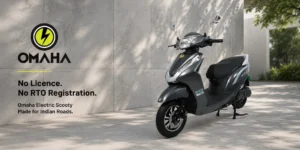
If the slow-speed rung is the right one, this is what that money gets. Omaha builds fifteen scooter models at our own plants in Hisar, Haryana and Burdwan, West Bengal, every one of them offered with a lead-acid or lithium battery — and that battery choice is what moves the price within the band more than any other feature.
Active Mini
Around ₹45k, lead-acidThe entry rung. Compact enough for Chandni Chowk lanes and a tight parking spot, which in older Delhi colonies matters more than any spec on the sheet.
Starling Neo
Around ₹50k–₹55kOur most-asked-for model in Delhi NCR. Anti-theft alarm and parking switch standard. Lead-acid charges in 6–8 hours, lithium in 3–5.
Active Pro
Around ₹55k–₹60kCentral locking and a reverse gear. The reverse earns its money the first time you back out of a crowded market row without dismounting.
Skylark Super
Around ₹58k–₹61kA 1200 W motor with heavy-duty suspension. If your route includes broken stretches or a daily flyover approach road, this is the one that will not punish your back.
The other eleven models — including the Drake 3 Wheel for riders who no longer trust their balance, and the Tezo GT with cruise control and USB charging — are on the electric scooters page, each with its own specification sheet. City-specific detail sits on our Delhi page.
Why we publish bands and not a single price. Omaha sells through dealers, and the final figure moves with your battery choice and what your dealer is running that month. The bands above are honest indications for Delhi in 2026, not a quotation. Any site that shows you one exact all-India price for a dealer-sold scooter is guessing — and the guess is usually the lead-acid figure being compared against somebody else’s lithium.
April 2028: the deadline that changes the question
There is a reason Delhi’s EV market is moving faster than the rest of the country, and it is not the subsidy.
Under the same policy, from April 2028 only electric two-wheelers may be newly registered in Delhi. New petrol and CNG two-wheeler registrations stop. Existing vehicles are not banned and can continue to be used under the applicable rules — but anyone buying a brand-new scooter in Delhi after that date will be buying an electric one, because that will be the only thing the RTO will register.
For a buyer today that reframes the whole decision. You are not choosing between petrol and electric as two live options with a long runway. You are choosing whether to switch now, with a subsidy that is at its highest in the policy’s first year and steps down twice after that, or to switch later on worse terms.
The clock, stated plainly
The purchase incentive falls from ₹10,000 per kWh to ₹6,600 and then to ₹3,300 across the policy’s first three years. On a 3 kWh scooter that is ₹30,000, then ₹20,000, then ₹10,000. Waiting has a price, and the policy has published exactly what it is.
What it costs to run one in Delhi
An average Delhi two-wheeler commute lands somewhere around 30 to 40 kilometres a day — home, office, a school run, a market trip. On a petrol scooter at current Delhi prices that is roughly ₹100 to ₹130 a day, so ₹3,000 to ₹4,000 a month before servicing.
On a slow-speed electric scooter, a full charge draws roughly 2.2 to 2.5 units and carries you 60 to 70 kilometres. At Delhi domestic tariffs that is around ₹15 to ₹18 a charge, which for most riders works out to ₹300 to ₹450 a month. There is no engine oil, no clutch plates, no exhaust and no pollution certificate.
But the honest number includes something the advertisements leave out.
The battery is a consumable, and it is the real running cost. A lead-acid pack typically needs replacing after two and a half to three years, and a replacement set runs somewhere in the region of ₹16,000 to ₹20,000. Spread across the kilometres you actually ride, that usually works out between ₹1 and ₹1.20 per kilometre — several times your electricity bill. Lithium costs more up front, lasts considerably longer and charges faster.
Our rough rule for Delhi buyers: under about 15 km a day, lead-acid is the cheaper total; above about 25 km a day, or if you have to carry the battery up to a second-floor flat, lithium wins over the life of the scooter. A great many Delhi buyers are in flats without ground-floor parking, which is why this question comes up here more than anywhere else we sell.
A Delhi situation we see constantly
A family in Uttam Nagar with one petrol scooter and two people who need to leave at the same time. They come in assuming they need a second full-size registered scooter and a second licence. What usually solves it is a slow-speed scooter in the ₹50,000–₹55,000 band, charged overnight from the flat, doing the eight-kilometre office run five days a week — while the petrol scooter keeps doing the weekend trip out on the highway. Nobody sits an RTO test, nobody argues at nine in the morning, and the household’s monthly fuel bill drops within the first month.
A composite illustration of a common enquiry pattern, not an individual customer’s account.
Before you buy an electric scooter in Delhi
- Decide which rung first, price second. Licence, route, distance and the three-year NOC question settle the rung. Comparing a ₹55,000 slow-speed scooter against a ₹1.05 lakh registered one on price alone tells you nothing.
- If you are buying registered, calculate your own subsidy. Battery capacity in kWh × ₹10,000, capped at ₹30,000 in Year 1. Do not accept “₹30,000 off” as a given.
- Get any subsidy claim in writing before payment, along with who files it and when the money is expected.
- If you are buying slow-speed, get the motor’s 30-minute rating on the invoice. Under 250 W is what makes it licence-free. A 1,000 W scooter software-limited to 25 km/h does not qualify, whatever the showroom says.
- Ask which battery you are being quoted for. An unusually low quote is almost always lead-acid being compared against someone else’s lithium.
- Confirm where you will charge it. In a Delhi flat this is the question that decides lead-acid versus lithium, and it is easier to answer before you buy than after.
- Test-ride with a pillion, on your own road, at the hour you actually travel.
See the models, and what they cost in Delhi
Fifteen scooters, each with full specifications and both battery options. Built at our own plants in Hisar and Burdwan — spares and service run on domestic supply chains, not an import cycle.
Frequently asked questions
What is the electric scooter price in Delhi in 2026?
Roughly ₹45,000 to ₹61,000 for a slow-speed scooter that needs no licence or registration, and roughly ₹75,000 to ₹1,21,000 ex-showroom for a registered high-speed model. Registered electric two-wheelers pay no road tax or registration fee in Delhi under EV Policy 2.0 and may claim a purchase subsidy of ₹10,000 per kWh capped at ₹30,000 in the policy’s first year.
What is the on-road price of an electric scooter in Delhi?
For a registered electric scooter, the on-road price is close to the ex-showroom price plus insurance, because Delhi waives road tax and registration fees for eligible battery electric vehicles through 31 March 2030. For a slow-speed scooter with no registration and no compulsory insurance, the on-road price is effectively the same as the ex-showroom price.
How much is the Delhi electric scooter subsidy?
₹10,000 per kWh of battery capacity, capped at ₹30,000, in the first year of the Delhi EV Policy 2026. It falls to ₹6,600 per kWh capped at ₹20,000 in year two and ₹3,300 per kWh capped at ₹10,000 in year three. The scooter’s ex-showroom price must not exceed ₹2.25 lakh, and it must be purchased and registered in Delhi.
Can I claim the Delhi subsidy on a no-licence electric scooter?
No. The purchase incentive is disbursed against a two-wheeler purchased and registered in Delhi. A slow-speed scooter under 250 W and 25 km/h is not a motor vehicle, so it is never registered and there is nothing for the incentive to attach to. It also never pays registration fees, road tax or compulsory insurance — so its price advantage does not depend on the subsidy. If any dealer promises you the subsidy on an unregistered scooter, get it in writing before paying.
Is there a scrapping bonus in Delhi?
Yes. Scrapping a Delhi-registered BS-IV or older two-wheeler at an authorised facility and buying a new electric two-wheeler within six months of the Certificate of Deposit carries an additional ₹10,000, paid by direct benefit transfer. This applies to registered electric two-wheelers.
Is it true that petrol two-wheelers cannot be registered in Delhi after 2028?
Under the Delhi Electric Vehicles Policy 2026, only electric two-wheelers may be newly registered in Delhi from April 2028. Existing petrol two-wheelers are not banned and may continue to be used in line with applicable regulations — the restriction is on registering new ones.
Can I take a subsidised electric scooter out of Delhi?
Not freely in the short term. A vehicle that has availed a purchase incentive under the policy is not eligible for a No Objection Certificate for transfer or re-registration outside Delhi for three years from the policy’s notification. If a move out of the city is likely, weigh that against the subsidy before claiming it.
What does an electric scooter cost to run in Delhi?
Electricity is roughly ₹15 to ₹18 for a full charge covering 60 to 70 km, so about ₹300 to ₹450 a month for a typical commute — against ₹3,000 to ₹4,000 on petrol. The cost most comparisons omit is battery replacement: a lead-acid pack usually needs replacing every two and a half to three years at roughly ₹16,000 to ₹20,000, which works out to about ₹1 to ₹1.20 per kilometre.
Where can I buy an electric scooter in Delhi?
Omaha sells through authorised dealers across Delhi NCR, and the network is expanding. Send your locality on WhatsApp or call and we will tell you the nearest showroom — and tell you plainly if there is not one close to you yet. Model details are on the electric scooters page and city-specific information on our Delhi page.
Lead-acid or lithium for a Delhi buyer?
Under about 15 km a day, lead-acid is usually the cheaper total across the ownership period. Above about 25 km a day, or where the battery has to be carried up to a flat to charge, lithium is worth the higher upfront cost — it lasts longer, charges in 3 to 5 hours rather than 6 to 8, and weighs far less. In Delhi the parking and charging question decides this more often than the kilometres do.
About this guide, and its limits
Written by the product team at Omaha Electric, a unit of JVG Electric Private Limited, which manufactures electric scooters and loaders at Mandi Adampur, Hisar, Haryana and at Burdwan, West Bengal. The buying patterns described here come from our own dealer and enquiry data across Delhi NCR.
We have an interest here. We manufacture slow-speed electric scooters and not registered high-speed ones, so weigh our view accordingly — and note that this page tells you plainly that our category cannot claim the Delhi subsidy, and sets out the four questions under which a registered scooter is the better buy.
Policy figures are not advice. Subsidy slabs, eligibility, portal processes and deadlines are set by the Government of NCT of Delhi and change. Prices for other brands are typical listed figures, not quotations, and are not endorsed by those manufacturers. Confirm current subsidy terms on the official Delhi Transport Department portal and current prices at a showroom before you buy.
Policy figures compiled August 2026 from reporting on the Delhi Electric Vehicles Policy, 2026, notified 30 June 2026 and effective 1 July 2026 to 31 March 2030. Questions about a specific model or a price in your area — contact us or message us on WhatsApp.