Most families compare an electric scooter and a petrol scooter the same way: by the price on the showroom tag. That is the one number that tells you least. A scooter is not bought once. It is paid for every week at the petrol pump or the plug point, every few months at the service centre, every year at the insurance renewal, and, with an electric scooter, every few years when the battery is due. Add all of that up over five years, and the comparison often looks completely different. This guide does exactly that, side by side, with a calculator you can fill in with your own numbers.
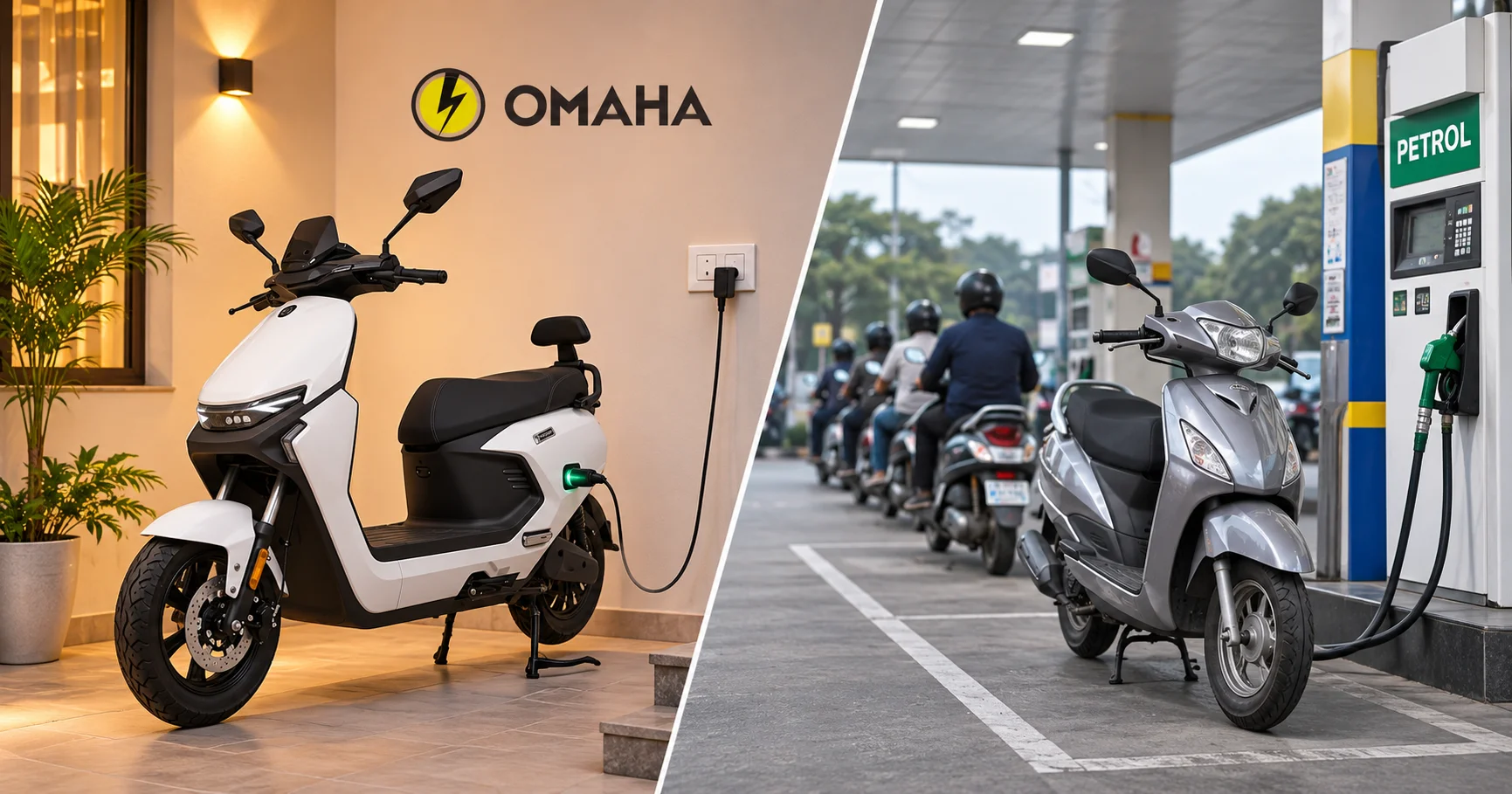
The short answer.
For short daily trips in town, an electric scooter usually costs far less to run than a petrol scooter. Electricity per kilometre is typically a fraction of petrol’s cost, there is no engine oil or PUC, and a low-speed model needs no registration, road tax or mandatory insurance. The main extra cost is a battery replacement every few years.
A petrol scooter still wins for highway trips, long distances and speeds above 25 km/h. So the honest answer to “is an electric scooter worth it?” depends on your route. Use the five-year calculator below with your own figures, then take a test ride on the roads you actually use.
Electric scooter vs petrol scooter: what you are really comparing
Before the numbers, an honest point that many comparisons skip. A low-speed electric scooter, the kind that needs no licence or registration, is limited to 25 km/h. A 110cc petrol scooter can do highway speeds and long distances with a five-minute refill.
So this is not a contest about which machine is “better”. It is a question of which one suits the riding you actually do. For the school run, the office commute across town, the mandi and the chemist, the two do the same job, and that is where the cost difference becomes real.
| Cost | Petrol scooter (110cc type) | Low-speed electric scooter |
|---|---|---|
| GST on the vehicle | 18% | 5% |
| Registration and road tax | Yes, varies by state | None |
| Driving licence | Required | Not required |
| Insurance | Mandatory, every year | Optional |
| PUC certificate | Every six months | Not needed |
| Daily running | Petrol | Electricity from a home socket |
| Routine maintenance | Engine oil, filters, spark plug, more moving parts | Mostly brakes and tyres |
| Big periodic cost | Major service items as it ages | Battery replacement every few years |
| Top speed | Highway capable | 25 km/h |
GST rates as revised from 22 September 2025: petrol scooters up to 350cc at 18% (earlier 28%), electric two-wheelers at 5%.
Electric vs petrol scooty: five years of costs, side by side
Fill in your own figures. Every value already in the boxes is only an example to get you started, so change the petrol price to your city’s rate, the electricity rate to the one on your bill, and the prices to the quotes you actually have.
Petrol scooter
Electric scooter
Totals include the purchase price. Electricity adds 10% for charging losses. Battery replacement figures are mid-points of market ranges, not Omaha prices. An estimate only: real costs depend on your city, riding, prices and how long parts last.
Electric scooter running cost per km, explained
Petrol
Petrol cost per kilometre is simply the price of a litre divided by the kilometres you get from it. Petrol has become expensive across India: recent pump prices are around ₹102 a litre in Delhi and above ₹110 in cities such as Indore and Jaipur. Our Indore cost guide shows what that means for a city commuter.
Electricity
Electricity cost per kilometre works the same way. Take the battery’s capacity in kWh, which your dealer can tell you, divide it by the kilometres you get per full charge, and multiply by your electricity rate per unit. Add a little for charging losses. Because a low-speed scooter uses very little energy per kilometre, the result is usually a small fraction of petrol’s figure.
Don’t forget the battery when you compare
The running cost per kilometre flatters electric scooters if you leave out the battery. A fair comparison includes replacement: lead-acid typically needs replacing every couple of years, lithium much less often. The calculator includes it, and our lead-acid vs lithium guide explains which suits your kilometres.
Electric scooter vs petrol scooter: the costs people forget
With a petrol scooter
- Insurance every year, which is mandatory, with 18% GST on the premium.
- PUC certificates every six months.
- Engine oil and filter changes, plus the parts an engine wears out over time.
- Price swings at the pump, which you can’t control or plan for.
With an electric scooter
- Battery replacement every few years, the biggest single cost.
- A safe charging spot near a proper socket at home.
- Optional insurance, which we still recommend for peace of mind.
- Range planning for longer days, since charging takes hours, not minutes.
From the showroom floor
A grocery shop owner in Hisar came in to replace his petrol scooter completely. When we talked through his week, most of it was local: home to shop, shop to the wholesale market, school pick-up. But twice a month he rode to a supplier 40 km away on the highway. We suggested he keep the old petrol scooter for those trips and use the electric one for everything else. A year later, he told us the petrol scooter now gets filled about once a month.
Is an electric scooter worth it for you?
- Most of your riding is within town or colony roads.
- Your daily round trip fits comfortably within one charge.
- You can charge at a safe socket at home.
- You ride most days, so running savings add up.
- The rider has no licence, or you want to avoid registration and road tax.
- Your route includes highways, bypasses or fast roads.
- You regularly ride long distances in one go.
- You have nowhere safe to charge.
- You ride only occasionally, so savings build up slowly.
- You need speeds above 25 km/h.
Don’t take a low-speed scooter onto highways or fast roads to “save petrol”. At 25 km/h among much faster traffic, the risk is real. If your daily route needs highway speeds, a low-speed scooter is the wrong vehicle for that route.
What about resale and the long term?
Petrol scooters have a long-established second-hand market. For electric scooters, resale value depends heavily on the battery’s condition, so keep service and battery records. A scooter with a recently replaced battery and a clean service history is easier to sell.
Over the long term, the electric scooter’s advantage is less exposure to petrol prices. Electricity tariffs also change, but a low-speed scooter uses so little energy that a rise in rates moves the total far less than a rise at the pump.
From the showroom floor
A retired couple in Jaipur were comparing an electric scooter with a used petrol one at a similar price. They had assumed the used petrol scooter was the cheaper choice. Once they added insurance renewals, PUC, servicing and petrol for their daily temple and market trips, the electric scooter came out ahead within a couple of years, even after allowing for a battery replacement. What decided it for them, though, was that neither of them had a licence.
The “From the showroom floor” stories are composite illustrations of common enquiry patterns, not individual customers’ accounts.
Before you decide: a comparison checklist
- Your real daily kilometres — and how many of them are on fast roads.
- Your city’s petrol price and the mileage you actually get today.
- Your electricity rate from a recent bill.
- Both quotes in writing — on-road for petrol, final for electric, with the battery you want.
- Battery plan — lead-acid or lithium, and what replacement will cost.
- A safe charging spot at home.
- A test ride on your own route.
Put your own route to the test
Run your numbers above, then ride an Omaha scooter on roads like yours before deciding.
Conclusion: compare five years, not one price tag
Comparing an electric scooter vs petrol scooter on the showroom price alone misses most of the story. Over five years, petrol, insurance, PUC and servicing add up steadily, while an electric scooter’s main extra is the battery. For local, everyday riding, that usually tips the total in the electric scooter’s favour, often by a wide margin.
But the right choice is the one that fits your roads. If your riding is mostly in town, run your numbers, look at the Omaha price list, and take a test ride. If you are weighing a familiar petrol model, our guide to the electric Activa question may also help.
Frequently asked questions
Is an electric scooter cheaper than a petrol scooter?
For short, everyday trips in town, an electric scooter is usually cheaper to own over several years. Electricity costs far less per kilometre than petrol, maintenance is simpler, and a low-speed model needs no registration, road tax or mandatory insurance. The main extra cost is replacing the battery every few years.
What is the electric scooter running cost per km?
Divide the battery’s capacity in kWh by the kilometres you get per full charge, multiply by your electricity rate per unit, and add a little for charging losses. For a low-speed scooter, this is usually a small fraction of a petrol scooter’s cost per kilometre.
Is an electric scooter worth it in India?
It is usually worth it if most of your riding is local, your daily trip fits within one charge, you can charge safely at home and you ride most days. It is not the right choice if your route needs highway speeds or long distances in one go.
How do electric and petrol scooters compare over five years?
Over five years, a petrol scooter’s costs build steadily through petrol, insurance, PUC and servicing. An electric scooter costs less to run each day, with battery replacement as the main extra. For daily local riding, the electric scooter typically comes out ahead. Use the calculator in this guide with your own figures.
Do electric scooters cost less to maintain than petrol scooters?
Generally, yes. An electric scooter has no engine oil, filters or spark plug, so routine care is mostly brakes and tyres. The battery is the one major part you can expect to replace over the years.
What GST is charged on electric and petrol scooters?
From 22 September 2025, petrol scooters up to 350cc attract 18% GST, down from 28%. Electric two-wheelers attract 5% GST.
Which costs does a low-speed electric scooter avoid?
A low-speed electric scooter with a motor rated up to 250 W and a top speed up to 25 km/h needs no driving licence, registration, number plate, road tax or PUC certificate, and insurance is optional. A petrol scooter needs all of these.
Can an electric scooter fully replace a petrol scooter?
For riders whose trips are all local and within one charge, yes. If you regularly ride on highways, need speeds above 25 km/h or travel long distances in one go, a low-speed electric scooter cannot replace a petrol scooter for those trips. Some households keep both.
Does battery replacement cancel out the savings?
Usually not, for regular daily riders. Battery replacement is a real cost and should always be included in a comparison, but for most local riders the savings on petrol, insurance, PUC and servicing over several years are larger. The calculator lets you check with your own numbers.
About this guide, and its limits
Written by the product team at Omaha Electric, a unit of JVG Electric Private Limited, which manufactures electric scooters and loaders in Hisar, Haryana. We make electric scooters, so weigh our view accordingly, and note that this guide says plainly when a petrol scooter is the better choice.
About the figures. Petrol prices are recent published retail rates and change often. GST rates are as revised from 22 September 2025. Every value in the calculator is an example input; battery replacement figures are mid-points of market ranges, not Omaha prices. Use your own city, quotes and bills for a real comparison.
Not financial advice. This guide helps you compare costs; the decision is yours.
About the stories. The “From the showroom floor” examples are composite illustrations of common enquiry patterns, not individual customers’ accounts.
Questions — contact us, message us on WhatsApp, or book a test ride.