Three completely different buyers type “electric Activa price” into Google. Only one of them wants Honda. This guide sorts out which one you are, gives you the real 2026 numbers for each path, and is honest about where a low-speed electric scooter is the wrong answer.
The short version, before you scroll.
Yes, Honda makes an electric Activa. It is called the Activa e: and it costs roughly ₹1.17–1.20 lakh ex-showroom for the Standard variant and about ₹1.52 lakh for the RoadSync Duo — and that price does not include the batteries, which you rent monthly. It is also only sold in a handful of cities.
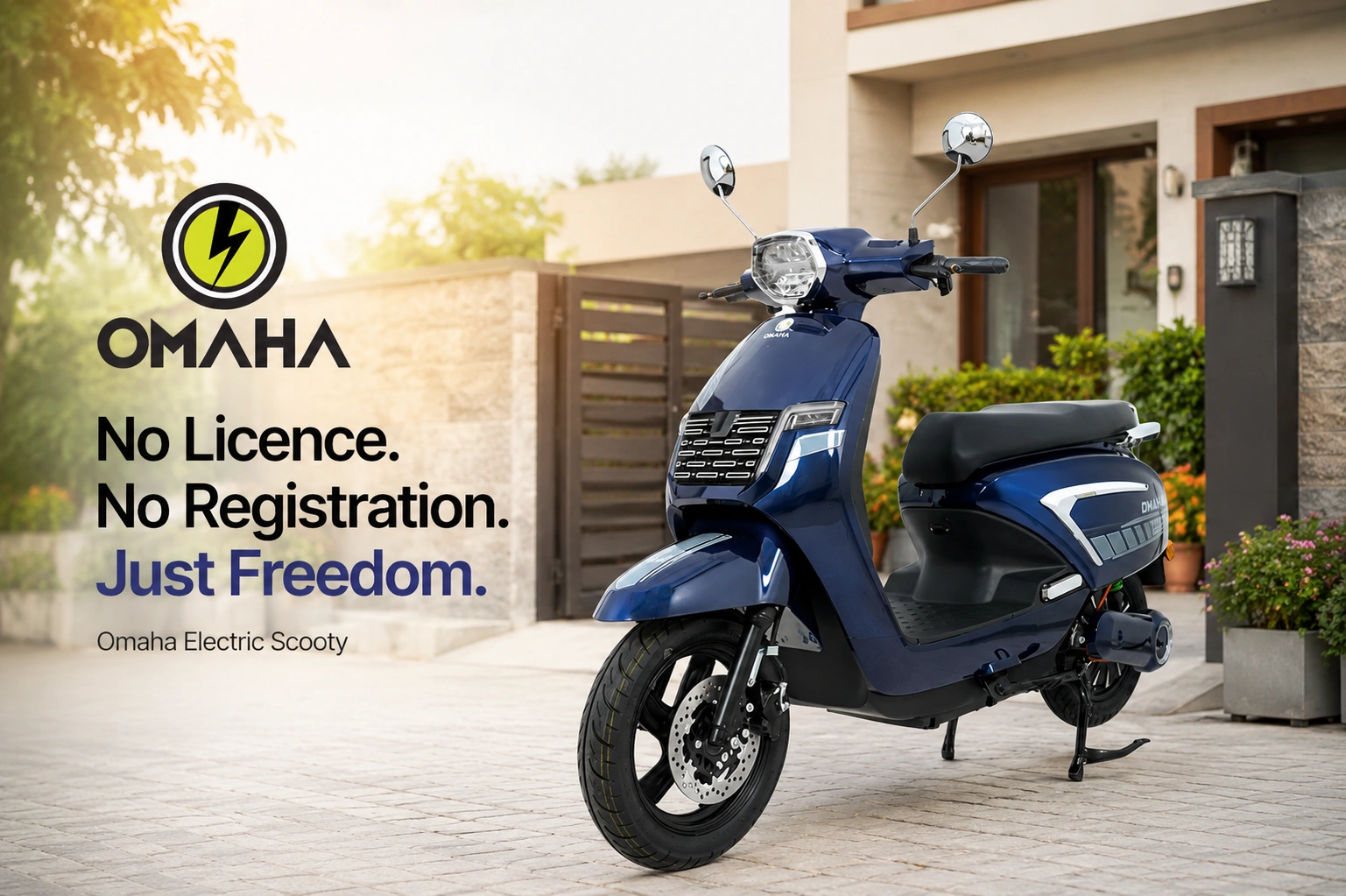
If you are searching “electric Activa price” because you want an Activa-style scooter that runs on a battery — a step-through family scooty, easy to ride, no petrol pump — that is a different product and a different price bracket entirely: roughly ₹30,000 to ₹75,000, no licence, no RTO. Omaha builds fifteen of them. Both paths are explained below.
Three people search “electric Activa price”. They want three different things.
Over the last two years we have taken thousands of walk-in and WhatsApp enquiries at our Hisar plant and through our dealers. When somebody opens the conversation with “electric Activa ka price kya hai”, they almost always fall into one of three groups — and the three want products that are ₹90,000 apart.
The Honda buyer. This person has read a news article about the Activa e: and wants the actual Honda product. Small group, but they know exactly what they want. They should read the next section and then go to a Honda dealer.
The “battery wali Activa” buyer. This is the largest group by far. For most Indian households, “Activa” stopped being a model name a decade ago and became the generic word for a step-through, gearless, family scooter — the way “Colgate” means toothpaste. When this person says “electric Activa”, they mean an Activa-shaped scooter that charges at home. They do not care about the Honda badge. They care about seat height, floorboard space, whether a bag of sabzi fits, and the price.
The no-licence buyer. A parent buying for a 16-year-old. A 62-year-old who never took a licence. A shopkeeper who wants a second vehicle for short runs and does not want to deal with the RTO. This person has usually already discovered that there is a legal category of electric scooter that needs no licence and no registration, and is trying to find out what it costs.
Google shows all three the same results, which is why the search is so confusing. Let us separate them properly.
Path one: the Honda Activa e: — the real price, and the part the price tag hides
Honda Motorcycle & Scooter India launched the Activa e: at the end of 2024, with deliveries starting in 2025. It is a genuine high-speed electric scooter: a 6 kW motor, 22 Nm of torque, 0–60 km/h in around 7.3 seconds, a claimed range of about 102 km and a top speed of 80 km/h. It runs on two swappable 1.5 kWh battery packs.
| What you pay | Standard | RoadSync Duo |
|---|---|---|
| Ex-showroom (approx.) | ₹1.17–1.20 lakh | ₹1.52 lakh |
| On-road, Delhi (approx.) | ₹1.23 lakh | ₹1.55 lakh+ |
| Batteries included? | No. Batteries are owned by Honda’s energy arm and rented on a monthly subscription. | |
| Monthly battery plans | From roughly ₹678 + GST on the entry “Lite” plan (about 600 km a month), rising to roughly ₹2,000 and ₹3,600 + GST on the higher-usage plans. | |
| Home charging | Not supported. You must visit a battery-swap station. | |
| Where you can buy it | Phased rollout — began with Bengaluru, then Delhi NCR and Mumbai, tied to swap-station coverage. | |
Figures compiled August 2026 from publicly listed ex-showroom prices and Honda’s published subscription plans. Prices vary by city, variant and dealer, and Honda revises them. Confirm at a Honda dealership before you buy.
Now the part that matters more than the sticker price. The Activa e: is built on a battery-as-a-service model. You buy the scooter; you do not own the batteries. Every month you pay a subscription, and when the charge runs down you ride to a Honda e:Swap station and exchange the packs — which takes under a minute, and is genuinely clever engineering.
The catch is geographic. That whole system only works where the swap stations are. Honda’s build-out has been focused on Bengaluru, Delhi and Mumbai, with a target of around 500 stations across those three cities. If you live in Hisar, Rohtak, Sirsa, Bhiwani, Burdwan or the several hundred other Indian towns where most scooters are actually sold, there is currently no swap network — and because the scooter has no home-charging option, that is not an inconvenience you can work around. It is a hard stop.
The honest maths on running cost. A subscription only makes sense if your riding matches the plan. On the entry plan at roughly ₹678 + GST for about 600 km, you are paying around ₹1.30 per kilometre — competitive. But if you buy a higher plan and then ride only 400 km in a month, the same scooter can cost you ₹8–10 per kilometre. A petrol Activa at a real-world 45–48 kmpl costs roughly ₹2 per kilometre. Match the plan to your actual usage, not your optimistic usage.
Why the petrol Activa price keeps pulling people back
A standard petrol Activa 6G sits at roughly ₹76,000 to ₹92,800 ex-showroom depending on variant, landing around ₹89,000 to ₹1.05 lakh on-road. So the electric Activa is not a cheaper Activa. It is roughly ₹30,000–₹40,000 more expensive up front, plus a monthly battery bill, in exchange for lower per-kilometre energy cost and no engine servicing.
That equation works beautifully for a Bengaluru delivery rider covering 80 km a day within a dense swap network. It works poorly for a household in a tier-2 or tier-3 town covering 12 km a day. And that second household is the overwhelming majority of scooter buyers in this country. Which brings us to the group most of you actually belong to.
Path two: what “electric Activa” usually means — and what it costs
If what you want is a scooter that looks and sits like an Activa but runs on a battery you charge at home from a normal 5-amp plug point, you are shopping in a completely different category — and a much cheaper one. In 2026 this category runs from roughly ₹30,000 at the entry end to about ₹75,000 for a well-equipped lithium model.
The reason it is that much cheaper is not that the scooters are flimsy. It is that they sit on the other side of a legal line — and that line changes what you pay before you even reach the showroom.
The 25 km/h line, explained once, properly
Under the Central Motor Vehicles Rules, an electric two-wheeler is not treated as a motor vehicle at all if it meets two conditions simultaneously:
- a 30-minute continuous motor rating below 250 watts, and
- a maximum speed below 25 km/h.
Meet both and the vehicle is legally closer to a bicycle. No driving licence. No RTO registration. No number plate. No road tax. No mandatory third-party insurance. Anyone 16 or older can ride it. This exemption has been in the rulebook since the early 2000s and, as of 2026, it still stands.
Both conditions, not one. This is where buyers get cheated. A scooter with a 1,000 W motor that has been software-limited to 25 km/h is not exempt — the motor rating already disqualifies it. Equally, a genuine 250 W motor on a scooter that can touch 40 km/h is not exempt either. If a seller waves off the question, walk out. Ask to see the CMVR test report and get the motor rating written on your invoice.
In practice 25 km/h is less limiting than it sounds inside a town. Peak-hour traffic in most Indian cities averages somewhere between 17 and 20 km/h. On a school run, a market trip or a 6 km commute through Hisar or Bardhaman, a 25 km/h scooter is not slowing you down — the traffic already is. On an open state highway, it absolutely is a constraint, and we say so plainly further down.
Omaha electric scooty price bands — what our range actually costs
We build fifteen electric scooters and two electric loaders at our own plants — Mandi Adampur in Hisar, Haryana, and Burdwan in West Bengal. Every scooter in the range is offered with a choice of lead-acid or lithium-ion batteries, and that single choice moves the price more than any other feature on the spec sheet.
We will be straight with you about pricing, because the internet is full of Omaha scooter price pages written by people who have never seen one, and a fair number of Omaha EV listings on third-party sites carry numbers we have never quoted. We do not publish a fixed all-India MRP. Omaha sells through dealers, and the final figure depends on the battery you pick, your state, and what your dealer is running that month. What we can give you honestly is the band each tier sits in.
| Tier | Models | Indicative price band |
|---|---|---|
| Compact / first scooter | Active Mini, Canary | ₹42,000 – ₹55,000 |
| Everyday family step-through | Starling Neo, Starling Round, Chetak, Drake | ₹48,000 – ₹63,000 |
| Feature-loaded | Active Pro, Dash Plus, Dash Pro, Tezo, Tezo GT, Starling Pro | ₹55,000 – ₹72,000 |
| Comfort / heavy-duty ride | Skylark, Skylark Super | ₹58,000 – ₹75,000 |
| Three-wheel stability | Drake 3 Wheel | On request — configuration-dependent |
Indicative bands only, valid for 2026 and not a quotation. Lower end of each band is typically the lead-acid configuration; upper end is lithium. Your dealer’s on-road figure is the one that counts. See the full range on the Omaha electric scooters page or ask us directly.
Set that against the Honda number and the gap is stark: an Omaha electric scooty at ₹55,000 on-road, ridden with no licence and no registration, against an Activa e: at ₹1.23 lakh on-road plus a monthly battery bill and a swap station you may not have. They are not competitors. They are answers to different questions.
Which Omaha electric scooter models come closest to an Activa
People shortlisting Omaha electric scooter models usually start from shape rather than spec, and that is the right instinct. If the Activa shape is what you are after — flat floorboard, step-through frame, upright seating, room for a pillion and a bag — these are the four we would put in front of you first.
Active Pro
Closest to the Activa feelFull-size step-through with central locking and a reverse gear — the reverse is genuinely useful when you are backing out of a tight gali or a crowded parking row. Lead-acid or lithium.
Skylark Super
Best ride qualityA 1200 W motor with heavy-duty suspension. If your daily route includes broken road, speed breakers or a canal-side stretch, this is the one that will not rattle your back.
Starling Neo
The everyday pickOur most-asked-for model. Anti-theft alarm and parking switch as standard. Charges in 6–8 hours on lead-acid, 3–5 hours on lithium. Straightforward, no fuss.
Tezo GT
For the younger riderSharper styling, cruise controller and USB charging on the Tezo line. This is the one teenagers actually ask for by name, which matters more than you would think.
The other eleven — including the Drake 3 Wheel, which we make for riders who do not trust their balance any more — are all on the electric scooters page, each with its own specification sheet.
The running cost nobody puts in the brochure
Every electric scooter advertisement in India quotes you electricity cost and stops there. That is the easy, flattering half of the number. Here is the whole thing.
Electricity is genuinely trivial. A full charge on a typical lead-acid Omaha draws roughly 2.2–2.5 units. At around ₹7 a unit, that is ₹16–18 for a charge that carries you 60–70 km. Call it ₹250–₹300 for every 1,000 km. A petrol Activa over the same 1,000 km, at a real-world 47 kmpl, costs somewhere near ₹2,000. That part of the pitch is true.
The battery is the real running cost. A lead-acid pack is a consumable. Depending on how you charge it and how deeply you drain it, expect two and a half to three years before it needs replacing, and budget in the region of ₹16,000–₹20,000 for a new set. Spread that across the kilometres you actually rode, and it usually works out somewhere between ₹1 and ₹1.20 per kilometre — several times your electricity bill.
Lithium costs considerably more up front but typically lasts far longer, charges faster and weighs a fraction as much. The rough rule we give buyers at the plant: if you ride under 15 km a day, lead-acid is the cheaper total; if you ride more than 25 km a day, or you have to carry the battery up stairs, lithium wins over the life of the scooter.
How to read these numbers
The figures above are worked illustrations using 2026 electricity and battery-replacement costs, not a guarantee. Your actual cost depends on tariff, riding style, load, terrain and how disciplined you are about charging. We would rather you saw the honest arithmetic than a marketing figure that falls apart in year three.
Three situations we see constantly — and what we actually recommend
Abstract advice helps nobody. These are the three enquiry patterns that come through our dealer network most often, written up as they usually play out.
The Class 11 student and the 4 km school run
A parent comes in wanting to stop doing two drop-offs a day. The child is 16, has no licence, and will not have one for two years. School is 4 km away, all inside town. Here the low-speed category is not a compromise — it is the only legal option, and it happens to also be the cheapest one. A compact model like the Active Mini in lead-acid does the job for well under ₹50,000, and the daily electricity cost is less than a cup of tea. The conversation we do have with these parents: buy a helmet on day one even though the law does not force you to, and set a rule that the scooter does not go on the bypass.
The 58-year-old shopkeeper who never took a licence
Runs a shop, needs to move between the shop, the bank and the wholesale market — maybe 10 km on a busy day, all within a two-kilometre radius. He has been managing on a cycle and a nephew’s bike. For him the deciding features are not speed but a low seat, a wide floorboard for a carton, and a reverse gear so he can back out of the market lane without dismounting. That points at the Active Pro or Dash Plus. If his balance is not what it was, we suggest he test-ride the three-wheel Drake before deciding.
The couple with one Activa and one problem
Both work. One petrol Activa between them, and every morning is a negotiation. They come in looking for a second vehicle and start by asking about the electric Activa price, assuming it will be cheaper than a second petrol scooter. It is not — the Honda is dearer, needs a swap network they do not have, and their town has none. What actually solves their problem is a second scooter in the ₹55,000–₹65,000 band that charges overnight at home. The petrol Activa keeps doing the highway trips to the in-laws; the Omaha does the 8 km office run five days a week. Total household fuel spend drops noticeably within the first month, and nobody argues at 9 a.m.
These are composite illustrations drawn from common enquiry patterns across our dealer network, not individual customer testimonials.
When a low-speed electric scooter is the wrong buy
We would rather lose a sale than have a scooter sitting unused in someone’s courtyard. Do not buy in this category if any of the following is true for you:
- You ride on highways or bypasses. A 25 km/h vehicle on a road with a 40 km/h minimum is unsafe and, in some stretches, not permitted. This is not a rule to work around.
- Your daily distance regularly exceeds the range. With no charging point at the other end, a 45 km day on a 60 km scooter turns into anxiety very quickly. Be realistic about your worst-case day, not your average one.
- You need to carry two adults plus load up an incline, every day. The category can do it occasionally. Doing it daily will shorten your battery life.
- You want resale value like a petrol Activa’s. The used market for petrol Activas is deep and predictable. The used market for low-speed EVs is thin and battery-condition-dependent. Buy this to use, not to flip.
- There is no service support near you. Ask before you pay: who fixes it, where, and how long a battery replacement takes to arrive. If the dealer cannot answer that in one sentence, that is your answer.
If two or more of those apply, buy the petrol Activa, or buy a registered high-speed EV and get the licence. We will still be here when your situation changes.
Before you pay: the seven-point check
This applies whether you buy from us or from anybody else. Print it, or keep it open on your phone at the showroom.
- Get the motor’s 30-minute rating in writing on the invoice — not the peak rating the brochure shows. Below 250 W is what makes it licence-free.
- Ask which battery you are being quoted for. A price that looks unusually low is almost always a lead-acid quote being compared against someone else’s lithium.
- Ask for the battery warranty in months and in kilometres, and what specifically voids it.
- Confirm charging time and the plug type. Lead-acid runs 6–8 hours, lithium 3–5. If you have no plug point where you park, solve that before you buy the scooter.
- Test-ride with a pillion, not alone. The scooter feels completely different with a second person on it, and that is how you will actually use it.
- Ask where the nearest service point is and how spare batteries are sourced.
- Keep the invoice safe. With no RC book in this category, your invoice is your proof of ownership.
See the actual scooters, not just the price bands
Fifteen models, each with its own specification sheet, battery options and feature list. Built at our own plants in Hisar and Burdwan.
Frequently asked questions
Is there an electric Activa in India, and what is the price?
Yes. Honda’s Activa e: is the official electric Activa. As of August 2026 it is priced at roughly ₹1.17–1.20 lakh ex-showroom for the Standard variant and about ₹1.52 lakh for the RoadSync Duo. That price excludes the batteries, which are rented on a monthly subscription starting from around ₹678 plus GST. Availability is limited to cities with Honda’s battery-swap network.
Can I charge the Honda Activa e: at home?
No. The Activa e: is designed around battery swapping rather than home charging — you exchange depleted packs at a Honda e:Swap station. That is quick where the stations exist, but it means the scooter is not practical in towns without a swap network. Omaha’s scooters, by contrast, charge from an ordinary household plug point.
What is the cheapest electric Activa-style scooter in India?
If you mean a step-through, Activa-shaped electric scooty, the low-speed licence-free category starts around ₹30,000 nationally in 2026 and runs to about ₹75,000 for well-equipped lithium models. Omaha’s own range sits roughly between ₹42,000 and ₹75,000 depending on model and battery type. These are indicative bands — your dealer’s on-road figure is the one that counts.
Do I need a licence or registration for an Omaha electric scooter?
Omaha’s scooters are built to the low-speed specification — under 250 W continuous motor rating and under 25 km/h — which under the Central Motor Vehicles Rules means no driving licence, no RTO registration, no number plate, no road tax and no mandatory third-party insurance. Riders must be at least 16. Always ask for the motor rating in writing on your invoice, from any brand.
Lead-acid or lithium — which should I choose?
As a rough guide: under about 15 km of riding a day, lead-acid usually works out cheaper across the ownership period despite needing replacement every two-and-a-half to three years. Above about 25 km a day, or if you need to carry the battery indoors to charge, lithium is worth the higher upfront cost — it lasts longer, charges in 3–5 hours instead of 6–8, and weighs far less.
How far does an Omaha electric scooty go on one charge?
Real-world range depends on the model, the battery configuration, rider weight, terrain and how much stop-start riding you do. Rather than quote a single flattering number, we list charging times and battery options on each product page — see the electric scooters range — and we encourage a test ride with a pillion before you decide.
Who makes Omaha electric scooters?
Omaha Electric is a unit of JVG Electric Private Limited, with manufacturing plants at Khairampur Road, Mandi Adampur, Hisar, Haryana, and at GT Road, Burdwan, Bardhaman, West Bengal. The brand is sometimes searched as “JVG Electric Omaha” for that reason. You can read more on our manufacturing units page.
Is an electric scooter cheaper to run than a petrol Activa?
On energy alone, decisively — roughly ₹250–₹300 per 1,000 km against roughly ₹2,000 for a petrol Activa at real-world mileage. But battery replacement is a real cost that most comparisons omit. Once you factor a lead-acid pack replacement into the per-kilometre figure, the honest saving is smaller than advertisements suggest, though still substantial for typical town riding.
About this guide
Written by the product team at Omaha Electric, a unit of JVG Electric Private Limited, which has manufactured electric scooters and loaders at Mandi Adampur, Hisar since the brand’s launch, alongside a second plant at Burdwan, West Bengal. The buying patterns described here come from our own dealer and enquiry data.
Where we have an interest, we have said so. We sell low-speed electric scooters, so treat our view of that category accordingly — and note that we have also spelled out five situations in which you should not buy one from us. Honda pricing and specification figures are drawn from publicly listed information as of August 2026 and are not endorsed by, or sourced from, Honda. All prices move; confirm before you buy.
Questions about a specific model or a price in your city — contact us, message us on WhatsApp, or if you are looking to sell rather than buy, see dealer registration.