Every shop owner who asks us about an electric loader starts with the same question: “Kitne ka hai?” It is the right question, but it is only half of one. The other half is what you are spending today to move your goods. The tempo you hire by the trip. The diesel your own vehicle drinks while it stands in a market queue. The deliveries you turn down because there is no one free to take them. Put those next to the electric loader price, and the decision stops being about cost and starts being about how many months it takes to earn the loader back. This guide works through both halves.
The short answer.
Across the market, electric loading rickshaws typically cost about ₹1.6 to ₹2.2 lakh with lead-acid and ₹2.4 to ₹3.1 lakh with lithium, while larger city electric goods carriers run to about ₹3.2 to ₹4.5 lakh. Registration, insurance and accessories usually add ₹15,000 to ₹30,000 on-road. Electric vehicles carry 5% GST.
Running costs are where the money comes back. On short city rounds, charging typically costs around ₹1 a kilometre against roughly ₹8 a kilometre in diesel for a small tempo. For Omaha’s Loader 2 Tyre and Loader 3 Tyre, ask your dealer for a written on-road quote, then put it into the payback calculator below.
Electric loader price in India: what you are actually buying
“Electric loader” covers a wide range of vehicles, which is why prices quoted online jump around so much. Before you compare numbers, make sure you are comparing the same kind of vehicle.
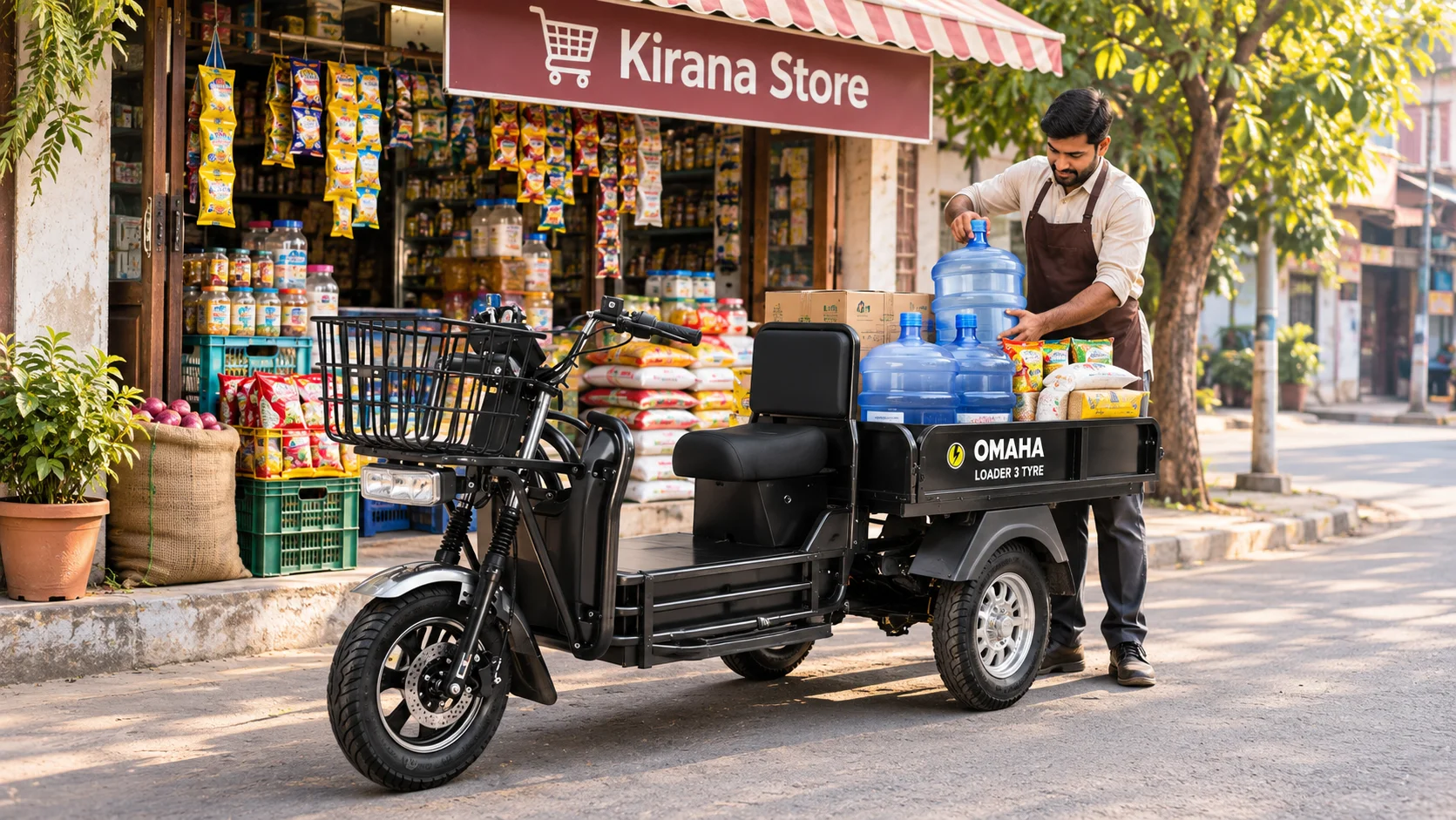
Omaha makes the first two: the Loader 2 Tyre and the Loader 3 Tyre, rated for around 300 kg and 350 kg respectively. Both come with a choice of lead-acid or lithium battery.
Battery loader rickshaw price: market ranges
| Type | Typical payload | Indicative price |
|---|---|---|
| Electric loading rickshaw, lead-acid | About 350 – 450 kg | ₹1.6 – 2.2 lakh |
| Electric loading rickshaw, lithium | About 400 – 500 kg | ₹2.4 – 3.1 lakh |
| City electric goods carrier, lithium | About 500 – 600 kg | ₹3.2 – 4.5 lakh |
| On-road extras | Registration, insurance, accessories | ₹15,000 – 30,000 |
Indicative market ranges, not Omaha prices. Final on-road figures depend on variant, deck size, battery capacity and location. Always ask for a written on-road breakup.
What moves the e-loader price up or down
- Battery chemistry. Lithium costs more upfront, but is lighter, charges faster and usually lasts much longer under hard daily use.
- Battery capacity. More kWh means more range, and a higher price.
- Payload and build. A stronger chassis, bigger deck and heavier suspension cost more.
- Body type. Open deck, high-side box or closed container changes the price.
- Paperwork. Registration and insurance add to the on-road figure.
What a shop owner earns back: the payback calculator
Pick what you do today, then enter your own numbers. Every value already filled in is only an example, so replace each one with your real figures.
Your work
What it costs today
Electric loader
A simple payback estimate: on-road price divided by monthly saving. It does not include loan interest, resale value, or a battery replacement in later years, so leave room for those. Running-cost defaults reflect typical light goods-carrier figures on short city rounds.
The earning side most shop owners miss
Savings are only half of the return. With your own loader, you can offer home delivery, take bulk orders from nearby shops, or run the morning supply round yourself instead of waiting for a hired tempo. Many owners find those extra orders matter as much as the fuel saving.
From the showroom floor
A kirana and water-can supplier near Hisar was paying a tempo by the trip for his morning round of about 30 societies. He wanted to know one thing: how many months until the loader paid for itself. We sat down with his last month’s hire bills. On his numbers, it came to well under a year. What he hadn’t expected was the evening: with the loader free after the morning round, his son started doing home deliveries, which brought in orders he had been turning away for years.
Running cost: electric loader vs diesel tempo
| What you pay | Small diesel tempo | Electric loader |
|---|---|---|
| Fuel or charging, per km | About ₹8.00 – 8.50 | About ₹0.85 – 1.10 |
| Upkeep, per km | About ₹1.20 – 1.60 | About ₹0.30 – 0.50 |
| Idling in a market queue | Burns fuel | Draws almost nothing |
| Oil, clutch, filters | Regular | None |
| Big planned cost | Engine wear as it ages | Battery replacement |
Illustrative estimates for a light city goods carrier on short rounds. Actual costs vary with payload, route, tariff and vehicle condition. See a full city example in our electric loader in Surat guide.
Lead-acid or lithium for a commercial loader?
For a loader that works hard every day, lithium usually wins over its life. Lead-acid saves money upfront, but heavy commercial use can wear it out quickly, sometimes within a year or two, while lithium typically lasts several years. If your loader does short, light rounds and charges at a ground-floor socket, lead-acid can still make sense. Our lead-acid vs lithium guide explains the trade-off.
Payload, range and charging: reading the spec sheet honestly

Payload
Rated payload assumes an even load on a flat road. For daily work, plan on loading a little below the rated figure, around 85 to 90%, especially with tall stacks that shift the centre of gravity. The vehicle, the motor and the battery will last far longer.
Range
Advertised range is usually measured unloaded at a steady speed. Fully loaded, with frequent stops, expect noticeably less. For most local routes that still covers a full working day, but plan with a buffer.
Charging
Omaha loaders charge in about 3 to 5 hours with lithium and 6 to 8 hours with lead-acid, so overnight charging at your shop or godown covers both. Use a dedicated, properly earthed socket, never a loose extension board.
Overloading “just this once” is the fastest way to ruin a loader. Repeated overloading strains the motor, controller, brakes and battery, and can void your warranty. If your loads keep growing, move up a size rather than pushing the vehicle past its rating.
Paperwork for an electric loader
This is where loaders differ from Omaha’s low-speed scooters. A goods vehicle, and especially a three-wheel loader with a motor above the low-speed limit, usually needs registration, insurance and the right driving licence for that category. Typical documents include PAN, Aadhaar, address proof and GST details if you are buying in your firm’s name.
Confirm the paperwork before you pay. Rules for battery-operated goods vehicles, permits and any incentives vary by state and change over time. Ask your dealer exactly what your chosen model needs, and check with your local RTO.
Who earns back fastest
- Kirana and FMCG distributors running fixed daily rounds to shops and societies.
- Water-can and packaged goods suppliers, with heavy loads, short distances and many stops.
- Dairy and vegetable morning runs, where an early, quiet start suits the neighbourhood.
- Textile and parcel traders moving consignments between markets and godowns.
- Hardware and building-material shops making short local deliveries.
- Last-mile courier partners paid by the delivery, where cost per trip decides profit.
From the showroom floor
A hardware shop owner in Jaipur came in sure he needed the biggest loader he could afford. When we looked at his real orders, most were bags of cement, pipes and fittings for houses within a few kilometres. He took a three-wheel loader on a loaded test run down his own lane, found it turned where a tempo could not, and decided the smaller vehicle suited his business better. The money he saved on the purchase went into lithium.
The “From the showroom floor” stories are composite illustrations of common enquiry patterns, not individual customers’ accounts.
Buying checklist
- Written on-road price — for both battery options, with registration and insurance broken out.
- Loaded test run — with your real goods, on your real route, including your tightest lane.
- Payload in writing — and what the warranty says about overloading.
- Battery warranty — period, terms and replacement cost.
- Local service — nearest service point and spare-parts availability.
- Paperwork confirmed — registration, insurance and licence needs for your model.
- Charging point ready — a dedicated, earthed socket at the shop or godown.
Get a loader quote you can calculate
See Omaha’s loaders, ask for a written on-road quote, and put it into the payback calculator.
Want to sell electric loaders?
Local businesses in towns across India need affordable goods transport. If you want to become an Omaha dealer, start with our dealer registration page.
Conclusion: price is the start, payback is the answer
The electric loader price is a real number, and it is higher than a scooter’s. But for a shop owner, the better question is how quickly the loader earns that price back. On short, repeating city rounds, charging costs a fraction of diesel or hired trips, upkeep is lower, and the loader opens up deliveries you could not do before.
Match the loader to your real loads, lean towards lithium if you run hard every day, confirm the paperwork and local service before you pay, and plan for the battery in later years. Then run your own numbers through the calculator. For most busy local businesses, the payback arrives sooner than they expect.
Frequently asked questions
What is the electric loader price in India?
Across the market, electric loading rickshaws typically cost about ₹1.6 to ₹2.2 lakh with lead-acid and ₹2.4 to ₹3.1 lakh with lithium, while larger city electric goods carriers run to about ₹3.2 to ₹4.5 lakh. Registration, insurance and accessories usually add ₹15,000 to ₹30,000. For Omaha loaders, ask your dealer for a written on-road quote.
What is the battery loader rickshaw price with lithium?
A lithium electric loading rickshaw typically costs about ₹2.4 to ₹3.1 lakh, compared with about ₹1.6 to ₹2.2 lakh for lead-acid. Lithium costs more upfront but usually lasts much longer under hard commercial use.
What does an electric loader cost to run per km?
On short city rounds, charging typically costs around ₹0.85 to ₹1.10 per km, with upkeep of about ₹0.30 to ₹0.50 per km. A small diesel tempo usually costs about ₹8 to ₹8.50 per km in fuel alone.
How long does an electric loader take to pay back?
It depends on how much you spend today and how hard the loader works. On a busy daily route replacing hired trips or diesel, payback often comes within the first year or two. Use the calculator in this guide with your own trips, distances and costs.
Do I need a licence and registration for an electric loader?
Usually, yes. Goods vehicles, especially three-wheel loaders with motors above the low-speed limit, typically need registration, insurance and the right driving licence for the category. Confirm the exact requirements for your model with your dealer and local RTO.
How much can an Omaha electric loader carry?
Omaha’s Loader 2 Tyre and Loader 3 Tyre are rated for around 300 kg and 350 kg respectively. For daily use, plan on loading a little below the rating, and confirm the payload for your variant with your dealer.
How long does an electric loader take to charge?
Omaha loaders charge in about 3 to 5 hours with a lithium battery and 6 to 8 hours with lead-acid, so overnight charging at a shop or godown covers both. Use a dedicated, properly earthed socket.
Is lithium or lead-acid better for a commercial loader?
For a loader that works hard every day, lithium usually works out better over its life, because it lasts longer, charges faster and weighs less. Lead-acid can suit light, short rounds where the upfront price matters most.
What GST applies to an electric loader?
Electric vehicles, including electric goods vehicles, attract 5% GST in India. Check the final GST-inclusive figure on your invoice.
About this guide, and its limits
Written by the product team at Omaha Electric, a unit of JVG Electric Private Limited, which manufactures electric scooters and loaders in Hisar, Haryana. We make the loaders mentioned here, so weigh our view accordingly.
About the figures. Price and running-cost ranges are indicative market estimates, not Omaha prices. Every value in the calculator is an example input. Fuel prices, tariffs and vehicle rules change, so use your own quotes and bills.
Paperwork. Registration, licence and permit rules for goods vehicles vary by state. Confirm with your dealer and local RTO before buying.
Not financial advice. The payback calculator is a simple estimate to help you compare; the decision is yours.
About the stories. The “From the showroom floor” examples are composite illustrations of common enquiry patterns, not individual customers’ accounts.
Questions — contact us, message us on WhatsApp, or book a demo.