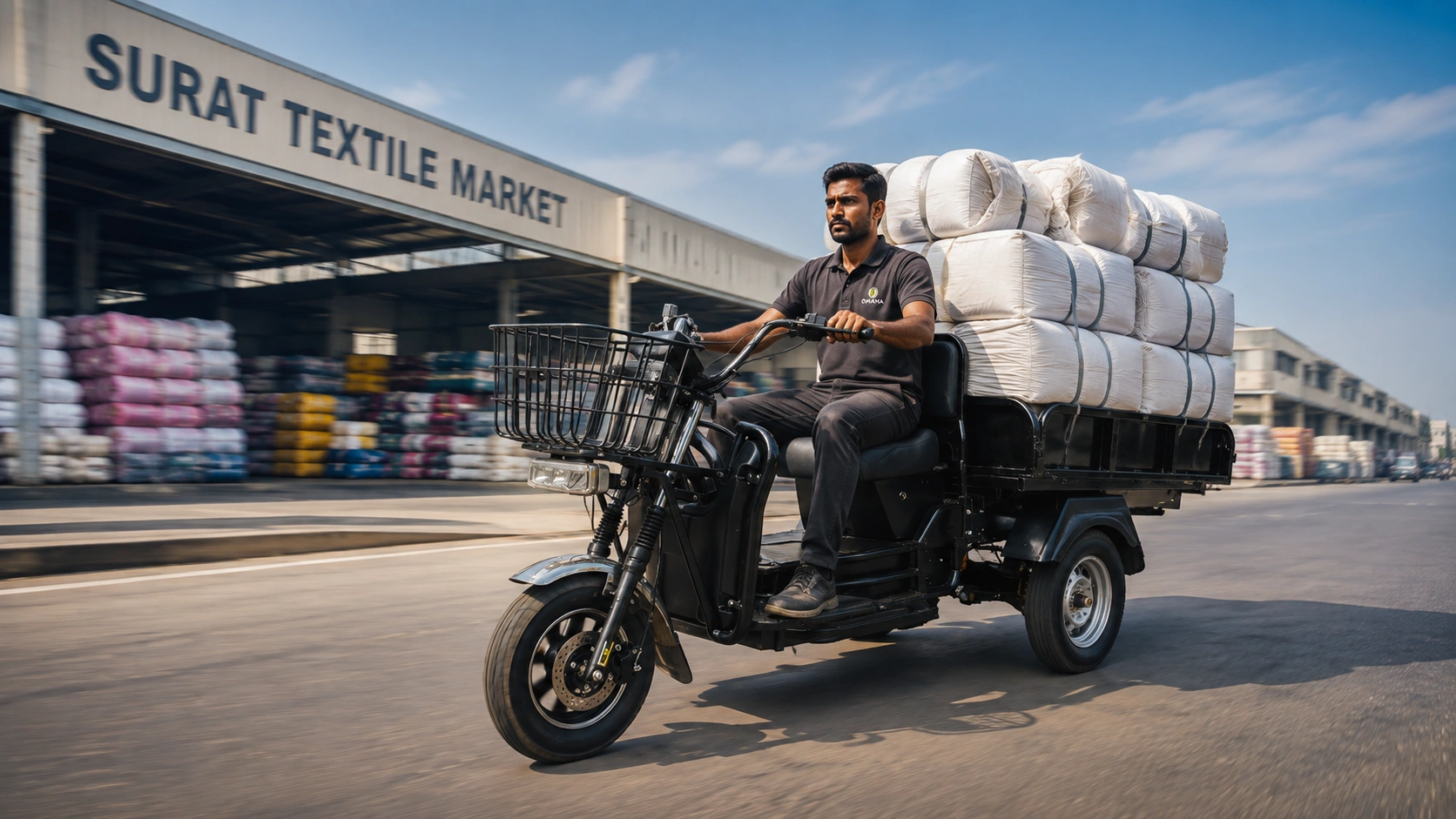
Electric Loader in Surat: Cost Per Trip vs a Diesel Tempo
Real numbers from Surat’s own routes — Sachin to Ring Road, Pandesara to Udhna. What one trip actually costs you on diesel, and what the same trip costs on electric.
Stand at Ring Road at ten in the morning and you’ll notice something: Surat doesn’t move on cars. It moves on loaders — fabric bundles stacked shoulder-high, saree cartons tied with nylon rope, parcels running from Varachha to Udhna and back before lunch.
If that’s your business, you’re not really asking whether EVs are the future. You’re asking a much smaller, much sharper question: what does one trip cost me? That’s the only question this guide answers. We’ll compare an electric loader in Surat against a diesel tempo on the same route, look at honest electric loader price ranges, and be upfront about the parts that don’t look good on a brochure.
Why Surat suits an electric loader better than most cities
Not every city is a good fit for a battery-powered goods carrier. Surat happens to be one of the best in Gujarat, and it comes down to how the city is built:
- Short, repeating routes. Sachin GIDC to the textile markets, Pandesara to Udhna, Katargam to Ring Road — most operators finish 40–70 km a day and return to the same godown every night. That is exactly the pattern a battery likes.
- Flat terrain. No ghats, no long climbs. Range figures hold up far better here than in a hill town.
- Stop-and-go traffic. A diesel engine burns fuel sitting idle in a Ring Road jam. An electric motor draws almost nothing when it isn’t moving — this is where a big chunk of the saving quietly comes from.
- Overnight parking at your own godown. Charging happens while you sleep, on a normal 15A point. No queue, no pump.
A textile parcel operator in Sachin told us his first month was pure suspicion — “charge khatam ho gaya to beech raste mein khada rahunga.” He ran his usual six rounds, plugged in at 8 pm, and by week three he had stopped checking the battery display. His words: the vehicle became boring, and boring is exactly what a commercial vehicle should be.
Cost per trip: electric loader vs diesel tempo
Let’s take a route almost every Surat operator will recognise — roughly a 12 km round trip, godown to market and back, repeated six times a day, twenty-five days a month.
Roughly ₹690 a day across six trips, and about ₹17,000 a month before you touch servicing, oil changes or a filter replacement.
Around ₹85 a day for the same six trips — close to ₹2,100 a month. No oil, no clutch, no fuel queue at 7 am.
| What you pay | Diesel tempo | Electric loader |
|---|---|---|
| Fuel / charging per km | ₹8.00 – 8.50 | ₹0.85 – 1.10 |
| Maintenance per km (avg.) | ₹1.20 – 1.60 | ₹0.30 – 0.50 |
| One 12 km trip | ₹110 – 120 | ₹13 – 16 |
| Six trips a day | ₹660 – 720 | ₹80 – 95 |
| 25 working days | ₹16,500 – 18,000 | ₹2,000 – 2,400 |
Illustrative 2026 estimates for a light city goods carrier in Surat. Actual cost varies with payload, route, tariff slab and vehicle condition.
A ₹14,000-a-month gap is real, but it isn’t free money. You paid more upfront, and somewhere in year four or five a lithium pack will need replacing — that’s a planned expense, not a surprise, and it should sit in your calculation from day one. Anyone showing you savings without mentioning the battery is selling, not advising.
Electric loader price in Surat: what you’ll actually pay
The electric loader price in Surat depends mostly on two things — battery chemistry and rated payload. Here’s the honest spread across the common categories of EV loader available in the city:
| Type | Payload | Indicative price |
|---|---|---|
| Electric loading rickshaw (lead-acid) | ~350 – 450 kg | ₹1.6 – 2.2 L |
| Electric loading rickshaw (lithium) | ~400 – 500 kg | ₹2.4 – 3.1 L |
| City electric goods carrier (lithium) | ~500 – 600 kg | ₹3.2 – 4.5 L |
| Add on-road | Registration, insurance, accessories | ₹15 – 30 K |
Ranges are 2026 market estimates. Final on-road figure depends on variant, deck size, battery capacity and any scheme applicable at the time of purchase. Ask your dealer for a written on-road breakup before booking.
One thing worth saying plainly: the cheapest quote in the market is rarely the cheapest vehicle to own. A lead-acid set saves you around ₹50,000 at purchase and then often asks for a replacement within 12–18 months of hard commercial use. Lithium costs more on day one and usually wins by the end of year two.
Capacity, range and charging — reading the spec sheet honestly
Rated payload assumes an even load on a flat road. Fabric bundles stacked high shift the centre of gravity — plan for about 85–90% of the rated figure in daily use and the vehicle will last years longer.
A “100 km” claim is an unloaded, steady-speed number. Fully loaded, with constant stops, expect 65–80% of it. For most Surat routes that’s still comfortably more than a full day’s work.
Lithium packs typically take 4–5 hours, lead-acid closer to 8–9. Overnight covers both. Get a dedicated, properly earthed 15A point at the godown — not an extension board.
And one Surat-specific habit worth building: in May, when the afternoon touches 42°C, park in shade and let the pack cool for twenty minutes before plugging in. Heat is the single biggest reason a battery ages faster than it should in this belt.
Who’s actually buying an electric loading rickshaw in Surat
The electric loading rickshaw in Surat isn’t a niche experiment anymore. The buyers cluster into a few clear groups:
- Textile and saree traders running fixed daily rounds between mills, markets and transport godowns.
- Kirana and FMCG distributors covering tight, repetitive society-to-shop beats where a big tempo is simply overkill.
- Water can and packaged goods suppliers — heavy load, low distance, dozens of stops. Almost the perfect EV use case.
- Courier and e-commerce last mile partners who are measured on cost per delivery, not cost per vehicle.
- Vegetable and dairy morning runs, where a 5 am start with zero engine noise is genuinely appreciated by the neighbourhood.
When does it pay back?
Paperwork you’ll need
Nothing exotic: PAN and Aadhaar, a valid driving licence for the vehicle category, vehicle registration and insurance, plus GST details if you’re buying in a firm’s name. Rules for permits and incentives on battery-operated goods carriers do change from year to year, so confirm the current position with the Surat RTO or your dealer before you finalise — don’t rely on a two-year-old blog post, including this one.
Mistakes first-time buyers make
- Buying from whoever quotes lowest, without checking if there’s a service point and spare-parts supply in Surat.
- Overloading “just this once” — repeatedly. It’s the fastest way to kill a controller and void a warranty.
- Choosing lead-acid to save upfront, then replacing the set twice in three years.
- Charging off a loose extension board with no earthing. A ₹2,000 electrical job protects a ₹3 lakh asset.
- Not taking a loaded test run on your own route before signing. Empty demos tell you nothing.
See the loader range built for Surat routes
Omaha EV builds electric goods carriers for exactly this kind of work — short city rounds, heavy loads, daily use. Check the range, or talk to the Surat team about what fits your route.
View Omaha EV Electric LoadersAlso serving Surat riders: Omaha electric scooters in Surat
Conclusion
Choosing an electric goods carrier in Surat isn’t a statement about the environment — it’s a line-item decision. On a fixed city route with six rounds a day, the per-trip gap between diesel and electric is large enough that it shows up in your monthly sheet within the first quarter. Match the payload honestly to your load, insist on lithium if you run hard, confirm local service before you pay, and plan for the battery in year four. Do those four things and the maths works quietly in your favour. When you’re ready, browse the Omaha EV loader range and get a route-based estimate for your business.