Most families notice it the same way. A father who rode to the market every morning for forty years starts asking for a lift. A mother stops going to the temple on her own after a small fall at a speed breaker. Nobody says much, but a little independence quietly disappears. For many older riders in India, the right electric scooter can bring it back — as long as it is chosen for the rider’s balance and confidence, not for the brochure. This guide explains how.
The short answer.
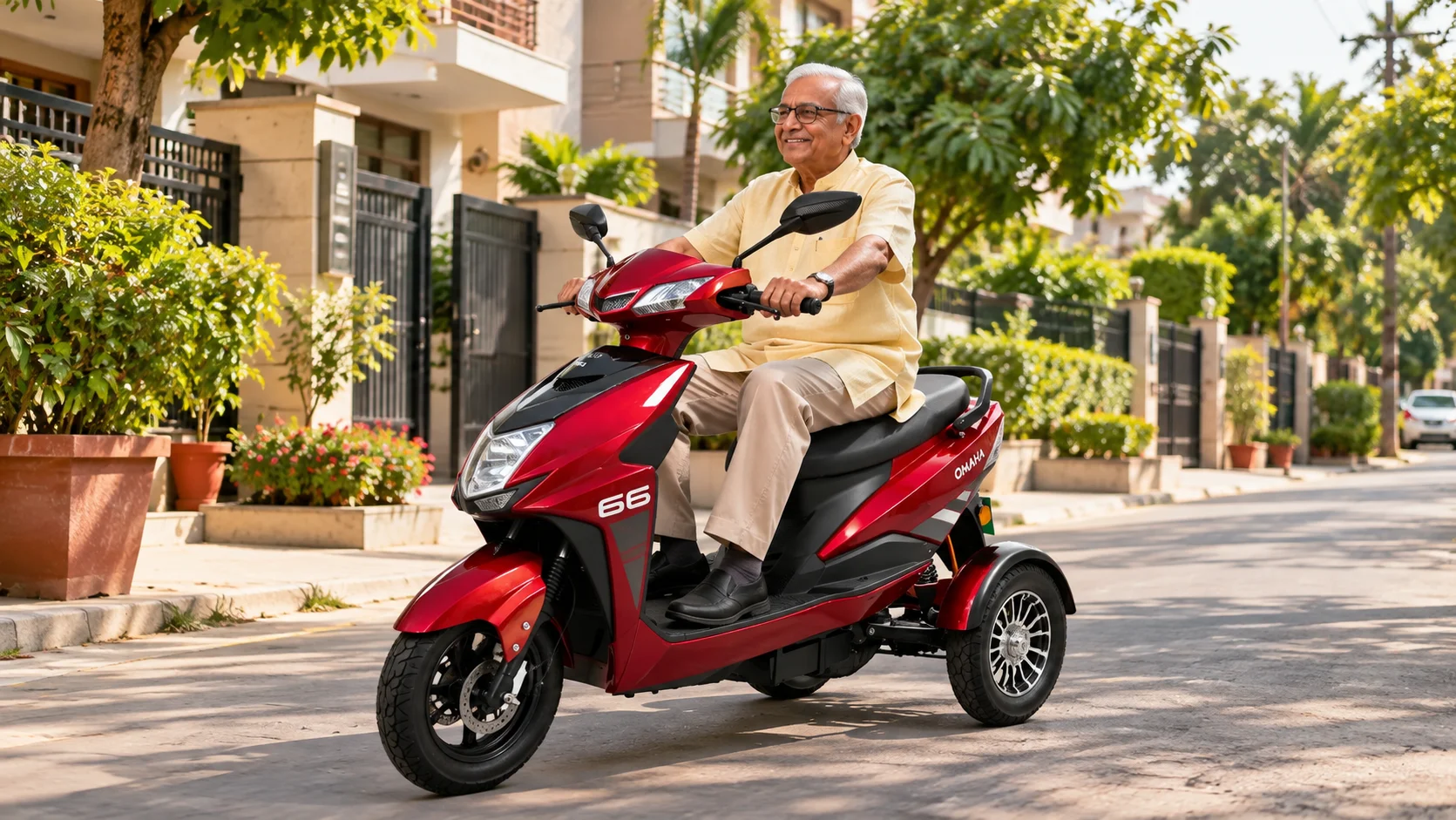
For many senior citizens in India, the most comfortable choice is a three-wheel, low-speed electric scooter that needs no driving licence and no registration. Three wheels mean you do not have to put a foot down and balance at every stop, and a top speed of 25 km/h keeps rides calm. Omaha’s Drake 3 Wheel is built for exactly this rider, and adds reverse gear and central locking.
An older rider who still feels steady on two wheels may do just as well with a light, compact two-wheel scooty. Either way, the rider — not the family — should do the test ride, and anyone with a condition affecting balance, vision or reflexes should check with their doctor first.
Age isn’t the real question — balance and confidence are
People search for the “best electric scooter for a 60 year old” as if age decides it. It doesn’t. Plenty of people in their sixties and seventies ride two-wheelers perfectly safely. Others stop in their fifties after an injury. What actually matters is how steady, strong and confident the rider feels.
This simple check, done honestly at home or at the showroom, usually settles whether two wheels or three is the better fit.
A practical guide, not a medical assessment. Only a doctor can advise on fitness to ride.
Why a 3-wheel electric scooter helps elderly riders
No foot down at every stop
On a two-wheeler, every red light, speed breaker and pause at a gate means catching the scooter’s weight with your legs. For a rider with weaker knees or less confident balance, that repeated moment is the risky one. A three-wheel scooter stands on its own when stopped, so the rider simply sits and waits.
Calmer starts from standstill
Moving off slowly on a two-wheeler requires balance at the exact moment you have the least speed. Three wheels remove that wobble, which is why many older riders say they feel relaxed from the very first ride.
Reverse gear, instead of pushing and pulling
Backing out of a parking row or a narrow gate usually means dragging the scooter backwards by hand. Reverse gear lets the rider do it seated, under power, with no strain on the back or knees.
Central locking
A simpler way to lock up at the chemist, the bank or the temple — fewer fiddly steps with keys and handlocks while holding a bag.
What three wheels do not do
Three wheels are more stable at a standstill and at low speed. They are not tip-proof. Honest limits every family should know:
- Sharp turns taken quickly can tip a three-wheeler. Slow right down before every corner.
- One wheel on a kerb or a steep road edge tilts the whole scooter. Keep all wheels on level ground.
- Steep slopes and ramps need care, especially when turning on them.
- It is wider than a two-wheeler, so narrow lanes and gates need checking.
The Omaha Drake 3 Wheel — built for this rider
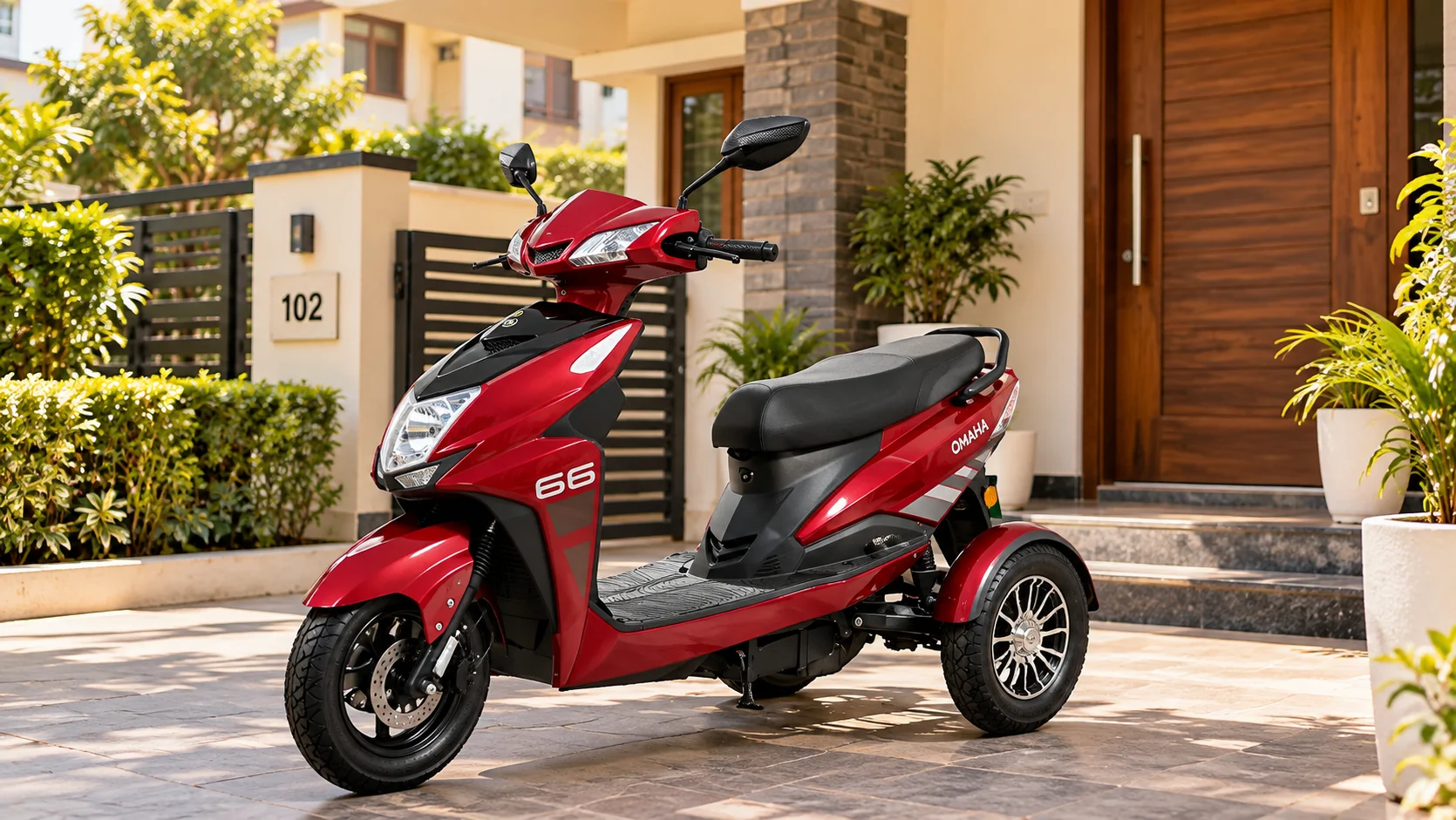
Across our range of fifteen scooters, the Drake 3 Wheel is the one we point to for stability. It was designed for riders who want to keep their independence but no longer trust their balance on two wheels.
| What matters to an older rider | Omaha Drake 3 Wheel |
|---|---|
| Stable at a stop | Yes — three-wheel build |
| Reverse gear | Yes |
| Central locking | Yes |
| Licence / registration | Not required — slow-speed model |
| Rated range | 70–80 km per full charge (Omaha range) |
| Charging | Ordinary 5A home socket |
| Battery options | Lead-acid (6–8 h) or lithium (3–5 h) |
| Price | Ask your dealer for a quote on both batteries |
From Omaha’s published product information. See the Drake 3 Wheel product page for the full specification sheet.
From the showroom floor
A retired schoolteacher in Hisar had not ridden since slipping at a speed breaker two winters earlier. His son came to the showroom alone “just to look”, then came back a week later with his father. He sat on the three-wheeler, rode two slow loops of the lot, and asked only one question: “Will it fall if I stop?” The answer was no — and the next morning he rode to the park on his own.
No licence — what that means for a senior citizen
An electric two-wheeler with a motor rated up to 250 W and a top speed up to 25 km/h is not treated as a motor vehicle under Indian rules. For an older rider, that brings real benefits:
- No driving licence needed — useful for a parent or grandparent who never took one, or whose licence has lapsed.
- No registration, no number plate, no road tax — no RTO visits.
- A calm top speed of 25 km/h, well suited to colony roads, markets and short errands.
“No licence” does not mean “no care”. We strongly recommend a helmet on every ride, even though it may not be legally required for this category, and optional insurance for peace of mind.
Keep older riders off fast roads. A 25 km/h scooter — two wheels or three — does not belong on highways, bypasses or busy arterial roads where traffic moves much faster. Plan routes through colony roads and service lanes.
When two wheels are still the better choice
Not every older rider needs three wheels. If the readiness check came back mostly “yes”, a light two-wheel scooty can be easier to park, narrower in lanes and quicker to charge in a small space.
| Rider | Suggested model | Why |
|---|---|---|
| Confident, but wants something light and easy | Active Mini (≈ ₹45,000) | Most compact and lightest-feeling model; easy to push and park |
| Confident, but struggles backing out of parking | Active Pro (≈ ₹55,000 – ₹60,000) | Reverse gear and central locking on two wheels |
| Less steady at stops, knee or balance concerns | Drake 3 Wheel (ask dealer) | Stands on its own when stopped; reverse gear and central locking |
Indicative prices. Every Omaha model comes with a lead-acid or lithium battery; lithium is typically ₹10,000–₹15,000 more on the same model.
When a scooter isn’t the right answer
An honest guide has to say this. If walking short distances is already very difficult, if there have been several falls, or if a doctor has advised against riding, a road scooter may not be suitable at all. Mobility aids designed for pavements and indoor use, or simply arranged transport, may be safer. A conversation with the doctor or a physiotherapist is the right first step — before any showroom visit.
Setting up the scooter for an older rider
Choose the battery around the charging spot
Lead-acid batteries are heavy. If the scooter can be charged where it is parked, at a ground-floor socket, lead-acid is fine and cheaper — and short colony rides mean one charge lasts several days. If the battery would have to be carried indoors or upstairs, choose lithium, which is far lighter. A family member can also take on charging duty.
Practise in a quiet lane first
Spend the first few days on an empty colony road or a quiet park lane: starting, stopping, slow turns and using reverse. Confidence builds quickly when there is no traffic pressure.
Ride in daylight, on familiar routes
Plan the regular trips — park, temple, chemist, market — along the calmest roads, and avoid early-morning fog and late-evening rides where possible. Keep the headlamp, indicators and mirrors clean and correctly set.
Keep it simple
Show the rider only what they need: power on, the throttle, brakes, reverse and locking. Write the three most important steps on a card kept in the scooter if that helps.
For families: how to decide together
The most common mistake we see is a son or daughter choosing the scooter alone as a surprise. It is done with love, but the rider’s comfort getting on and off, reaching the ground, and feeling the brakes can only be judged by the rider.
- Bring the rider to the test ride. Let them sit, start, stop and reverse themselves.
- Measure the gate and parking spot before choosing a three-wheeler.
- Agree the routes together — and the roads to avoid.
- Respect the answer. If the rider is nervous after the test ride, wait, practise, or choose differently.
From the showroom floor
A widow in Jaipur had stopped going to her morning temple visit after her husband passed away, because he had always driven her. Her daughter-in-law brought her in to “just see”. She chose the three-wheeler after one ride, and the family’s only condition was that she stick to the colony road. She has kept to it — and to the temple visit.
The “From the showroom floor” stories are composite illustrations of common enquiry patterns, not individual customers’ accounts.
Test-ride checklist for an older rider
- Getting on and off — is it easy without lifting a leg high?
- Reaching the ground — can the rider comfortably put feet down if needed?
- Brakes — can the rider squeeze them firmly without strain?
- Throttle — does it start gently and smoothly?
- Reverse and locking — can the rider operate them without help?
- Mirrors and lights — are they easy to see and adjust?
- Slow turns — does the rider feel steady turning at walking pace?
- How the rider feels — relaxed or anxious? That answer matters most.
Let the rider try it first
See the Drake 3 Wheel’s full details, then book a test ride so the person who will ride it can feel it for themselves.
Conclusion: the right scooter gives back a little freedom
An electric scooter for a senior citizen is not about speed or specifications. It is about the morning walk that becomes a ride to the park again, the chemist visit that no longer waits for someone to be free, and the confidence that comes from not worrying about every stop. For riders whose balance is not what it was, a three-wheel, no-licence scooter like the Drake 3 Wheel is often the most comfortable way back. For those still steady on two wheels, a light compact scooty may be all they need.
Start with the readiness check, talk to the doctor if there is any doubt, bring the rider to the test ride, and plan calm routes. Chosen that way, it is one of the kindest purchases a family can make.
Frequently asked questions
Which is the best electric scooter for senior citizens in India?
For older riders who feel less steady at stops, a three-wheel, low-speed, no-licence electric scooter is often the most comfortable choice, because it stands on its own when stopped. Omaha’s Drake 3 Wheel is built for this, with reverse gear and central locking. Riders who are still confident on two wheels may prefer a light compact scooty such as the Active Mini.
Is a 3-wheel electric scooter safe for elderly people?
A three-wheel scooter is more stable at a standstill and at low speed, which helps many older riders. It is not tip-proof: slow down before turns, keep all wheels on level ground, and take care on slopes. A helmet is strongly recommended, and anyone with a condition affecting balance, vision or reflexes should check with their doctor first.
Do senior citizens need a licence for an electric scooter?
Not for a low-speed electric scooter with a motor rated up to 250 W and a top speed up to 25 km/h. These need no driving licence or registration. Omaha’s scooters, including the Drake 3 Wheel, are slow-speed models.
What is the best electric scooter for a 60 year old?
Age alone does not decide it. A 60-year-old who is steady and confident may be happy with a light two-wheel scooty. One who feels unsteady at stops, or has knee or balance concerns, is often more comfortable on a three-wheel scooter. The readiness check in this guide helps decide.
Is there an upper age limit to ride a no-licence electric scooter?
There is no licence test for low-speed electric scooters, so there is no licensing age limit. What matters is whether the rider can ride safely. If there is any doubt about balance, eyesight, reflexes or health, consult a doctor before riding.
What is the price of a three wheeler scooty for old people?
Prices vary by model, battery and dealer. For Omaha’s Drake 3 Wheel, ask your nearest dealer for a quote with both the lead-acid and lithium battery options. On Omaha models, lithium typically costs ₹10,000 to ₹15,000 more than lead-acid.
Which battery is better for an elderly rider?
If the scooter can be charged where it is parked at a ground-floor socket, lead-acid is cheaper and fine for short colony trips. If the battery must be carried indoors or upstairs, choose lithium, which is much lighter and charges in 3 to 5 hours.
Should an elderly rider wear a helmet on a low-speed electric scooter?
Yes. Even if a helmet may not be legally required for this category, we strongly recommend one on every ride. Falls at low speed can still cause head injuries, and older riders are more vulnerable.
How do I book a test ride for my parent?
Use Omaha’s test ride booking page or message on WhatsApp with your locality. Bring your parent along so they can sit on, start, stop and reverse the scooter themselves before you decide.
About this guide, and its limits
Written by the product team at Omaha Electric, a unit of JVG Electric Private Limited, which manufactures electric scooters and loaders in Hisar, Haryana. We make the models mentioned here, so weigh our view accordingly — and note that this guide says plainly when a scooter is not the right answer.
Not medical advice. The readiness check is a practical guide only. Fitness to ride depends on individual health; anyone with a condition affecting balance, vision, reflexes or strength should consult their doctor before riding.
About the stories. The “From the showroom floor” examples are composite illustrations of common enquiry patterns, not individual customers’ accounts.
Last reviewed September 2026. Questions — contact us, message us on WhatsApp, or book a test ride.