An electric scooter without licence and registration is a real, legal category in India — you can buy one and ride it home the same day, with no RTO visit and no number plate. The exemption is real, it is narrow, and a lot of scooters sold under it do not actually qualify. Here is exactly what the law says in 2026, what changes are being considered right now, and how to check a scooter before you pay for it.
The short answer.
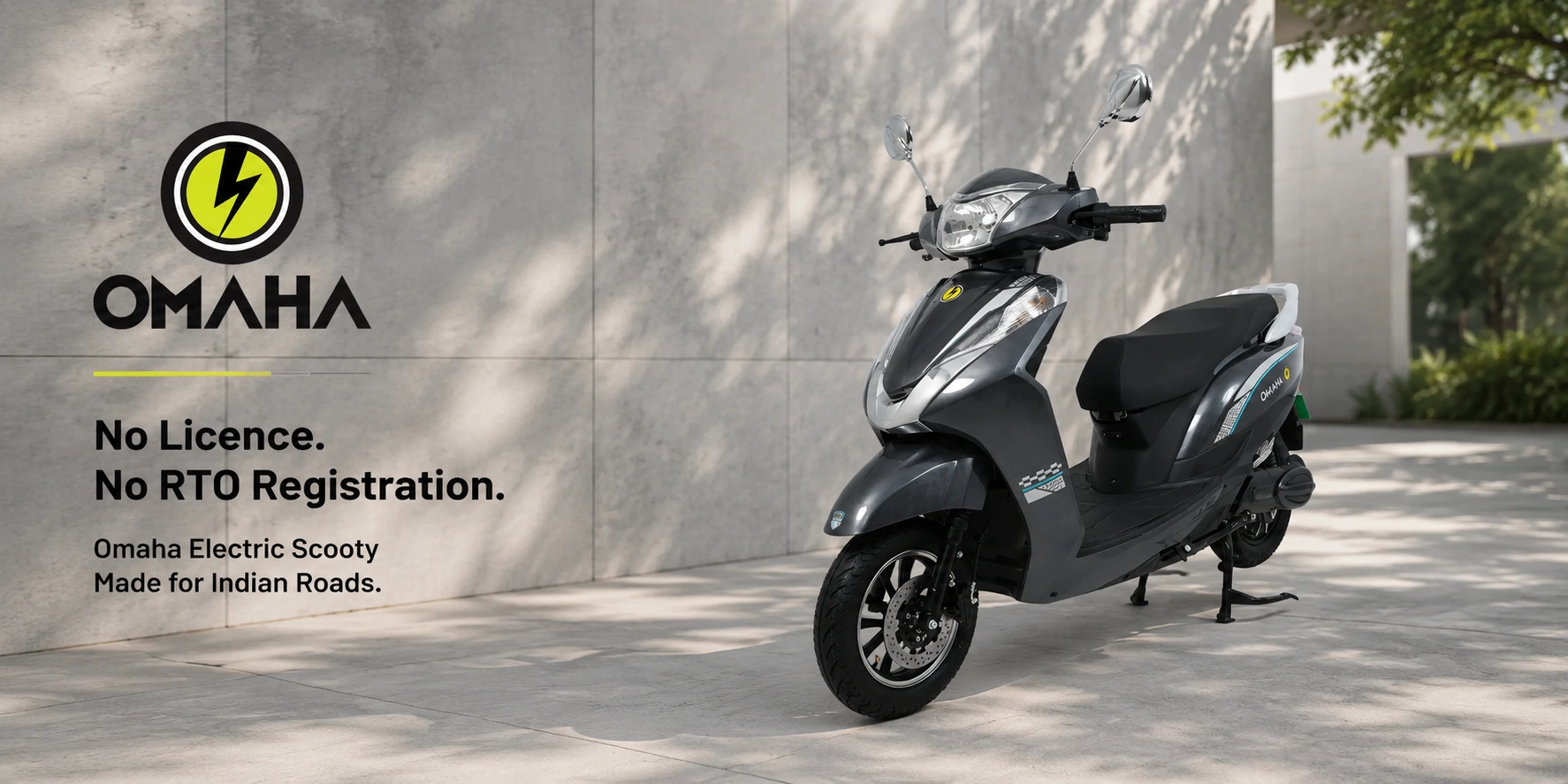
Yes — you can legally buy and ride an electric scooter without licence and registration in India, but only if it stays inside both legal limits at once: a motor rated under 250 watts and a top speed under 25 km/h. Meet both and the law does not treat it as a motor vehicle at all. No licence, no registration, no number plate, no road tax, no compulsory insurance. Anyone aged 16 or over can ride one.
Cross either limit — even by a little, even if the seller insists otherwise — and it is a motor vehicle, with every obligation a petrol scooter carries. There is no middle category.
The rule that makes a licence free electric scooter in India legal
Under the Central Motor Vehicles Rules, a battery-powered two-wheeler that stays below 250 watts of motor output and below 25 km/h is classed as a non-motorised vehicle — the same legal bracket as a bicycle or a hand cart. Industry homologation guidance points to MoRTH notification G.S.R. 291(E), under which electric two-wheelers below those thresholds are exempt from type approval, with the surrounding CMVR framework carrying the registration and licensing exemption through. The classification was settled through gazette notifications in the mid-2010s and, as of August 2026, it still stands.
That single exemption is what created the whole non-RTO electric scooter category in India — every electric scooty without registration you see advertised sits on this one rule. It is also why prices in this category start so much lower than a registered EV — you are not paying registration fees, road tax or compulsory insurance on top.
Both conditions. Not one.
This is the single most misunderstood point in the entire category, and it is where buyers get caught.
Work through the two ways this goes wrong:
- A scooter with a 1,000 W motor limited by software to 25 km/h is not exempt. The motor rating already disqualifies it, no matter how slowly it goes. This is the most common thing mis-sold as “non-RTO”.
- A scooter with a genuine 250 W motor that can touch 40 km/h is also not exempt. The speed disqualifies it.
A vehicle that genuinely qualifies is engineered — in hardware and firmware together — to sit inside both numbers. That is a design decision made before the scooter is built, not a setting applied afterwards.
The third condition almost nobody mentions
Most articles on 25 kmph electric scooter rules stop at two numbers. There is reporting that suggests a third.
Autocar India, covering a government review of this category in mid-2026, described the CMVR treatment as applying to electric two-wheelers that stay within 250 W motor output, 25 km/h top speed and an unladen weight of 60 kg — three thresholds, not two. Weight rarely comes up in showroom conversations, and most buyers have never heard of it.
What to do with this. Do not treat the weight figure as settled the way the 250 W and 25 km/h numbers are — those two are cited consistently everywhere, the weight condition is not. But it costs you nothing to ask the dealer for the model’s unladen weight and its CMVR exemption test report, which will state what the vehicle was certified against. If a scooter is genuinely certified, that document exists and the dealer can produce it. If nobody can find it, that is your answer about the scooter, regardless of which threshold you were worried about.
Electric scooter without licence and registration: what you skip, and what still applies
People assume the exemption is broader than it is. It removes paperwork. It does not remove road rules.
| Requirement | Non-RTO electric scooter (under 250 W & 25 km/h) | Registered electric scooter |
|---|---|---|
| Driving licence | Not required | Required (gearless two-wheeler class) |
| RTO registration & RC | Not required | Required |
| Number plate | Not required | Required |
| Road tax | Not applicable | Applicable (many states exempt EVs — check locally) |
| Third-party insurance | Not legally mandatory | Mandatory |
| Minimum age | 16 | 18 |
| Helmet | Not legally mandated for this class — wear one anyway | Mandatory |
| Traffic rules, signals, lane discipline | Apply in full, to both. The exemption is from paperwork, not from the road. | |
| National highways & expressways | Not suitable or permitted where a minimum speed applies | Permitted |
General guidance as of August 2026. State enforcement practice varies and rules change — confirm anything that affects a purchase with your local RTO.
Two of those rows deserve a sentence more.
Insurance is not mandatory, but buy it anyway. With no registration, there is no compulsory third-party cover — but a ₹55,000 scooter is still ₹55,000 if it is stolen from outside a market, and fire-and-theft cover for this class is inexpensive. Ask your insurer; several will write a policy against the purchase invoice.
Helmets are not required by law here, and that is not a recommendation. Two-wheeler riders are the most vulnerable category on Indian roads by a wide margin. A 25 km/h impact against a stationary object is not a gentle event. Buy a BIS-marked helmet on day one and make it non-negotiable for whoever rides.
The age question — 16, and the strange reason the law is worded that way
A 16-year-old can legally ride a non-RTO electric scooter. This is the single biggest reason parents end up on this page.
The mechanism is worth understanding, because it explains why the answer changes the moment you cross the threshold. Section 4(1) of the Motor Vehicles Act, 1988 bars anyone under eighteen from driving a motor vehicle. Its one exception is written for “a motor cycle with engine capacity not exceeding 50cc”, which may be driven from the age of sixteen — a clause drafted in cubic centimetres, a unit that simply does not exist on an electric scooter.
A genuine sub-250 W, sub-25 km/h scooter sidesteps the whole question: it is not a motor vehicle, so Section 4(1) does not reach it at all. A 16-year-old may ride it. But the instant a scooter crosses either threshold, it becomes a motor vehicle, the rider must be eighteen with a licence, and if a minor is riding it the consequences under Section 199A of the Act fall on the guardian or the registered owner — not only on the child.
If you are buying for a teenager, this is the part that matters. A dealer telling you “no licence needed” about a scooter with a 1,000 W motor is not giving you a legal opinion — he is giving you a sales line, and it is your household that carries the liability, not his. Get the motor’s 30-minute rating written on the invoice before you pay. That one line is your protection.
How buyers get sold a “non-RTO” scooter that is not one
This is not a theoretical risk. MoRTH has previously warned states about manufacturers and dealers marketing vehicles that pass type-approval tests within the 250 W and 25 km/h limits, and are then sold or modified with larger motors and battery packs capable of 40 to 55 km/h. The scooter is certified in one configuration and delivered in another.
If that happens to you, the seller is not the one who gets stopped at the naka. You are riding an unregistered, uninsured motor vehicle without a licence, and the fact that a showroom told you otherwise will not help.
Four questions that separate a real one from a fake one
- “What is the 30-minute continuous motor rating?” Not peak power. Peak can be double the continuous figure, and brochures print whichever number sounds better. Below 250 W continuous is the legal test.
- “Can I see the CMVR exemption test report for this model?” Certified models are tested by an agency such as ARAI or ICAT and there is a document. A dealer who has genuinely stocked a certified model can show it. Vagueness here is the answer.
- “Will you write the motor rating and the speed limitation on my invoice?” A truthful seller has no reason to refuse. A seller who hesitates is telling you the specification will not survive being written down.
- “Has this unit been modified after certification in any way?” Ask it plainly. Upgraded controller, bigger pack, a “speed unlock” offered as a favour — all of it takes the scooter out of the exemption, and the favour is not a favour.
The “speed unlock” trap. A dealer offering to remove the limiter after delivery, at no charge, as a goodwill gesture, is offering to convert your licence-free scooter into an unregistered motor vehicle. Some buyers accept this thinking it is a bonus. It is the single fastest way to turn a legal purchase into an illegal one, and it usually voids your warranty as well.
Before you pay: the document check
This applies whether you buy from us or from anyone else. With no RC book in this category, your paperwork is thin — which makes the little you have matter more.
- The invoice, with the motor’s 30-minute rating on it. In this category the invoice is your proof of ownership and your proof of classification. Keep it, photograph it, and keep the photo on your phone.
- The CMVR exemption or type-approval test report for the model. Ask for a copy even if you never read it.
- A written statement of the speed limitation — that the vehicle’s maximum speed is under 25 km/h as manufactured.
- Battery warranty in months and in kilometres, plus what voids it and what a replacement costs today.
- The charger, the user manual and the helmet at the time of delivery, not “next week”.
- Service details: where it goes, who fixes it, and the lead time on a battery replacement in your town.
Where you can and cannot ride a no RTO electric scooter
Inside a town, 25 km/h is far less limiting than it sounds. Peak-hour traffic in most Indian cities averages somewhere between 17 and 20 km/h, so on a school run, a market trip or a six-kilometre commute you are keeping pace with everything around you and filtering past cars that are not moving at all.
Outside a town, it is a genuine constraint, and we will not pretend otherwise. A low-speed electric scooter has no business on a national highway, an expressway, or any stretch carrying a posted minimum speed above 25 km/h. If your daily route includes a bypass, this whole category is the wrong answer for you and you should buy a registered vehicle and get the licence.
A worked example from our own belt
Take a typical Hisar household. School in the town, market on the same side, office six kilometres away, and the in-laws forty kilometres out on the highway. The non-RTO scooter handles the first three perfectly and should never do the fourth. Households that are happy with this category are the ones that keep a second vehicle — often an old petrol scooter — for the highway run. Households that try to make one 25 km/h scooter do everything are the ones who end up disappointed, and it is usually predictable on day one.
What may change: the rules are under review right now
Most pages on this subject read as though the rulebook is frozen. It is not, and if you are buying in the next few months you should know what is being discussed.
As reported in mid-2026, India’s testing and certification agencies have been reviewing the power and weight specifications for low-speed electric two-wheelers. Two pressures are driving it: enforcement problems with vehicles being modified after certification, and the rapid growth of quick-commerce and hyperlocal delivery fleets, which has turned low-speed scooters into commercial workhorses the category was never designed around.
Separately — and this one matters to parents — a proposal was put out for public comment that would let 16 and 17-year-olds legally ride electric two-wheelers with motors of up to 1,500 W, provided the vehicle stays limited to 25 km/h. That is a very different shape of rule from today’s: it keeps the speed cap and relaxes the power cap for that age group.
Where this stands as of August 2026
These are reviews and proposals, not law. Nothing described in this section has taken effect, and a proposal that goes out for comment may be notified in an amended form, or not at all. The rule that governs your purchase today is the one at the top of this page: under 250 W and under 25 km/h. We will update this section if MoRTH notifies a change — and if you are reading this some months after the date shown, check with your RTO rather than trusting our timestamp.
When you should skip this category entirely
We build these scooters, so read this section knowing that. We would still rather you bought the right vehicle than bought ours.
- You ride on highways or bypasses regularly. Not a workaround situation. Buy registered.
- Your genuine daily distance is near or above the scooter’s range, with nowhere to charge at the far end. Plan for your worst day, not your average one.
- You carry two adults plus load up a gradient every day. The category will do it occasionally; doing it daily will punish the battery.
- You want petrol-scooter resale value. The used market here is thin and depends heavily on battery condition. Buy this to ride, not to trade.
- You need to look impressive at 60 km/h. Said plainly because it is a real reason people buy, and this is not the product for it.
If two or more of those describe you, get the licence and buy a registered EV. That is the honest recommendation, and it costs us a sale to give it.
How Omaha builds to this specification
Omaha Electric is a unit of JVG Electric Private Limited. We build our scooters at our own plants — Khairampur Road, Mandi Adampur in Hisar, Haryana, and GT Road, Burdwan in West Bengal — which matters here for a specific reason: when a vehicle is designed and assembled in-house to a slow-speed specification, the specification is a manufacturing decision rather than something adjusted at the dealer’s end.
Our slow-speed models are built to be ridden without a licence, without registration and without insurance paperwork, and our test ride page says the same thing in the same words. Fifteen scooter models are listed with full specifications on the electric scooters page, each offered with a lead-acid or lithium battery option.
And apply the four questions above to us as rigorously as you would to anyone else. A manufacturer that cannot answer them about its own product does not deserve the sale.
Ride one before you decide — no licence needed for the test ride either
Free test ride through your nearest dealer. Take it on your own route, at the hour you actually travel, with a pillion if you usually carry one.
Frequently asked questions
Can I really ride an electric scooter in India without a licence and registration?
Yes, provided the scooter meets both conditions at once — a motor rated under 250 watts and a maximum speed under 25 km/h. Under the Central Motor Vehicles Rules such a vehicle is not classed as a motor vehicle, so no driving licence, RTO registration, number plate, road tax or compulsory third-party insurance applies. Cross either threshold and every one of those requirements returns.
What is the minimum age to ride a non-RTO electric scooter?
Sixteen. Because a compliant low-speed scooter is not legally a motor vehicle, the Motor Vehicles Act’s under-eighteen bar does not apply to it. If the scooter exceeds either threshold, the rider must be eighteen and licensed — and where a minor rides a motor vehicle, liability under Section 199A can fall on the guardian or registered owner.
Is insurance compulsory for a licence-free electric scooter?
Not legally, because compulsory third-party cover attaches to registered motor vehicles. We would still recommend buying fire-and-theft cover — the scooter represents real money and this class is easy to steal. Several insurers will write a policy against your purchase invoice; ask before you assume it is unavailable.
How do I check that a scooter genuinely qualifies as non-RTO?
Ask four things: the 30-minute continuous motor rating (not peak), a copy of the model’s CMVR exemption or type-approval test report, a written statement of the speed limitation, and whether the unit has been modified after certification. Get the motor rating printed on your invoice. A seller who will not put the specification in writing is telling you something.
A dealer says his 1000W scooter needs no licence because it is limited to 25 km/h. Is that right?
No. Both conditions must be satisfied. A 1,000 W motor breaches the power limit regardless of how the speed is capped, so the vehicle is a motor vehicle in law and requires registration, a licence and insurance. A software limit that can be removed is not the same thing as a vehicle engineered to stay inside the threshold.
What happens if the traffic police stop me?
Carry your purchase invoice, ideally showing the motor rating. That is your evidence that the vehicle is a non-motorised vehicle under the CMVR and outside the registration requirement. In practice this class is visually recognisable and stops are uncommon, but there is no reason to be caught without the document.
Do I need a helmet on a 25 km/h electric scooter?
Not as a legal requirement for this class, but wear one. Two-wheeler riders account for the largest share of road deaths in India, and a low-speed impact against a stationary object is still a serious event. Buy a BIS-marked helmet with the scooter and make it a household rule, particularly if a teenager is riding.
Can a non-RTO electric scooter be ridden on highways?
No. A vehicle limited to 25 km/h is unsuitable and not permitted on national highways, expressways, or any road carrying a minimum speed above that. This category is designed for town and neighbourhood riding. If your regular route includes a highway stretch, buy a registered vehicle instead.
Are the rules for licence-free electric scooters changing in 2026?
The framework is under review. Certification agencies have been examining the power and weight specifications for low-speed electric two-wheelers, and a separate proposal was circulated for comment that would allow 16 and 17-year-olds to ride electric two-wheelers of up to 1,500 W where the vehicle remains limited to 25 km/h. As of August 2026 none of this has been notified into law — the operative rule remains under 250 W and under 25 km/h.
Are Omaha scooters licence-free and registration-free?
Omaha’s slow-speed models are built to the low-speed specification and are sold to be ridden without a licence, registration or insurance paperwork. Omaha is a unit of JVG Electric Private Limited, with manufacturing at Mandi Adampur, Hisar, Haryana, and Burdwan, West Bengal. Ask us the same four verification questions you would ask any manufacturer — and book a test ride before you decide.
About this guide, and its limits
Written by the product team at Omaha Electric, a unit of JVG Electric Private Limited, which manufactures electric scooters and loaders at Mandi Adampur, Hisar, Haryana and at Burdwan, West Bengal. The buying pitfalls described here come from questions our dealers are asked most often.
This is general information, not legal advice. Rules on motor vehicles are set centrally but enforced by state authorities, and both the rules and the enforcement practice change. Where we have described proposals under consideration, we have said so explicitly and dated them. Before a purchase, a dispute or a challan, confirm the current position with your local RTO — their answer governs, not ours.
We have an interest here. We manufacture and sell slow-speed electric scooters, so weigh our view of the category accordingly — and note that this page also sets out five situations in which you should not buy one from us.
Rules and figures compiled August 2026 from Indian homologation and regulatory reporting, including coverage of MoRTH notifications and of the 2026 government review of low-speed electric two-wheeler specifications. Questions about a specific model — contact us or message us on WhatsApp.