Electric Scooty in Haryana — No Licence, No Registration
Every electric scooty page in India says "Made in India." This one can say something narrower and considerably more useful: Omaha is made in Haryana. 15+ models, 70–80 km of range, and the shortest service and spares chain of anywhere in the country.
where JVG Electric is headquartered and Omaha is built
spares originate in-state, so service turnaround is short
range on a full charge, from a normal 5-amp socket
licence, registration and motor vehicle tax on slow-speed models
The most practical fact on this page
Omaha Electric is made in Haryana. The company behind it, JVG Electric Private Limited, is headquartered in Hisar, and manufacturing takes place in the state.
If you are reading this in Rohtak, Bhiwani, Sirsa, Jind or Fatehabad, the factory is closer to you than most brands' nearest service centre. If you are in Gurugram or Faridabad, it is a few hours up the road.
That is not a sentiment. It is the single most useful fact on this page — and no competing electric scooty brand can make the same claim to a Haryana buyer.
Because the most common real-world problem with any electric two-wheeler in India is not range, and it is not battery life. It is what happens on the day something breaks.
Made in Hisar
What "made in Haryana" actually buys you
A controller fails. A brake lever snaps. A charger stops working. With an imported or far-manufactured product, that becomes a four-to-six week wait while a part travels — and a vehicle standing idle outside your house the entire time. Anyone who has owned an EV from a brand without a real supply chain has lived this. For a Haryana buyer, the arithmetic is different.
The wait, when something breaks
Typical time from part failure to vehicle back on the road.
Indicative comparison for illustration, not a guaranteed service commitment. Turnaround depends on the part, the dealer and stock on hand — always get service terms in writing at purchase.
Spares originate in-state
Parts are not crossing the country to reach your dealer.
Head office is reachable
If a dealer cannot resolve something, the company is not on the other side of India.
Dealer support is local
Training, stock and replacement supply all run on shorter chains.
It is a Haryana business
JVG Electric was established in Hisar. Buying it keeps money and jobs closer to home than buying an imported product does.
One thing to still do at purchase. Being in-state shortens the chain; it does not replace a written commitment. Get warranty terms, service intervals, battery replacement cost and lead time documented when you buy. A good dealer will have no problem with that.
Haryana EV tax status
Haryana just made EVs cheaper — and we are going to be straight about it
This is the one page in this series where we have to tell you that the other option got better. In its 2026–27 Budget, presented on 2 March 2026, the state announced expanded EV incentives, and the Haryana Cabinet approved them in late July 2026.
Current position
Verified August 2026Approved by the Haryana Cabinet in late July 2026, implementing the Budget announcement. It explicitly covers battery-operated two-wheelers, three-wheelers including autos and e-rickshaws, and four-wheelers purchased and registered in the state.
The ₹30 lakh threshold covers effectively every mainstream electric two-wheeler on the market.
Battery electric vehicles in Haryana previously received only a 20 per cent road tax exemption. This is a substantial expansion, not a marginal one.
Applies to new private vehicles up to ₹20 lakh ex-showroom, separate from the EV exemption above.
Reported provisions have included EV registration at a nominal token fee of about ₹100 against ₹1,500–₹3,000 for a petrol two-wheeler, and exemption from state toll tax — a genuine daily saving for Gurugram and Faridabad commuters. The policy was notified 8 July 2022, with incentives reported valid to around 9 July 2027.
The 2022 road tax exemption for electric two-wheelers was capped at the first 30,000 registrations, and that quota may be exhausted. The new Cabinet decision appears to supersede it with a price-based structure, but no source confirms that explicitly. Confirm the current applicable position with the Haryana transport department, or ask your dealer for the notification in writing, before you rely on any figure.
No registration, no RC, no licence, no insurance formality — so there is no motor vehicle tax to exempt in the first place. You pay none of it either way, and you claim no state incentive either way.
So here is the honest position for a Haryana buyer
If you hold a driving licence and are comfortable with the RTO process, a registered electric two-wheeler in Haryana is now a genuinely strong proposition — better than it was six months ago, and better than in most other states we sell in. We are not going to pretend otherwise.
In this state the case for choosing slow-speed rests less on money than it does elsewhere. It rests on whether you hold a licence, whether you want to buy and ride today, and whether the in-state manufacturing advantage matters to you. Work through the question below.
Sources: Haryana Budget 2026–27 (2 March 2026), Cabinet approval reporting (July 2026), Haryana EV Policy 2022 (notified 8 July 2022). This is the most time-sensitive section on this page — re-verify before every publish.
Work out which vehicle is right for you
The question that actually decides it
Do you hold a driving licence?
In Haryana this single question changes the answer more than the money does.
Structural fit
Why Haryana suits this vehicle unusually well
Set the factory and the policy aside. Structurally, this is one of the strongest natural markets in India for a low-cost, no-licence electric two-wheeler.
A state of towns, not just cities
Rohtak, Bhiwani, Jind, Kaithal, Sirsa, Fatehabad, Narnaul, Charkhi Dadri, Palwal, Tohana, Gohana — dense, walkable-scale towns where nearly every daily trip is short. Home to shop, house to mandi, village to block town. Top speed was never the binding constraint in these places. Cost, paperwork and lane width were.
The mandi and agri economy runs on short repeated trips
Grain markets, commission agents, input dealers, dairy collection, small workshop supply — all high-frequency, short-distance movement, often carrying a load. That is the exact profile a compact electric vehicle and a 300–350 kg electric loader are built for.
Battery vehicles are already normal here
E-rickshaws are a fixture in almost every Haryana town. Local mechanics who understand battery vehicles, controllers and motors already exist, and overnight home charging is an established habit. A first-time EV buyer in Hisar or Karnal is not the pioneer on their street.
Licence penetration is uneven, particularly among women
Across small-town and rural Haryana, a very large number of adults who need daily transport do not hold a licence. A vehicle that legally requires none is not a convenience feature for that population — it is the difference between having transport and not having it. That is the single biggest driver of demand for this category in this state.
On fuel, we will say plainly that Haryana is a mid-tax state. Petrol has been running roughly ₹102.76 to ₹103.71 a litre through mid-2026 — Gurugram around ₹102.97, Faridabad ₹103.28, with Jind at the lower end and Fatehabad and Bhiwani at the upper — on state VAT of about 26.25 per cent. That is cheaper than Hyderabad at ₹115.73 or Indore at ₹114.60, and dearer than Delhi at ₹102.12. The per-litre saving is real but not the headline. The headline in Haryana is the factory and the paperwork.
15+ models
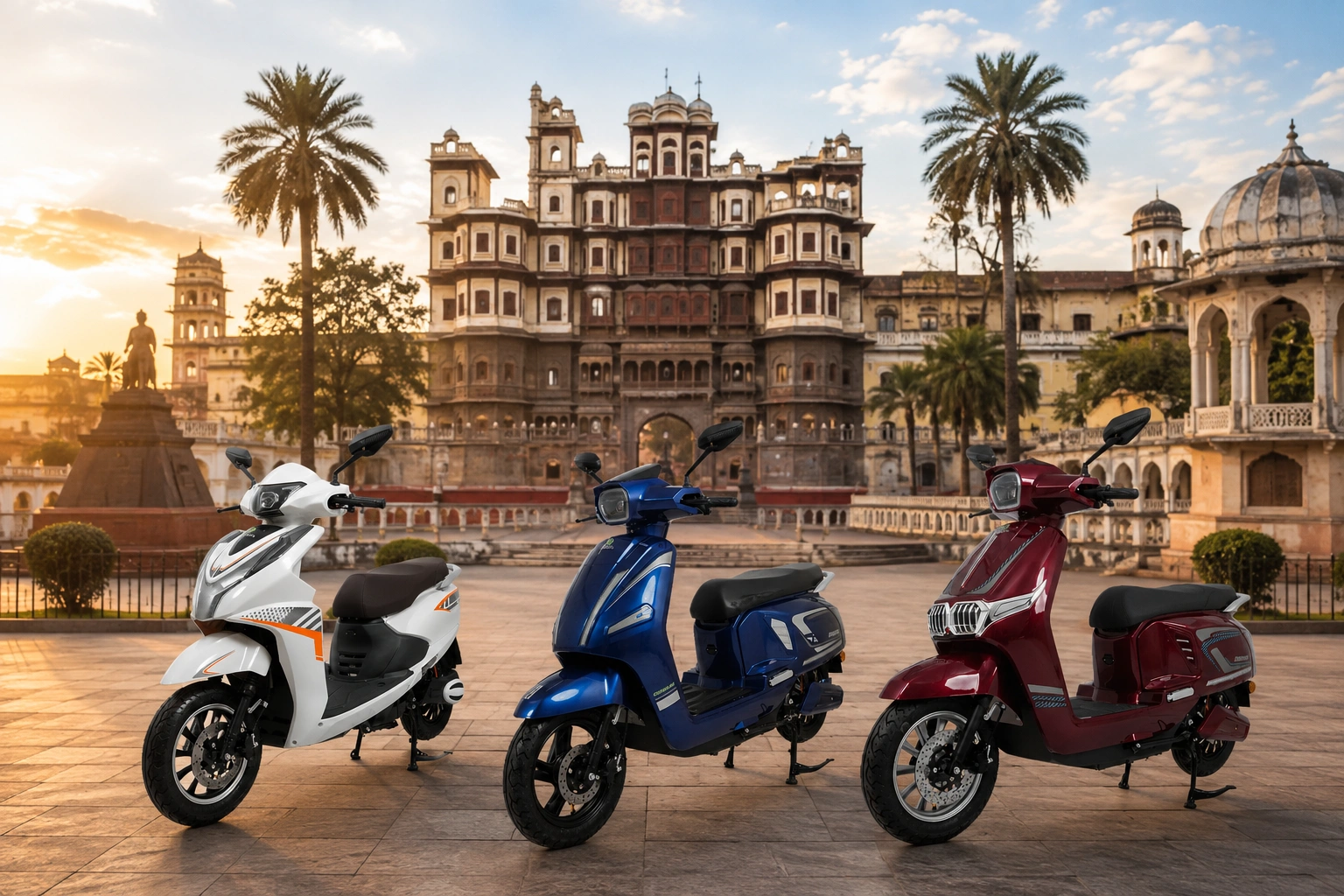
The Omaha range
Short town and city commutes
Light, narrow, easy to park. Built for the old bazaar lanes of Rohtak, Bhiwani, Ambala Cantt, Hisar's market area and every mandi town in the state.
Longer daily runs
Higher battery capacity, comfortable for 30–40 minute rides, digital speedometer and strong LED headlamps — worth taking seriously given how thick the winter fog gets across north Haryana.
Feature-conscious riders
Cruise control, central locking, reverse gear, USB charging port, anti-theft alarm and hydraulic suspension.
Stability and senior-friendly riding
Extra balance for elderly riders and anyone recovering from a knee or hip issue — a strong seller in a state with a large, dispersed older rural population.
Commercial and load work
300 to 350 kg capacity. Suited to mandi and commission-agent movement, dairy collection, kirana and water-can supply, agri-input dealers, and small logistics around Faridabad, Bahadurgarh, Manesar, Panipat and Yamunanagar.
See everything
The full range, including models not listed above, with specifications and current availability.
Every model is offered with both lead-acid and lithium battery options, so budget and charging preference stay your decision. Range is 70 to 80 km on a full charge, well beyond a typical Haryana town commute. Charge overnight from an ordinary 5-amp socket — lithium in 3 to 5 hours, lead-acid in 6 to 8 — with no dependence on public charging infrastructure, which remains thin outside the NCR districts.
The daily reality
What it costs to run
A typical rider covering 25 to 40 km a day on a 110cc petrol scooter, returning a realistic 42 to 50 kmpl in town conditions, spends roughly ₹55 to ₹95 a day at Haryana pump prices.
Petrol scooter
₹1,700–2,900/ month
Before servicing, engine oil, filters and the pollution certificate.
Omaha electric
₹300–450/ month
About 1 to 1.5 units of electricity a day, roughly ₹10 to ₹15. Annual running cost comfortably under ₹5,000.
On price: third-party trade listings for Omaha models have shown figures in the ₹45,000 to ₹61,000 range depending on model and battery type — the Canary and Starling R around ₹46,000 to ₹49,000, the Swallow around ₹61,000. Treat these as indicative; confirm on-road pricing with your nearest dealer.
District by district
Electric scooty across Haryana
Omaha's dealer network is expanding across the state. Where a dedicated city page exists, follow the link for local pricing and dealer locations.
Hisar
HomeJVG Electric is headquartered here and manufacturing is in the state. Strong across the town's dense market areas and the surrounding agricultural belt, with the shortest service and spares chain of anywhere in India.
Flagship city page coming soonGurugram
NCRHaryana's largest EV market, and its most competitive. Strong fit in older Gurugram, the sectors' internal roads, and among the very large domestic and service workforce commuting short distances daily without a licence.
City page coming soonFaridabad
NCRDense industrial and residential mix with heavy short-distance movement. Strong for both personal scooties and commercial loaders around the industrial sectors.
City page coming soonRohtak, Panipat, Sonipat & Karnal
CentralMid-sized cities with compact cores, active mandi economies and growing student populations. Among the best-fitting markets in the state.
City pages coming soonBhiwani, Jind, Kaithal, Sirsa, Fatehabad & Charkhi Dadri
WestAgricultural district towns where nearly every trip is short, licence penetration is uneven and EV retail is very thin. Strong product fit, minimal competition.
Dealership territory openAmbala, Kurukshetra, Yamunanagar & Panchkula
NorthNorth Haryana's education, industry and trade belt. Yamunanagar's plywood and timber trade in particular generates constant short-haul goods movement.
Dealership territory openRewari, Narnaul, Mahendragarh & Jhajjar
SouthSouth and west Haryana, spanning industrial and agrarian demand, largely unserved in this category.
Dealership territory openPalwal, Nuh & Bahadurgarh
NCRMixed industrial and agrarian demand on the NCR fringe, with heavy short-haul goods movement and very light EV retail presence.
Dealership territory openA note for NCR districts. Gurugram, Faridabad, Sonipat, Jhajjar, Rewari, Palwal, Nuh and other Haryana districts within the National Capital Region are subject to NCR-wide vehicle age and air-quality rules that do not apply elsewhere in the state. If you are replacing an ageing petrol vehicle in these districts, check the current end-of-life vehicle position with your RTO — it may affect your timing.
November to January
Riding through a north Haryana winter
Fog across north Haryana between November and January is a serious visibility hazard on state highways and district roads. The vehicle copes fine with cold and damp; the risk is being seen.
Treat the headlamp as a safety spec
If you ride early through those months, prioritise a model with strong LED lighting — Drake, Canary, Tezo and Skylark are the sensible picks. Ask your dealer to show you the headlamp working before you buy.
Slow down on district roads
Open stretches between towns are where fog bites hardest and where visibility drops fastest. A slow-speed scooty is already an advantage here.
Wear something reflective
Being seen matters more than seeing. A reflective strip on a jacket or bag costs very little and works in exactly the conditions where nothing else does.
Keep the charging port dry
Cold and damp are hard on connectors. Wipe the vehicle down before plugging in, and park under cover through the worst of the fog weeks where you can.
Commercial
Loaders for the mandi economy
The Loader 2 Tyre and Loader 3 Tyre carry 300 to 350 kg and suit exactly what Haryana's economy generates — short, frequent, loaded trips between mandi, shop, godown and village.
Mandi and commission agents
Grain market movement between arhtiya, godown and transport — high frequency, short distance, always carrying.
Dairy collection
Village-to-chilling-centre runs made twice daily, on fixed routes, where diesel running cost eats directly into margin.
Agri-input and kirana supply
Seed, fertiliser and input dealers serving surrounding villages, plus kirana and water-can distribution in every town.
Small industry and trade
Short-haul movement around Faridabad, Bahadurgarh, Manesar, Panipat and Yamunanagar's plywood and timber cluster.
Ask for a loaded demo, not a spec sheet. Whatever your trade, ask your dealer for a demonstration with your actual load on your actual route. That test tells you more than any brochure will.
Book a loaded demoDealership
Start an Omaha dealership in Haryana
Haryana is the strongest dealership territory in the Omaha network, for reasons that are structural rather than promotional.
Entry investment
₹5–6 lakh
Among the lowest entry points in the Indian EV dealer market. Call to discuss available territories.
Call +91 99961 17882The manufacturer is in your state
Stock lead times, spares supply, training, warranty resolution and escalation are all shorter here than anywhere else in the country. For a dealer, that is the difference between a business you can run and one that runs you.
The market is under-served exactly where the product fits best
EV retail in Haryana concentrates in Gurugram and Faridabad. That leaves Hisar, Rohtak, Bhiwani, Sirsa, Jind, Kaithal, Fatehabad, Narnaul, Palwal, Tohana, Gohana, Charkhi Dadri and dozens of block towns thinly served — in a state with a dispersed, cash-generative, short-commute population and a large adult segment without driving licences.
Two revenue lines, not one
Personal scooties plus 300–350 kg commercial loaders, and Haryana's mandi, dairy, agri-input and small-industry economy generates constant demand for the second.
A category that is easy to sell honestly
No subsidy paperwork, no portal, no claim files, no waiting on notifications, no explaining why a policy changed last quarter. Customer pays, takes delivery, rides out.
Territories currently open
FAQs