12,729
EVs registered in Gujarat in March 2026, up 75.5% year on year
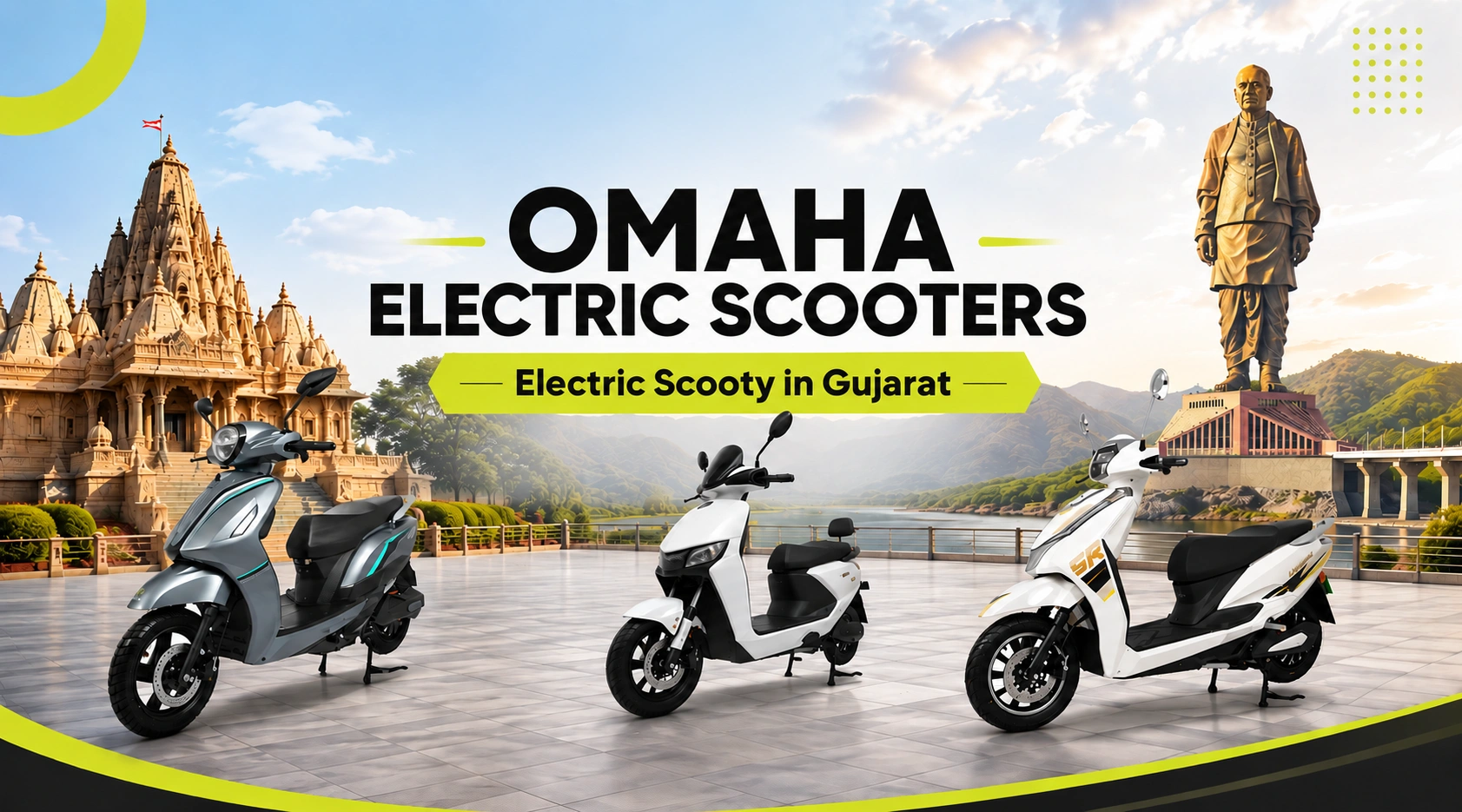
Omaha electric scooters across Ahmedabad, Surat, Vadodara, Rajkot and the wider state. 15+ models, 70–80 km of range, no road tax — and a category that sits entirely outside Gujarat's shifting subsidy position. Find your nearest dealer, or start one.
EVs registered in Gujarat in March 2026, up 75.5% year on year
growth in pure EV registrations, from 5,271 to 11,126
subsidy forgone — because none applies to these models here
dealership entry, among the lowest in the Indian EV market
Why the market moved
In March 2026, Gujarat registered 12,729 electric vehicles in a single month — up 75.5 per cent on the same month a year earlier. Pure EV registrations more than doubled, from 5,271 to 11,126, a 111 per cent jump, according to Ministry of Road Transport and Highways data.
Industry people quoted at the time gave two reasons. One was ordinary: affordability improving, preferences shifting. The other was more revealing — a rush to buy before tax benefits expired.
That second reason tells you something important about how EV buying works in this state, and it is worth understanding before you spend money. Gujarat's incentives have moved repeatedly. A generous purchase subsidy arrived in 2021 and was withdrawn in 2024. A concessional road tax rate arrived in April 2025 with a March 2026 deadline, and reporting on whether that deadline was extended is genuinely contradictory. Buyers have been timing purchases around notifications, and a lot of people have been quoted numbers at showroom counters that were no longer true.
There is a category of electric two-wheeler that sits entirely outside all of it. That is what this page is about.
Gujarat EV subsidy — current status
We are going to lay this out plainly, including where the sources disagree, because you will not get a straight answer anywhere else and because getting this wrong costs real money.
Current position
Verified August 2026The 2021 policy offered around ₹10,000 per kWh, capped at ₹20,000 for two-wheelers and ₹1.5 lakh for electric cars under ₹15 lakh — among the most generous in India. Direct purchase subsidies were discontinued in 2024, and multiple sources are consistent on this. If a dealer quotes you a ₹20,000 Gujarat subsidy in 2026, they are quoting a policy that ended two years ago.
Introduced April 2025, down from the standard 6%, valid to 31 March 2026. What happened next depends on which source you read — and the two positions cannot both be right.
Position A — national EV guides
Several national guides, updated through mid-2026, report that the window closed on 31 March 2026 with no extension confirmed, and that the rate may have reverted to 6%.
Position B — Gujarat reporting
Gujarat-based reporting from April 2026 states that the state government extended RTO-linked tax incentives to 31 March 2027, revising the earlier March 2026 deadline.
We are not going to pick one for you. Confirm the current motor vehicle tax rate directly with the Gujarat transport department, or ask your dealer to show you the applicable notification in writing, before you sign anything. On a registered vehicle this is a difference of thousands of rupees.
₹2,500 per kWh capped at ₹5,000. Verify its current status before relying on it. It applied to registered high-speed vehicles only.
Gujarat is a major EV manufacturing state, with Tata Motors at Sanand and further development planned at the Mandal Becharaji Special Investment Region, and industry has been actively lobbying for demand incentives to return. A new framework may well be notified. It had not been, on the information available at the time of writing.
No registration, no RC, no licence, no insurance formality. No purchase subsidy was ever attached, so its withdrawal cost you nothing. No motor vehicle tax is levied, so whether the rate is 1% or 6% is irrelevant. No PM E-DRIVE entitlement existed, so its lapse changes nothing. And whatever Gujarat notifies next, these models are unaffected.
In most Indian states, choosing a slow-speed vehicle means consciously giving up a subsidy. In Gujarat today, on the current position, you are giving up nothing.
Delhi
Rajasthan
Maharashtra
Uttar Pradesh
Gujarat
Subsidy forgone by choosing slow-speed, by state. That is an unusual situation and it will not last forever. The product trade-off, stated plainly as always: slow-speed means built for city and town speeds. If your routine involves NH-48, the Ahmedabad–Vadodara Expressway or regular intercity runs, this is the wrong vehicle and any honest dealer will say so.
Sources: DeshGujarat (April 2026), Ecozaar, MeraEV, EVSelect. This is the fastest-moving section on this page — re-verify on publish day and maintain it on its own schedule.
Structural fit
Set the policy aside for a moment. Structurally, Gujarat is close to an ideal market for a low-cost, no-licence electric two-wheeler, for four reasons.
Surat's diamond and textile economies sit in defined pockets with workers living beside them. Rajkot, Jamnagar, Bhavnagar, Morbi and Anand are mid-sized cities where almost every daily trip is short. Even in Ahmedabad, a very large share of everyday movement — market runs, school drops, shop-to-shop trade — is under ten kilometres. Top speed was rarely the binding constraint. Cost, parking and lane width were.
South Gujarat's textile and chemical belt, Saurashtra's engineering and ceramic clusters at Rajkot and Morbi, Kutch's industrial zones — these employ millions of people making short, repeated, daily journeys. A very large number of them do not hold a driving licence, not from carelessness but because the RTO process competes with a working day they cannot afford to lose.
Petrol across Gujarat has been sitting around ₹101.50 to ₹102.50 a litre through mid-2026 — cheaper than Hyderabad at ₹115.69 or Jaipur at ₹113. The per-litre saving is real but more modest than a page written for a high-VAT state would claim. The stronger arguments here are the absence of paperwork, the fit with short trips, and the commercial loader case.
Gujarat is among India's leading solar states, with high irradiance and substantial rooftop adoption. An Omaha covering 30 km a day draws roughly 1 to 1.5 units of electricity — an amount even a modest rooftop system generates comfortably. For a household already running solar, the marginal running cost of the scooty rounds to close to zero.
City by city
Omaha is expanding its authorised dealer network across the state. Below is how the product maps to each major market. Where a dedicated city page exists, follow the link for local pricing, dealer locations and city-specific guidance.
The state's largest market and its densest concentration of EV retail. Strong fit in the walled-city pols and older western neighbourhoods where lane width genuinely constrains vehicle choice, and among students, homemakers and first-time owners across Maninagar, Naranpura, Bapunagar, Vastral and Nikol.
City page coming soonArguably the best-fitting city in India for this category. The diamond and textile economies concentrate lakhs of workers making three-to-eight kilometre commutes twice a day, many without a licence. The Ring Road markets are the state's largest loader opportunity.
Electric Scooty in SuratA compact, well-laid-out city where most daily trips are short. Good fit around Mandvi, Raopura, Karelibaug, Gotri and the industrial belt out towards Makarpura and Nandesari.
City page coming soonSaurashtra's commercial and engineering capital, with a dense small-manufacturing base and a large trading community making constant short trips. Strong for both personal scooties and commercial loaders.
City page coming soonMid-sized cities where almost every journey is under ten kilometres and a no-licence, low-cost vehicle fits the market unusually well. Currently very lightly served by EV retail.
Dealership territory openIndia's ceramic manufacturing capital. High concentration of industrial workers and enormous short-haul goods movement. A significant loader market.
Dealership territory openGovernment, education and dairy-belt towns with steady, short, repetitive commuting patterns — and dairy supply chains that suit the loaders well.
Dealership territory openThe south Gujarat industrial corridor. Dense worker populations, heavy short-distance movement, and among the least-served slow-speed EV markets in the state.
Dealership territory openIndustrial and port-linked demand, with a strong case for commercial loaders around the Kandla and Mundra ecosystems.
Dealership territory open15+ models
Omaha Electric is a unit of JVG Electric Private Limited, headquartered in Hisar, Haryana, with manufacturing in Haryana and West Bengal. Every scooter is designed and assembled in India — which for a Gujarat buyer is a spare-parts argument rather than a patriotic one. Domestic components reach dealers in days, not the four to six weeks an imported part typically takes.
Built for dense old-city lanes: Surat's Mahidharpura and Sagrampura, Ahmedabad's walled-city pols, Rajkot's older bazaars, Vadodara's Mandvi area. Where vehicle width decides whether you can reach your own shop.
Every model is offered with both lead-acid and lithium battery options, so budget and charging preference stay your decision, not the brand's. Charge overnight from an ordinary 5-amp domestic socket — lithium in 3 to 5 hours, lead-acid in 6 to 8. No dependence on public charging infrastructure.
The daily reality
A typical rider covering 25 to 40 km a day on a 110cc petrol scooter, getting a realistic 42 to 50 kmpl in city conditions, spends roughly ₹55 to ₹95 a day at current Gujarat pump prices.
₹1,700–2,800/ month
Before servicing, engine oil, filters and the pollution certificate.
₹300–450/ month
About 1 to 1.5 units of electricity a day. Annual running cost comfortably under ₹5,000.
Near ₹0marginal
For a household already generating, the scooty's daily draw disappears into the existing surplus.
On price: third-party trade listings for Omaha models have shown figures in the ₹45,000 to ₹61,000 range depending on model and battery type — the Canary and Starling R around ₹46,000 to ₹49,000, the Swallow around ₹61,000. Treat these as indicative only. Confirm actual on-road pricing with your nearest dealer, since it varies by location, battery choice and current offers.
Commercial
The Loader 2 Tyre and Loader 3 Tyre carry 300 to 350 kg and suit exactly the movement pattern Gujarat generates — short, high-frequency, congested trips. Four clusters where the case is strongest.
Ring Road consignment movement — bales, parcels, sample lots and job-work batches shuttling between markets, processing units and transport offices all day.
India's ceramic manufacturing capital, with enormous short-haul goods movement between units, warehouses and transport yards.
A dense small-manufacturing base where components move constantly between workshops over very short distances.
Port-linked industrial demand across Gandhidham and Anjar, plus Anand's dairy supply chains and kirana, water-can and pharmacy distribution statewide.
Ask for a loaded demo, not a spec sheet. Whatever the cluster, ask your dealer for a demonstration with your actual load on your actual route. That test tells you more than any brochure will.
Book a loaded demoDealership
Gujarat is one of the strongest dealership opportunities in the Omaha network, and the reasons are structural rather than promotional.
Entry investment
₹5–6 lakh
Among the lowest entry points in the Indian EV dealer market. Call to discuss available territories.
Call +91 99961 17882Ahmedabad, Surat, Vadodara and Rajkot hold the overwhelming majority of EV showrooms in Gujarat. That leaves dozens of cities and taluka towns thinly served or unserved — in a state with a very large, dispersed, industrially employed population.
A no-licence, ₹45,000–₹61,000 vehicle sells hardest exactly where premium high-speed EVs sell worst: smaller cities, industrial towns, and buyers making short daily trips who have never owned a vehicle before.
As a dealer you are not explaining a subsidy that changed last quarter, not managing claim paperwork on a state portal, and not losing sales while buyers wait for the next notification. That is a materially easier business to run in this state right now than a registered-EV franchise.
And in Surat's textile markets, Morbi's ceramic cluster, Rajkot's engineering belt and the Kandla–Mundra corridor, potentially a larger one than scooties.
Territories currently open
FAQs