₹0
subsidy forgone — because none applies to these models in Gujarat
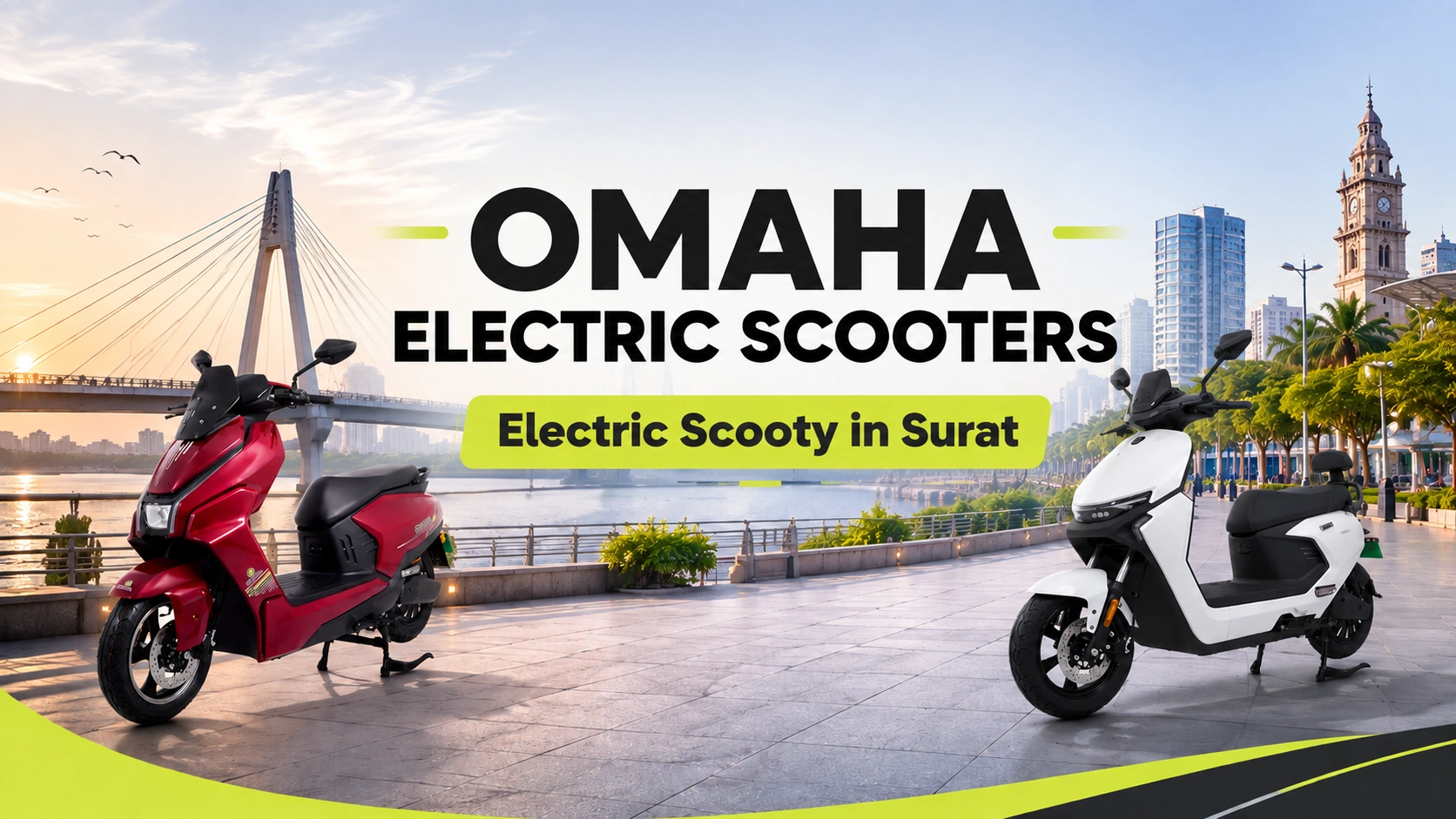
Gujarat's EV subsidies have lapsed. Omaha never needed them. 15+ models, 70–80 km of range, no road tax, and a design built for exactly the short trips this city runs on.
subsidy forgone — because none applies to these models in Gujarat
the trip length most of this city actually makes, twice a day
loader capacity for Ring Road market consignments
licence, registration and road tax on slow-speed models
Gujarat subsidy status — straight answer
This section is blunt, because Surat buyers are walking into showrooms right now getting contradictory answers. Gujarat currently offers the least EV purchase support of any major state in India. Here is the sequence, dated.
Current position
Verified August 2026The 2021 policy offered one of the country's most generous two-wheeler subsidies — around ₹10,000 per kWh, capped at ₹20,000. Direct purchase subsidies were discontinued in 2024.
Introduced April 2025, down from the standard 6%. That window has closed and, as of reporting through mid-2026, no extension had been confirmed. The rate may have reverted to 6% — do not assume either way without checking.
₹2,500 per kWh capped at ₹5,000, scheduled to run only until 31 July 2026. That window has now closed. It applied to registered high-speed vehicles only.
Widely anticipated and actively lobbied for by industry. It could be notified any week. It had not been at the time of writing.
No registration, no RC, no licence, no insurance formality — so no subsidy was ever attached, no motor vehicle tax ever applied, and no PM E-DRIVE entitlement ever existed. Nothing was lost, and nothing changes when the next policy lands.
In every other city we sell in, choosing a slow-speed vehicle means giving up a subsidy. In Gujarat right now, you are giving up nothing at all. The gap between a registered electric two-wheeler and a slow-speed one has narrowed further in this state than anywhere else in the country — not because the slow-speed option improved, but because the registered one lost its advantages.
Delhi
Rajasthan
Maharashtra
Uttar Pradesh
Gujarat
Subsidy forgone by choosing slow-speed, by state. We would rather explain this than let a dealer quote you a figure from a 2023 brochure. If anyone quotes you a state or central EV subsidy in Surat this month, ask to see the current notification — and verify the position on the Gujarat transport department portal before you pay.
Sources: Ecozaar, MeraEV, EVSelect (2026 reporting). This is the fastest-moving section on this page — re-verify on publish day and set a weekly check until a new policy is notified.
A real Surat commute
A diamond polisher in Varachha has made the same journey twice a day for nine years. His unit is near Katargam. His room is off a lane in Varachha. The distance is 4.2 kilometres.
He came to Surat from a village near Amreli at nineteen, the way a few lakh people in this city did. In nine years he has never owned a vehicle and never held a driving licence — not out of principle, but because the paperwork always sat behind something more urgent, and because there was always a cousin with a bike, or the option of walking when nobody turned up.
Last year he added it up. Nine years, twice a day, a little over four kilometres each way — something like 25,000 kilometres of the same short trip, made on other people's terms. Not one of those trips needed a vehicle that could do 80 kmph. Not one of them left the city.
He bought an Omaha Active Mini in April. No licence. No RTO. No file. He paid at the counter and rode it home the same afternoon.
Surat is full of that story, and it is the reason this city fits an electric scooty better than almost any other in India.
Your commute is four kilometres
This is a city organised around proximity. The diamond economy sits in Varachha, Katargam and Mahidharpura, and its workers live within riding distance of it. The textile economy sits along Ring Road and out through Udhna, Pandesara and Sachin, and the pattern repeats. Surat did not sprawl and then ask people to commute across it — it grew in clusters, and people settled next to the cluster that employed them. Pick your route and see the arithmetic.
Choose the run you make most days
Round trip, daily
8.4km
Over a year
2,621km
Petrol, per year
₹5,920
Omaha, per year
₹917
On a Varachha to Katargam run, top speed was never the constraint. Traffic, parking, lane width and running cost were — and this is the vehicle built for exactly that.
Distances are indicative straight-line-plus-road estimates for illustration, not measured survey data. Petrol figures use roughly 45 kmpl in Surat traffic at ₹101.82 a litre, over 313 riding days. Short trips return worse real mileage than this, so treat the petrol figure as conservative.
The daily reality
Be aware that Gujarat is not a high-fuel-tax state. Petrol in Surat has been sitting around ₹101.55 to ₹101.82 a litre through July and early August 2026 — cheaper than Hyderabad at ₹115.69, Jaipur at ₹113 or Pune at ₹111.85. The per-litre savings argument here is more modest than a page written for Rajasthan would suggest, and you should know that before you buy rather than after. The arithmetic still works, because in Surat it is the distance profile that carries the case, not the fuel price.
₹1,700–2,800/ month
For a fuller day of 25 to 40 km — a delivery worker, a market runner, a supervisor moving between units — roughly ₹55 to ₹95 a day, before oil, filters, servicing and the pollution certificate.
₹300–450/ month
About 1 to 1.5 units of electricity a day, roughly ₹10 to ₹15. Annual running cost stays comfortably under ₹5,000.
A reality check on price: third-party trade listings for Omaha models have shown figures in the ₹45,000 to ₹61,000 range depending on model and battery type — the Canary and Starling R around ₹46,000 to ₹49,000, the Swallow around ₹61,000. Treat these as indicative only. Actual on-road pricing in Surat varies by dealer, battery choice and running offers, so confirm at the showroom.
The Surat commercial case
This deserves its own section, because it may be the largest single opportunity in this city and almost nobody is addressing it. Surat's textile markets move an extraordinary volume of small consignments every day — bales, parcels, sample lots, job-work batches shuttling between markets, processing units and transport offices. Most of that movement happens over very short distances, in extremely congested conditions. That is close to a perfect specification for an electric loader.
Precisely the pattern where diesel running costs are worst and electric running costs are lowest. The same trip repeats twenty times a day.
Compact loaders reach market gates and lane entrances that a tempo simply cannot get to.
A vehicle that spends half its working day stationary in a loading queue burns nothing at all while it waits.
Which matters when margins on job-work movement are thin and the trip count is what drives your day.
Rated load capacity
The same logic applies to diamond-unit ancillary movement, kirana and water-can supply across Adajan, Rander and Vesu, and small logistics operators around Udhna, Pandesara and Sachin GIDC.
Ask for a loaded demo, not a spec sheet. If you run a market delivery operation, a transport office or a supply business in this city, ask your dealer for a demonstration with your actual load on your actual route. That test tells you more than any brochure will.
Book a loaded demoMonsoon care
Omaha scooters are built for Indian conditions and battery systems are enclosed and protected, but Surat's monsoon demands respect from any vehicle, electric or petrol. Four habits cover most of it.
This applies to every vehicle on the road, not just electric ones. Deep water is where damage happens, and no drivetrain is immune to it.
Wipe the vehicle down before plugging in, and check the port is clear of water before the charger goes anywhere near it.
Let it sit and dry off first. This is the single most avoidable form of damage in a rain season.
If you park at ground level in a low-lying pocket of Rander, Adajan or the older river-side areas, plan where the vehicle stands during a heavy spell.
15+ models
A ratnakalakar riding four kilometres to a unit and a textile trader moving between three Ring Road markets a day do not need the same machine. Most brands offer three models and expect both to adjust. Every Omaha comes with both lead-acid and lithium options — that choice stays yours, not the brand's.
No models in this category yet.
Why Omaha
With state subsidies discontinued, the concessional tax window closed and the central incentive lapsed, a slow-speed Omaha is the one option in this city that gave up nothing — because it never depended on any of them.
A very large share of this city's workforce arrived young from Saurashtra, Odisha, Bihar and Uttar Pradesh, often without documentation sorted. For that population this is not a convenience feature — it is the difference between owning transport and not owning it.
Surat's daily movement is three to eight kilometres, repeated. That is the design target of this category, not a compromise against it.
Mahidharpura, Sagrampura, Begumpura, Nanpura, Limbayat and older Varachha and Katargam — where wider scooters simply do not fit.
Very few slow-speed EV brands also build 300–350 kg loaders. For a city whose textile markets move consignments all day over short distances, that is the single most valuable product in the range.
Manufactured domestically in Haryana and West Bengal, so when a controller or brake lever fails in Udhna, service turnaround is measured in days rather than weeks.
Riders across the city
Sample cards. Swap in real customer quotes, names and localities before this page goes live.
"Nine years in this city and I never had a licence. I paid at the counter and rode it home the same afternoon. Four kilometres to my unit, that is all I ever needed."
"We move parcels between three markets on Ring Road all day. The loader gets to the gate the tempo cannot reach, and it burns nothing sitting in the queue."
"My run is under ten kilometres a day, so I charge every second or third night. The lanes near my building are narrow and this one actually fits down them."
Dealers near you
Call +91 99961 17882 or check omahaev.com for the showroom nearest you. Areas we cover and are expanding into:
Dealership enquiries from Navsari, Bardoli, Vapi, Valsad, Ankleshwar, Bharuch, Ahmedabad, Rajkot and Vadodara are welcome too.
How to buy
Check the dealer section on omahaev.com or call +91 99961 17882 and ask for the closest showroom — Varachha, Katargam, Adajan, Udhna, Limbayat, Vesu, Rander or the Ring Road belt.
Ride the model where you will use it, with a pillion if you usually carry one. For loader buyers, insist on a demonstration with a realistic load on a real market run.
Gujarat's position changed twice in the last two years and again this year. If a dealer of any brand quotes a state or central subsidy, ask for the current notification in writing. For slow-speed Omaha models the question does not arise, because no subsidy or road tax applies either way.
Surat is hot and humid for much of the year. Document the warranty terms, service intervals, battery replacement cost and lead time at purchase, and ask the dealer to recommend between lead-acid and lithium for your specific daily kilometres.
For slow-speed models there is no registration file, no insurance formality and no RTO visit. Pay, take delivery, ride out the same day.
Confirm a working 5-amp socket where you park. If you are in a shared building or worker housing in Varachha, Limbayat or Pandesara, settle socket access and metering with the owner before delivery rather than after.
Want to sell Omaha, not just ride one? Dealership from approximately ₹5 to 6 lakh — one of the lowest entry points in the Indian EV market. Surat district and the belt of Navsari, Bardoli, Kamrej, Olpad, Vyara and Valsad are markedly under-served, and south Gujarat's dense industrial worker population is among the strongest natural markets for this category in India.
Call +91 99961 17882FAQs